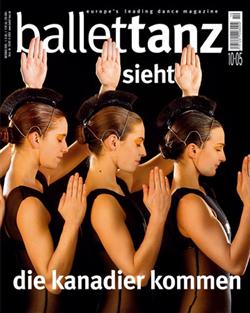
Isabelle Van Grimde

Why do we dance why do we dance why do we dance – why do we make our very fragile, inadequate bodies dance, our beautiful, intelligent, post-human bodies dance? Post-human or is it trans-human? I mean: Our decoded bodies choreographed within a context or without a context, yielding to the scrutiny of the spectator’s gaze … For freedom?
In the days of the decoded body, the encoded body, i. e. the trans-human or post-human body, why do we dance? Sometimes it seems that we are obsolete.
Sometimes when I watch dance performances I feel that we as choreographers are afraid that dance – that our bodies – are not enough, are inadequate and so we feel we must provide a context. We need to make sure that others see that we have ideas, that we can articulate things beyond the body and so we use theatre, new media, teachnology and hurl words across the space. We enlist the visual help of beautiful or fashionably mundane sets and the guidance of the almighty dramaturge. Through all of these dance has become the most powerful form of theatre in the 20th century … It’s great, but let me, for one moment, rebel against it!
Where is the power of the human body unadorned?
Thrusting ourselves in ...
Weiterlesen mit dem digitalen Monats-Abo
Sie sind bereits Abonnent von tanz? Loggen Sie sich hier ein

- Alle tanz-Artikel online lesen
- Zugang zum ePaper
- Lesegenuss auf allen Endgeräten
- Zugang zum Onlinearchiv von tanz
Sie können alle Vorteile des Abos
sofort nutzen
The list of international applicants was impressive and it is to Wayne Eagling’s credit that he has now secured this important post: becoming the new leader of English National Ballet, Britain’s largest touring company. His tenure at the Dutch National Ballet has given him the experience of running a major national company and may have proved the deciding factor in...
Ein Walzer von George Balanchine gefällig, ein Lied von Serge Diaghilew? Lera Auerbach macht’s möglich. Auf der CD «Tolstoy’s Waltz» hat die Pianistin und Autorin aus der ehemaligen UdSSR ein paar Raritäten eingespielt, wahre Preziosen. Der «Valse lente» von Mr. B. beispielsweise, den er Madeleine Malraux verehrte: «Balanchine komponierte ihn relativ spät in seinem...
Over the last century dance has traveled from continent to continent, shifting its focal points of creativity and intensity. Historically, the fluctuating cartography situates long traditions in Berlin, Paris, and London. In the mid-1980s rejuvenation occurred in places like Brussels, Ljubljana, Barcelona, and Montéal. Guy Cools, the former dance programmer and...