kissing horses

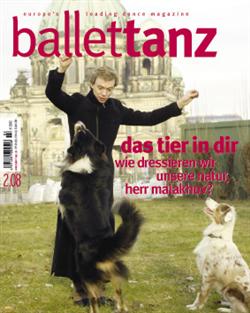
When the curtain lifts on Cavalia, a woman and a gelding stand on a stage covered in sand. They appear to be strangers to one another – fine representatives of their species and sexes, reflected in the pool of water between them. But when the woman moves, the horse responds and when the horse moves, the woman responds. She offers him water from her hand, he drinks. Gradually, this tentative reciprocal play turns into an interactive dance in which the two bodies become absolutely complementary and logical in their togetherness.
“Cavalia” is a multi-media spectacle that combines circus acrobatics, dressage, dance and music, and features 35 two-legged and 50 four-legged performers. Since opening in 2003, it has been seen by over 1.5 million people in North America and Europe. Its success stems in part from its professionalism – artistic director Normand Latournelle was one of the founders of the immensely successful Cirque du Soleil – but also from the narrative at its core, one of enduring fascination: the relation-ship between man and beast.
“Cavalia’s” equestrian directors are the young French couple Frédéric Pignon and Magali Delgado. Pignon is one of Europe’s most renowned “horse ...
Weiterlesen mit dem digitalen Monats-Abo
Sie sind bereits Abonnent von tanz? Loggen Sie sich hier ein

- Alle tanz-Artikel online lesen
- Zugang zum ePaper
- Lesegenuss auf allen Endgeräten
- Zugang zum Onlinearchiv von tanz
Sie können alle Vorteile des Abos
sofort nutzen
Michael Kidd konnte toll tanzen, er war ja rechtzeitig von Verfahrenstechnik auf Ballett umgestiegen. Er tourte mit Lincoln Kirsteins Ballet Caravan, war «Billy the Kid» und, obwohl eher zierlich als bedrohlich, auch «Bluebeard»; 1942 ging er als Solist zum Ballet Theatre, dem späteren American Ballet Theatre, aber zum Glück für die Nachwelt dauerte seine...
Miguel Robles
ich sah die Tänzer Ihrer Kompanie bei einer öffentlichen Probe von «Tabula rasa», und die Körpersprache schien mir einer antiken Tragödie zu entstammen. Am Abend der Aufführung war ich überrascht, sie in Tierkostümen zu sehen. Es gibt in der Tat einen Zusammenhang mit der griechischen Mythologie. In manchen Szenen nährt sich die Körpersprache der...
In 2005, Portuguese choreographer Rui Horta presented a piece called “Set Up” as part of a trilogy that, in general terms, sought the place of the body in this vicious world. This implied for him the use of technology to explore the vagueness that today’s fast-moving times have imposed on the body. “Set Up” was far removed from the consistency of “Pixel,” his 2003...