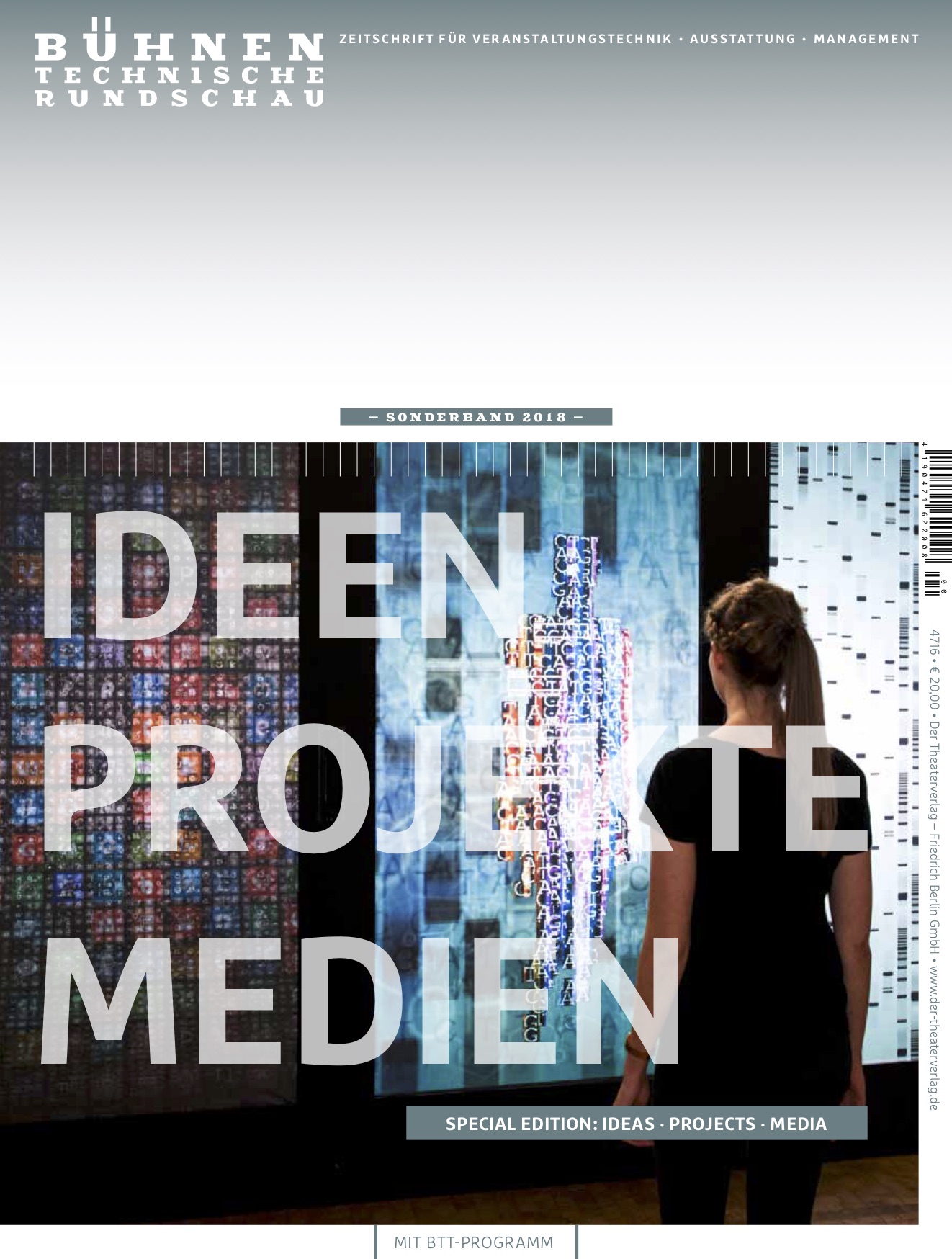
Ideas Projects Media
As the wheels of progress keep turning, the issues surrounding technological innovation and especially digitalization are as controversial as ever. New technologies have already fundamentally changed our ways of living and working. What further changes are on the horizon and how shall we deal with them? What opportunities will they bring? What does the future hold for opera, theatre, and architecture? This year’s special summer edition looks at the projects and initiatives that are addressing these questions and exploring new avenues in the industry.
As well as highlighting new departures in professional training and specialist exchange, we explore the impact of technological innovation on working methods and profile some innovative technologies that are already being used by designers, artisans and planners. To open, we endeavour a glance in to the future. The Digital Theater Akademie was recently founded as a forum for exchange where artists and technicians can share their inventions and ideas, and so extend the common repertoire. The number of projects devoted to developing modern media is steadily growing; one of them is the Creative Skills Europe network, which pools several projects. And with ever more people increasingly on the move, the importance of e-learning is set to rise. Despite the many shocks and upheavals in politics recently, Europe seems to be growing closer together again, especially where economic cooperation is concerned. For this reason, the comparability of working conditions and standards is a primary concern of the industry, especially since touring and working in several different countries has become the norm. We report on an update of the the German public procurement law, the professional training project ETTE and the latest developments in CEN norms – all projects that are forging a way ahead to the future! In planning, workshops and product development, the future has already begun. Will 3D printers make sculptors redundant? Will large image printing technology replace painted stage sets? While these issues remain controversial, having multiple options doubtless creates more scope for artistic expression. Technological innovation can also promote inclusion and participation, as the prototype ‘Sound Shirt’ shows, designed to helpthe hard of hearing to feel music. Both BTR and the DTHG, the German stage technicians’ association, were founded 111 years ago with the aim of disseminating specialist knowledge and promoting the industry. There will be plenty more opportunity for exchange and fact-finding at the stage technology conference in Dresden in June. Turn to the enclosed copy of “Podium” for details of the programme and more information about the conference. In the very near future, then, we will be in Dresden to celebrate 111 years of DTHG and BTR. Hope to see you there!
Yours the editors
BTR Sonderband 2018
Rubrik: English Texts, Seite 201
von
Laserscanner eignen sich nicht nur für Vermessungsarbeiten, sondern erfassen auch komplexe Architekturen und Objekte in 3D. Die gescannten Daten lassen sich auf verschiedene Arten weiterverarbeiten und -verwenden: ob als Grundrisse und Schnitte, für den Export in CAD-Programme, für fotorealistische und 3D-Visualisierungen sowie für virtuelle Räume und 3D-Druck. Ein Besuch im Atelier von...
Im großen Saal der Oper Leipzig finden maximal 1250 Zuschauer Platz, eine zweite Spielstätte ist die Musikalische Komödie mit 520 Sitzen. Das Haupthaus am Augustusplatz wurde 1960 eröffnet und steht heute unter Denkmalschutz. Die Streaming-Lösung MobileConnect von Sennheiser für Hörunterstützung kann ohne viel baulichen Aufwand installiert werden – und kam daher für die Tonabteilung der...
Mit einem 8500 Quadratmeter großen Neubau wollen die Niedersächsischen Staatstheater in Hannover ihre Werkstätten an einem Standort zusammenführen. Bei dem Vorhaben ist das Theater nicht nur selbst Bauherr – und nicht das Land Niedersachsen –, sondern auch, dass es sich dabei um ein Pilotprojekt in Sachen „digitales Bauen“ handelt. Die Staatstheater sind die erste Einrichtung des Landes...