
Tanz im August
Berlin Summer Follow-up
A second look at the festival’s standout performances: highlights we hadn't already featured in the run-up to the festival
Alone Together
Rhine Maidens and Tinder Analyses
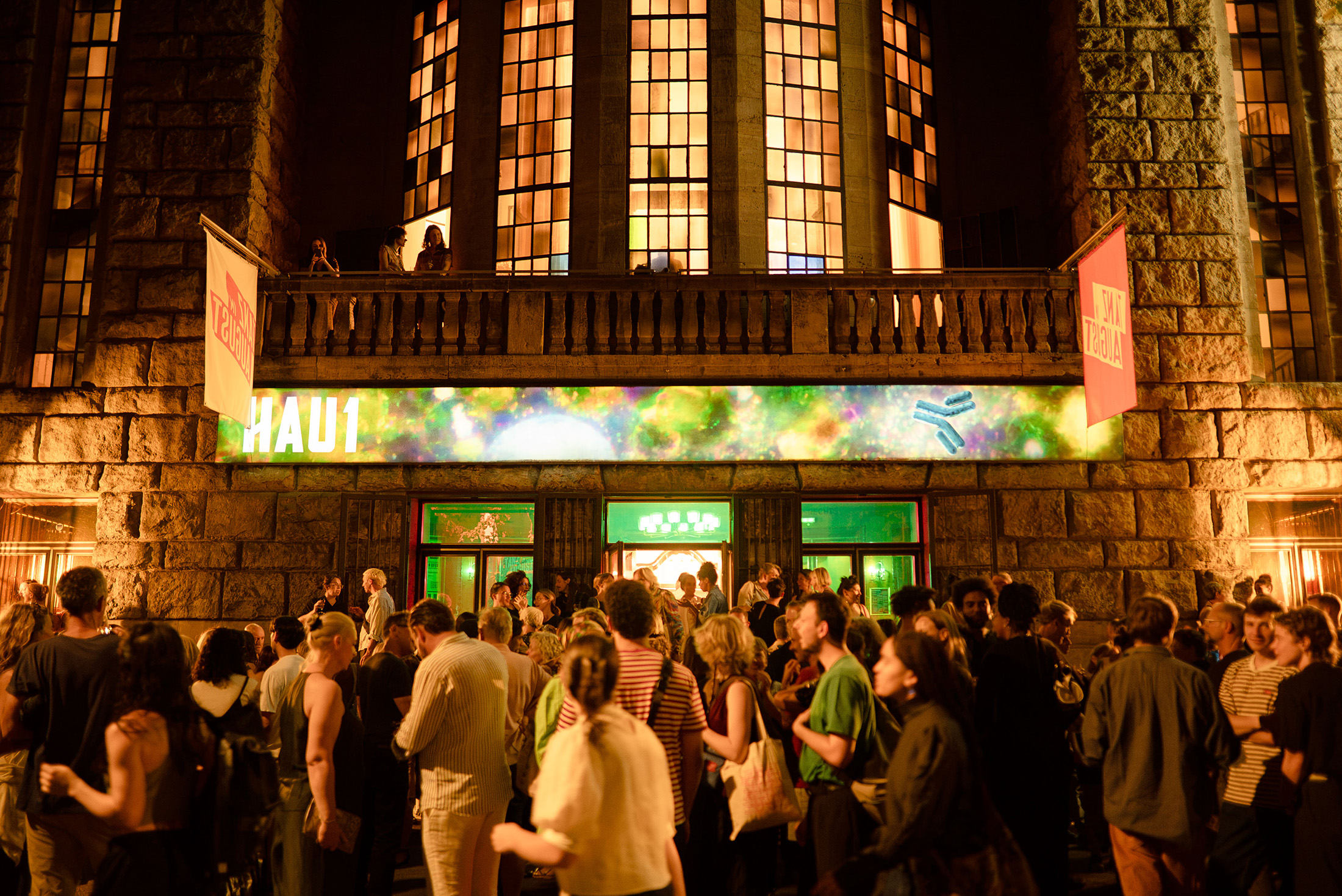
Let’s be honest: the atmosphere in many parts of Berlin is more euphoric than at Tanz im August. The festival does not set out to create cozy social spaces; the artistic works take center stage, and a shared atmosphere must emerge from them. In the intervals, that feeling is sustained by thoughtful touches: a fan offers welcome relief after the inaccessible staircase at HAU3, conciliatory glances are exchanged while squeezing past one another in Row 3, and there are moments when professional analyses, over a drink, seamlessly shift into an equally complex curation of a Tinder profile.
But who would have wanted to pull the wool over our eyes? Naturally, the mood reaches a boiling point following the performance of (La)Horde’s Après moi, le déluge at the Haus der Berliner Festspiele. Yet, once the crowd disperses after the ovation, those whose bodies have remained resistant to the intoxication of "superficial over-aestheticization" step forward. A generational clash ensues: some view the underworld nymphs’ wigs as reminiscent of conservative Rhine Maidens, while others compose an epic ode to them. A different venue, different customs: a drumroll from the stands at Radialsystem V, where—in Clap & Slap—Agnietė Lisičkinaitė and Igor Shugaleev first encourage the audience to clap rhythmically, then proceed to slap each other in unison as a form of self-flagellation, until finally, a spectator asks them to stop. The play’s engagement with Russia’s war of aggression against Ukraine lends the plea a political ambiguity: Who is supposed to stop? Those who perpetrate the violence? Those who fuel it? And what about those who simply watch?
Let’s not kid ourselves: often, the objects (which transcend the merely human) make a greater impression than the (human) movements themselves. The brilliant glass carafes in The Choreography of Water (Deaconescu/Moser/Oprescu)—like the massive structure in Hornfuckers (Diana Niepce)—have the most powerful effect on their own. In Les Oiseaux (Lenio Kaklea), meanwhile, the question arises as to what happens to a work that evokes the aesthetics of drone surveillance, but whose images are not produced in real time. And even Trajal Harrell’s unmistakable movement language—described by some as “caressing the world with eyes closed, as only he can”—seems, through its transmission to the Zürich Dance Ensemble, to be gradually detaching its impact from his own body. Far more moving in Music Music is the distorted symphony that unfolds when audience members are asked to pull up “Cold Heart” by Elton John feat. Dua Lipa on their smartphones.
We can no longer kid ourselves: Peter Weibel’s “televisual society” has now firmly taken its place in the theater, too. Watching screens together as the finest moments of a festival—that is simply typical Berlin: experiencing something together while remaining alone.
Thusnelda Marín Jungmann
Background photo: HAU 1; © Naima Maleika
You cannot can; photo: bozzo
Dana Michel
You cannot can
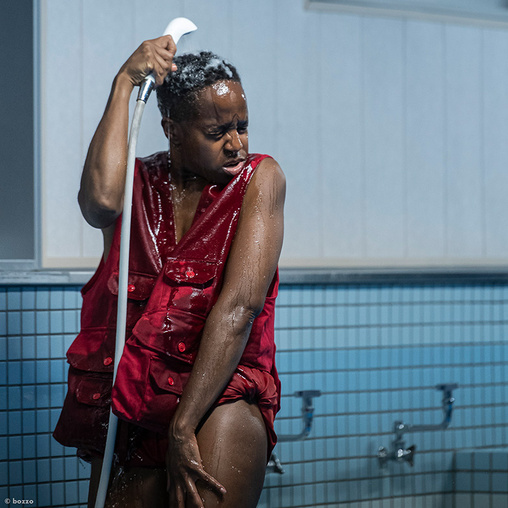
For her work You cannot can, Canadian performer Dana Michel has chosen one of Berlin’s most beautiful venues: the former municipal swimming pool Stadtbad Oderberger Straße. Today, the space houses a magnificent hotel swimming pool, and it is opening its doors for Tanz im August—admission requires pool slides. Everyone is allowed to dangle their feet in the water, while in the sun-drenched hall, Michel—hidden beneath a voluminous mane of hair, wearing a chocolate-brown swimsuit and long white stockings—appears anything but relaxed. She seems to be wrestling with herself, approaching the water almost reluctantly. She showers laboriously, hauls a heavy laundry bag along with her, before squeezing into a leotard and finally slipping into the water. Equipped with a life jacket, goggles, and plastic containers, she drifts as a bright red figure in the pale blue pool. Time and again, one thinks one is catching a glimpse of a destiny, a story—or is it just imagination? The wet, destabilizing adventure we were promised merely laps gently along, and by the end of the hour-long performance, we still do not know why Dana Michel feels uncomfortable in the water.
Claudia Henne
Further performances in Marseille, Festival Actoral, Piscine Desautel, 3 & 4 October; Birmingham, Fierce Festival Birmingham, 17 & 18 October;
Podcast: www.youtube.com/watch?v=oBCaHEslaC4
Masterwork for Six Dancers; photo: Sara Rman
En-Knap/Emese Cuhorka/Csaba Molnár
Masterwork for Six Dancers
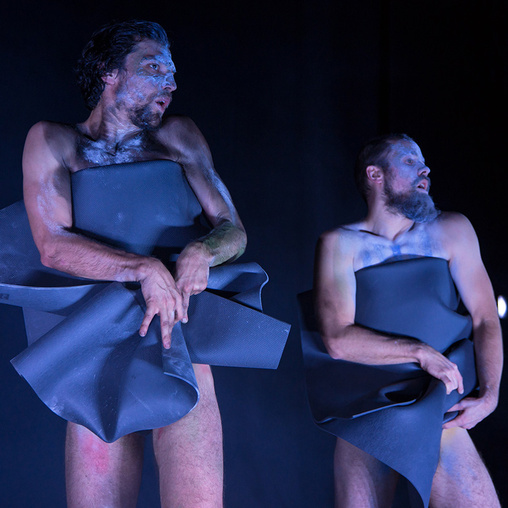
One does no injustice to Masterwork for Six Dancers by thinking of a water ballet during the opening minutes. The six dancers of the title perform in unison, facing the audience directly; furthermore—and this is the decisive factor for that association—they wear bikini bottoms, swim caps, and body paint. As they jump, stretch, and spin, it is a sheer delight to watch (while penises and breasts bounce joyfully). In this piece created for the Slovenian company En-Knap, Budapest-based choreographers Emese Cuhorka and Csaba Molnár briefly reference Oskar Schlemmer’s Triadic Ballet, with robotic mechanics that soon give way to cheerful, puppet-like gestures; and just as one is thinking of an homage—perhaps Bauhaus meets techno aesthetics—the piece shifts imperceptibly, turning into costume theater and then into clowning that is more pointed in its substance than one had actually expected.
Gradually, one realizes that the "masterpiece" being celebrated is not the choreography itself, but the dancers' bodies—which, for all their techno-esque, steely physique, reveal themselves to be vulnerable, limited, and impaired.
Wooden shoes clatter loudly against the stage floor, bondage motifs restrict freedom of movement, and at the end of this sequence of scenes—which at times comes across a bit like a variety revue—stands a crucifixion: a monumental, powerful motif from Christian iconography. That this water ballet—which is in truth a journey through the beauty of diverse bodies and the capabilities of those bodies—is also great fun, quite apart from its confident handling of the repertoire of imagery, goes without saying.
Falk Schreiber
Trapicana; photo: Lennart Brede
Joana Tischkau/ Jeremy Nedd/Sophie Yukiko
Trapicana
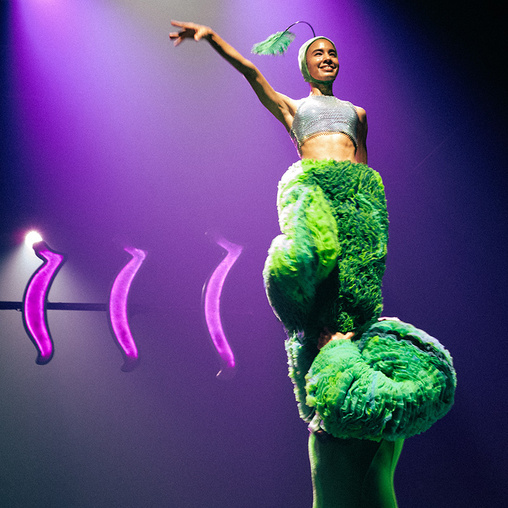
The "Tropicana" is a famous nightclub in Havana—founded in the 1930s, nationalized after the revolution, and architecturally a prime example of Caribbean Modernism. Shows take place there daily, catering primarily to tourists—the "Tropicana" is also a "tourist trap," according to choreographer Joana Tischkau. Yet, what is interesting is this: What if embracing this tourist trap turns out to be deeply gratifying? The Malpaso Dance Company performs professional show dance, the staged cheerfulness of which is cleverly deconstructed by the choreographic trio—comprising Tischkau, Jeremy Nedd, and Sophie Yukiko. There is the genre-typical pasted-on grin, there are the military-style formation dances, and there are the samba and rumba rhythms which are excessively exploited during the revues. In Frieder Blume’s music, however, they are repeatedly contrasted with the heavy beats of the rap subgenre Trap. Yet, at one point, a dancer stumbles—a cardinal sin within the formation—while another loudly complains about sound issues, and smiles falter. The perfect revue fails to work, yet simultaneously reveals itself as an art form that cannot simply be dismissed as irrelevant. And in the end, the performers break formation, shed Lenna Stam’s absurdly futuristic costumes, and dance a few brief solos accompanied by roaring enthusiasm—an act of liberation.
Falk Schreiber
(La) Horde & Ballet National de Marseille
Après moi, le déluge
Classical drama comprises five acts: exposition, conflict, turning point, delay, and resolution. The (La)Horde trio has structured its new production, Après moi, le déluge—currently touring with the Ballet National de Marseille, which the group directs—in precisely this way. Kampnagel and the Haus der Berliner Festspiele are presenting the 70-minute piece which opens behind a sheer curtain with the conclusion of a performance: thirteen dancers bow to a projection of an auditorium—turning their backs on the actual audience present. Act 1 features a soundscape in the style of Philip Glass and Minimal Dance moves, quasi-quotations from the 2022 collaboration with Lucinda Childs. Act 2 features backward running and hopping in a continuous loop until a void is revealed in the floor and the ensemble moves downward—documented by a photograph and selfie video: Instagram-worthy facial expressions and masquerades that sometimes go awry and represent the jaded present.
For Part 3—Turning Point—the floor tilts, and the action lands, as it were, underground, in a hybrid setting of a fountain of youth (borrowed from Hieronymus Bosch) and temple walls (reminiscent of the rock-cut Kailasa Temple dedicated to Shiva) where humanity, in the form of three senior citizens, is revitalized. Hard rock from System of a Down plays. The message: "Trust in my self-righteous suicide," until the fourth image returns to the Earth's surface, where the entire crew once again vehemently exerts themselves and stages a physical theatre performance that oscillates between brutal hip-hop and Meg Stuart's exoesoteric tendencies. The solution? The biblical image of Noah's Ark as a survival construct, animalistically marked by elephant legs and fluffy tails on the dancers' bodies. Après moi, le déluge is strong swarm stuff and picks up where Hofesh Shechter’s Grand Finale conjured up the apocalypse nearly a decade ago. Yet it is a good deal more brutal—fitting for humanity, which now seems to be hurtling irreversibly toward the abyss.
Dorion Weickmann
Further performances in Rome, Romaeuropa, 1–4 October; Barcelona, Mercat de les Flors, 9–11 October; La Louvière (B), Théâtre de La Louvière, 6–8 November; Antwerp, DeSingel, 13–15 November; Aix-en-Provence, Grand Théâtre, 10, 11 December;
Bruits Marrons; photo: David Lemarié
Calixto Neto/Voa
Bruits Marrons
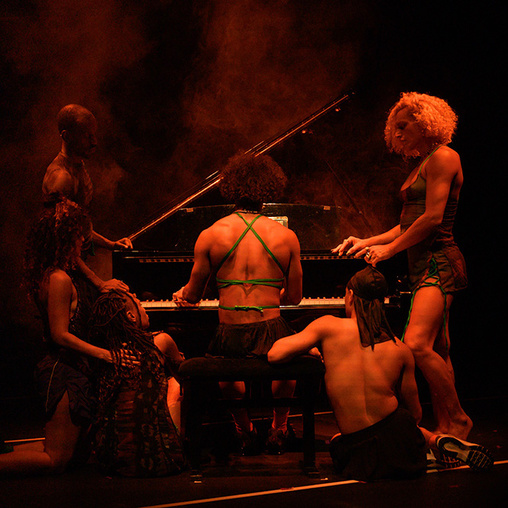
Marrons were hidden settlements established by escaped slaves—including on La Réunion—serving as utopian spaces within the volcanic island's inaccessible calderas, where distinct social orders took root. The inhabitants of these settlements lived in constant fear of discovery, yet they also created spaces for leisure, play, and art—celebrations, fairs, and rituals. In Bruits Marrons, choreographer Calixto Neto—originally from Brazil and now based in France—constructs such utopian spaces himself, finding them within art: in the Congolese national anthem—sung in memory of the Maoist opponent of Mobutu, Pierre Mulele—and in the Gwoka song La Guadeloupéenne, which blares from a mobile phone, inviting a gently swaying dance, leading finally to a bucolic celebration while Sexual Healing drifts seductively through the hall. "Sexual Healing"—the very theme of the piece. Neto opens up a space of free community for his five dancers through understated yet impactful dance—friendly, humorous, queer.
But take note: like the Maroons, this community faces constant threats; the sense of joy that emerges, for instance, while playing the piano is shattered by the racism of the teacher, who believes a Black pianist ought to play ragtime rather than Chopin. And yet: for 75 minutes, this engaging, intelligent, deeply human piece evokes the feeling that a better life is conceivable—a life free from homophobia, racism, and class distinctions.
Falk Schreiber
Podcast, Calixto Neto: www.youtube.com/watch?v=IkpawCx9Y-Y
Mohamed Toukabri in Every-Body-Knows …; photo: Stef Stessel
Mohamed Toukabri
Every-Body-Knows …
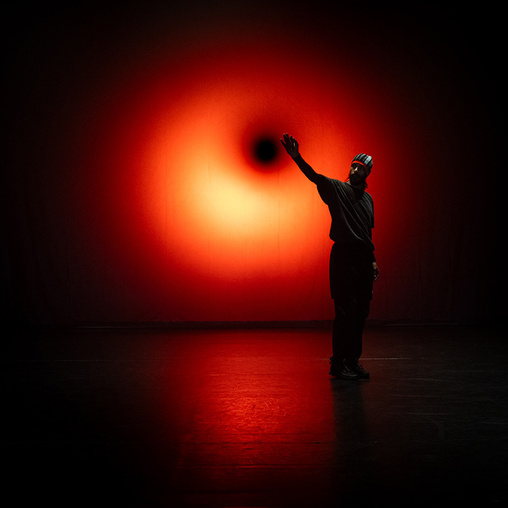
Festival Day #2: Energy levels hitting mega-amplitude. Back-to-back, we have Mohamed Toukabri’s Every-Body-Knows-What-Tomorrow-Brings-And-We-All-Know-What-Happened-Yesterday and the self-assertive rave F*cking Future by Marco da Silva Ferreira—a piece that cares not a whit about the future, but instead occupies the here and now with a queer totality that renders resistance futile and wrests the codified aesthetic of a Sharon Eyal away from ballet. Simply breathtaking. The same applies, in a different way, to Toukabri’s elemental solo, which inspects the archives within his own body memory, combining and connecting them with biographical and political fragments. The P.A.R.T.S. graduate traverses the spectrum from hip-hop to ballet, spanning the virtuosic and everyday styles of the art of dance, accompanied by aphorisms from playwright Essia Jaïbi: "This is a ritual. I am just a voice. The body is a language." And a political language at that, for references to the situation in the Eastern Mediterranean crop up everywhere, and when Toukabri finally sheds his glittering outer garments, a bulletproof vest is revealed underneath. That’s what the sheer madness of our times looks like.
Dorion Weickmann