

At A Glance
Side Steps
Guillem Rojo i Gallego, Radialsystem Berlin, Collier Schorr, Simone Forti – and more
Newcomer
Guillem Rojo i Gallego
"The Junior Ballet was the beginning of everything for me," says Guillem Rojo i Gallego in a short film marking the institution's tenth anniversary at Ballett Dortmund. In 2014, the then-ballet director Xin Peng Wang founded the NRW Junior Ballet—a program for young professional dancers from around the world designed to support them in their careers. Guillem Rojo i Gallego—born in Valencia, Spain, and trained at the Conservatorio Profesional de Danza de Valencia and the Ballet Academy of the University of Music and Theatre Munich—joined the Junior Ballet in 2018 and has been a member of Ballett Dortmund since 2019.
Last July, he received the €20,000 "Prof. Balzert Ballet Prize 2026" for his first choreography, The Blood of a Poet, which he presented at the 42nd International Ballet Gala at the Dortmund Theatre. A model career, then, fitting the agenda of the new Dortmund ballet director, Jaš Otrin, who "wants to develop the stars of tomorrow" and has established a mentoring program for choreography.
Guillem Rojo i Gallego collaborated with the Academy for Theatre and Digitality on The Blood of a Poet. The 29-year-old considers the analog and the digital not as opposites; rather, the aim is to create a dialogue: "Technology does not replace the body; it amplifies its questions. The digital realm does not erase the human element; it asks us what it truly means to remain deeply human." And so, videos of rocky cliffs and underwater currents rush across the stage's backdrop, while dancers clad in black form body waves, spin, and swing their arms—swirls of water and body alike, caught in a frenzy. It is a passionate atmosphere—at times almost tragically kitschy—that Guillem Rojo i Gallego has created; a poetic one that nonetheless remains enigmatic.
For the choreographer—who is also a writer—poetry is, alongside dance, another vital language that teaches us how to live. It is the quality of transience that links poetry and dance. "A poem exists as long as someone gives it breath. A movement, as long as someone embodies it. What remains afterwards is the memory—an invisible trace that changes us."
For him, the evening is a tribute to female poets such as Sappho, Emily Dickinson, and the Brontë sisters—women who could only write in secret. The dancers move across the stage reading; they dance en pointe and move like trailing vines that continue to grow in the accompanying video. Powerful, individual women—such as singer and composer Hannah Tolf, who further bolsters the ensemble musically. Guillem Rojo i Gallego—a poet of dance—ventures into unusual creations and bold combinations in his choreography.
Sarah Heppekausen
See him perform again at the premiere of Krzysztof Pastor’s Dracula on 17 October;
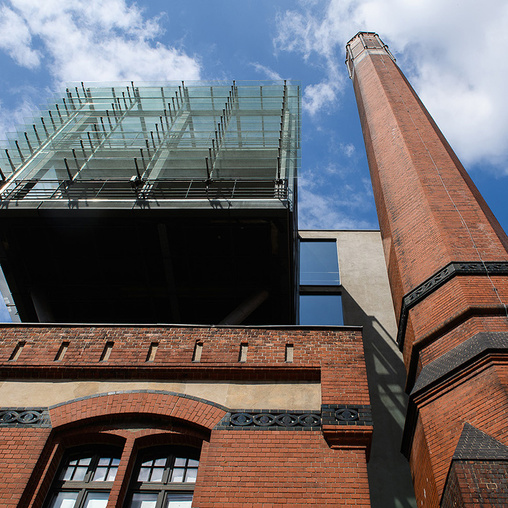
Radialsystem Berlin; photo: Phil Dera
Anniversary 1
Radialsystem Berlin
Summer 2006. Concert designer Folkert Uhde and cultural manager Jochen Sandig are giving a tour of an old industrial building on the river Spree: here, in the Radialsystem V sewage pumping station—unused since 1999—they plan to open a cultural center, a venue for experimental musical formats that transcend the categories of "classical" and "contemporary," as well as for dance and theater. Sandig’s wife, choreographer Sasha Waltz, will be associated with Radialsystem, though Uhde and Sandig are careful to ensure that the venue does not acquire the reputation of being a "Sasha Waltz theater." Which does not change the fact that, over the years, the building complex became Waltz’s preferred venue for performances and rehearsals; works such as In C and Beethoven 7 premiered here. Uhde, who represented the musical side of things, moved on after a few years to the Köthen Bach Festival. Nevertheless, as a production hub, Radialsystem serves as an artistic home base for a diverse range of genre-defying and boundary-pushing artists—such as Heiner Goebbels, Xavier Le Roy, and Nico and the Navigators—and has become an indispensable fixture of the Berlin dance scene (and not just for the Tanz im August festival). The 20th-anniversary celebrations took place in early September, but Radialsystem remains.
Falk Schreiber
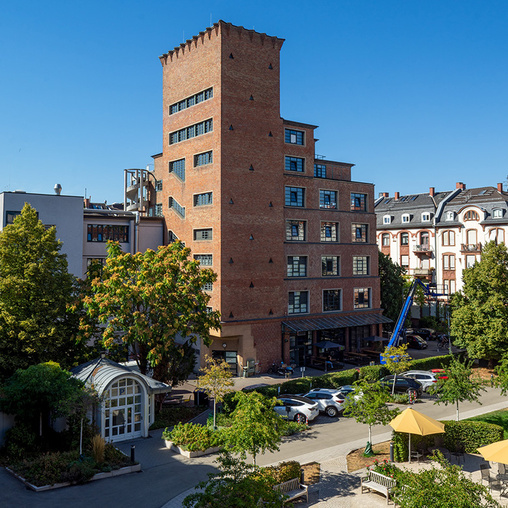
Mousonturm Frankfurt; photo: Axel Stephan
Anniversary 2
Mousonturm Frankfurt
Built in 1926 as a soap factory, this Expressionist building in Frankfurt’s Ostend district now provides a venue for groundbreaking productions by the local and international independent arts scene. In August, the Mousonturm artists’ center celebrated its centenary with a performative street festival: soapbox cars were fitted out with discarded stage equipment, Snow White figures moved through the crowd giggling and curtsying (choreography by Eisa Jocson), and, as the evening wore on, the building itself became a performer. Bathed in the light of a video projection by Jésus Baptista, the shapes of the façade seemed to shift, creating the impression that the tower was dancing.
However, these are challenging times. The "Alliance of International Production Houses"—of which Mousonturm is a member—has lost its federal funding; furthermore, artists associated with the venue, such as Joana Tischkau, Paula Rosolen, Ligna, and Fabrice Mazliah, are no longer receiving three-year municipal grants. This decision is disastrous not only for the artists involved but also demonstrates that Frankfurt currently offers few prospects for long-term local work. All the more reason, then, to wish Mousonturm—on the occasion of its centenary—that it remains a major stage for a vibrant scene.
Pauline Michel
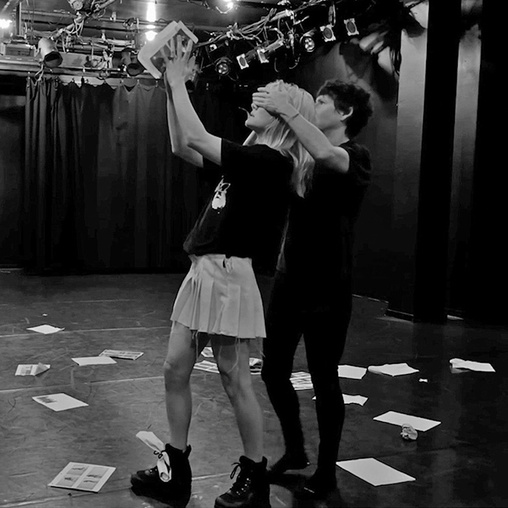
Writing a Letter: Akerman Ballet, Act 1; photo: Collier Schorr
Photography
Collier Schorr
Collier Schorr’s Writing a Letter: Akerman Ballet, Act 1 gathers 180 black-and-white stills from a project developed over seven years in response to Chantal Akerman’s 1974 film Je tu il elle. The publication was conceived as a score, not simply a record of dancing. She performs with Sophia Parker and Maria Metsalu, while static cameras watch from tripods. Bodies leave the frame, sometimes reduced to one limb that seems to float alone. These accidents are what make the pages so haunting. The pictures feel intimate yet never fully accessible. You sense touch without being told how to read it.
Peggy Phelan’s introduction, On Partnering, considers desire and the lesbian gaze, asking how an artist can enter another’s work. That question stays quietly close to every spread. Rather than copying her predecessor, she moves through that language and lets it shift. In print, choreography loses its continuity. A gesture is frozen, then followed by another fragment. The reader rebuilds motion in the gaps. What remains is awkward and tender, closer to a private exchange than a tribute. This book turns fleeting action into suspension, each page carrying the trace of a presence already gone.
Nicolas Vamvouklis
Collier Schorr: Writing a Letter: Akerman Ballet, Act 1;
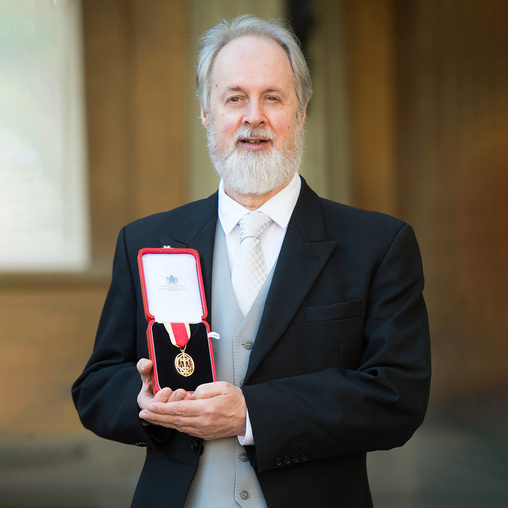
Richard Alston; photo: imago/i Images
Farewell
Richard Alston
Sir Richard Alston, a gentle giant of neoclassical modern dance, died on 7 September, following a brief illness. Educated at Eton College, he trained at the London School of Contemporary Dance and plunged into choreography at an early age, celebrating fifty years of making dance with the Mid-Century Modern programme at Sadler’s Wells in 2018. Sadly, just two years’ later the same theatre hosted Final Edition when the Richard Alston Dance Company (RADC), created in 1994, was forced to close due to funding cuts.
Alston was described by the New York Times critic, Alastair Macaulay as ‘the finest choreographer the British modern dance scene has ever known.’ He created over 100 works, including 62 for RADC and a further 24 for Rambert, where he was artistic director (1986-1992). He had started early as a company leader when forming Strider, the UK’s first independent dance company, in 1972. In a 2017 interview, Alston told me: “I might be listening to the radio and suddenly there’s a strange compulsion to hear a piece of music, again. I ask myself why and the answer is always that I feel a dance coming on.” His elegant choreography was always influenced by an intense musicality, fashioned as a schoolboy, listening to records—anything from Bach to Billie Holliday—in Eton’s gramophone library; and, more actively, through choral singing. He first sang Benjamin Britten’s music, Rejoice in the Lamb, as a teenager, and Britten became a leit motif throughout his choreography.
He suffered health issues in later life, having problems with both mobility and hearing but his desire to make work never diminished and in his final years, Alston set his work on dance students for their end-of-year shows. He had a passion for connecting young people to dance as a former chair of Youth Dance England.
I concluded that 2017 interview by writing “so long as Alston draws breath, he will never stop feeling a dance coming on” and sadly that last breath has now expired.
Graham Watts
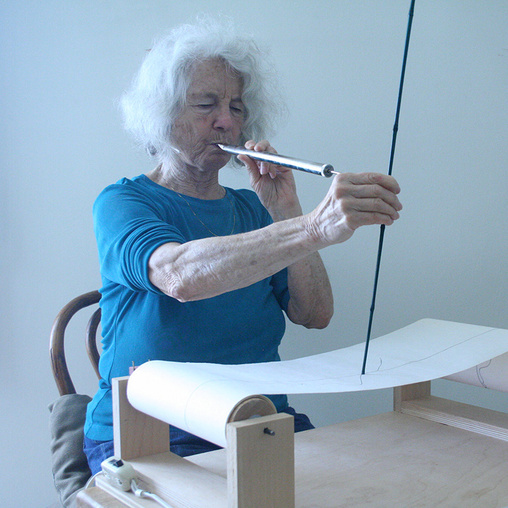
Simone Forti; photo: Jason Underhill
Adieu
Simone Forti
Simone Forti was characterized by a passion for research, a spirit of experimentation, and a sense of humor. When the artist—who came from a Jewish family that had emigrated from Italy to the USA in 1939—lived in Rome for a time in the late 1960s, she drew inspiration for dance pieces from the animals at the zoo. She had previously made a name for herself in the New York dance scene with kinetic sculptures formed by human bodies clinging to and climbing over one another; choreographers associated with the Judson Church, such as Trisha Brown and Steve Paxton, are considered to have been profoundly influenced by Forti’s exploration of everyday actions. Later, she worked with her own students to investigate the relationship between language and movement. Through her performances, drawings, texts, and holograms, Forti was part of movements including modern dance, minimalism, Fluxus, arte povera, and postmodern dance; it was in recognition of this legacy that she was awarded the Golden Lion for Lifetime Achievement at the 2023 Venice Dance Biennale. The dance and performance pioneer passed away in Los Angeles on 29 July at the age of 91.
Katrin Bettina Müller
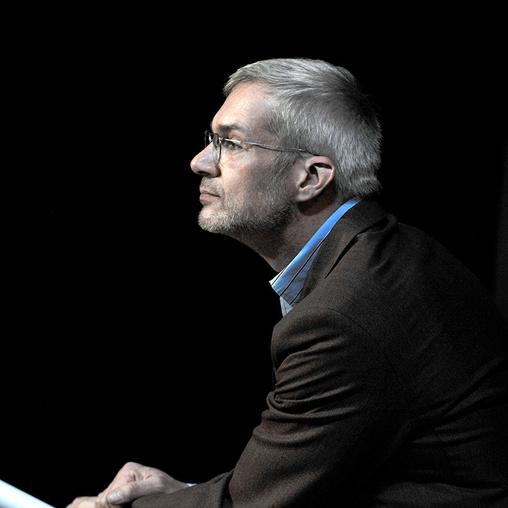
Felix Schnieder-Henninger; photo: Sebastian Hoppe
Farewell
Felix Schnieder-Henninger
At one point, I was sitting at a panel discussion at Berlin’s HAU 2—far left, row 8—when suddenly, rings of smoke began to rise above row 2. There was only one person who would dare do such a thing, and that was Felix Schnieder-Henninger.
Tall, with distinguished grey hair, and usually dressed in a suit and always ready to facilitate contacts and procure materials and appointments. As a spokesperson for major institutions, he had gained a wealth of experience before—acting as a liaison for the Wolfsburg Movimentos festival—he took the capital’s dance journalists under his wing, arranging trips and interviews while always remaining in good spirits. Until the coronavirus struck; subsequently, he was afflicted by the disease that gradually erases every memory. Felix Schnieder-Henninger died in Berlin at the age of just 62. What remains is his resonant laughter.
Dorion Weickmann
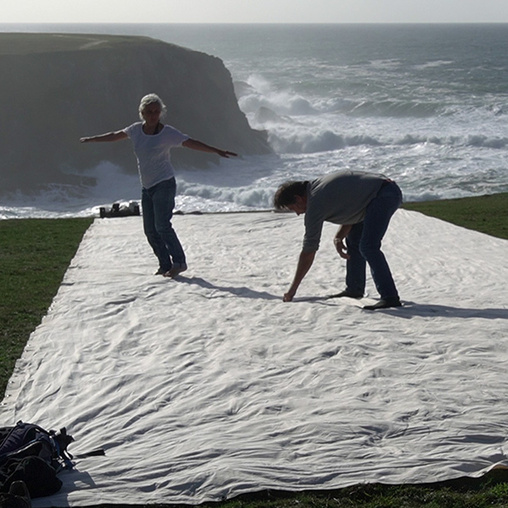
Anne Teresa De Keersmaeker and Steven Fillet; photo and background: Belle-Île, 2024, Videostill Courtesy Fillet, De Keersmaeker, Steven Fillet
Exhibition Project
Anne Teresa De Keersmaeker and Steven Fillet
At the MACS Museum of Contemporary Arts in Grand-Hornu, Belle-Île opens on an imposing sight. Seven vast paintings by Anne Teresa De Keersmaeker and Steven Fillet stretch through the Salle Pont, following the pair’s first presentation at Xavier Hufkens in Brussels. Made after working outdoors on the Breton coast, their surfaces retain something physical: pressure, weather and the passage of bodies. Up close, marks accumulate without becoming an image.
Across the room, Amnesia turns this material logic back into live movement. Set to Beethoven’s final piano sonata, the new solo travels along the gallery’s full length with restraint. Alain Franco’s musical dramaturgy lets sound accompany rather than explain. Nothing here tries to merge. Canvas, choreography and architecture keep their distance, yet each changes how the other is read. What remains is less a story than evidence of an action.
Nicolas Vamvouklis
Belle-Île exhibition until 1 November; Amnesia solo show: 4, 25 October, 1 November followed by an artist talk with MACS Director Denis Gielen
Video: www.youtube.com/shorts/pX2hoUGrikE?si=BubJQ60Uw1dggrfk
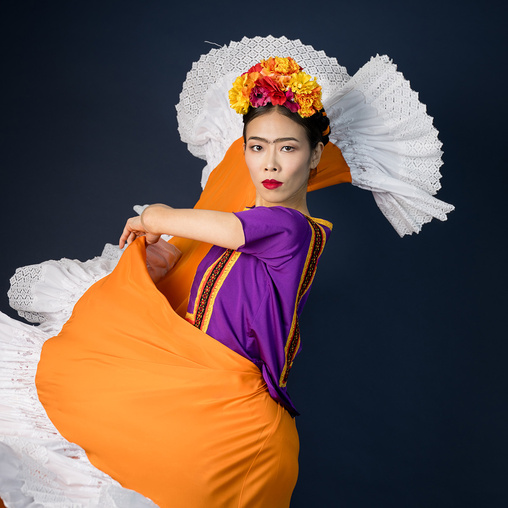
Sae Tamura as Frida; photo: Leszek Januszweski
In Short
- French choreographer Lea Bessoudo Greck has taken over as director of the NDM Ballet in Ostrava.
- New York stars have announced their departures from the stage: the American Ballet Theatre will lose two audience favorites—Herman Cornejo and James Whiteside—in 2027. Heather Ogden of the National Ballet of Canada is retiring even sooner.
- Seven Leipzig theaters, including LOFFT—a venue frequently hosting dance performances— are joining forces to form the Theaterquartier West.
- Choreographer Christian Spuck, Artistic Director of the Berlin State Ballet, has been appointed a member of the Academy of Arts.
- A changing of the guard: Kevin O’Day is set to become the head of dance in Münster for the upcoming season. A successor is also being sought for Stefano Giannetti, who left the Anhaltisches Theater Dessau in the summer.
- Awards: Haruka Sassa and Kalle Wigle, Principals at Staatsballett Berlin, have received the prestigious "Premio Positano Léonide Massine," while choreographer Christopher Wheeldon received the "Queen Elizabeth II Coronation Award"; in Dortmund, Sae Tamura became the first recipient of the "Dancer of the Year" award, which is sponsored by Sparkasse.
- A magnificent Danshuis is currently taking shape in Rotterdam—thanks in part to Samuel Wuersten; meanwhile, in Chemnitz, Dance Director Sabrina Sadowska has established a new dance center in the former spinning mill—one that spans generations and genres.