
In Motion
Submerged
Julian Charrière’s unsettlingly intoxicating Midnight Zone
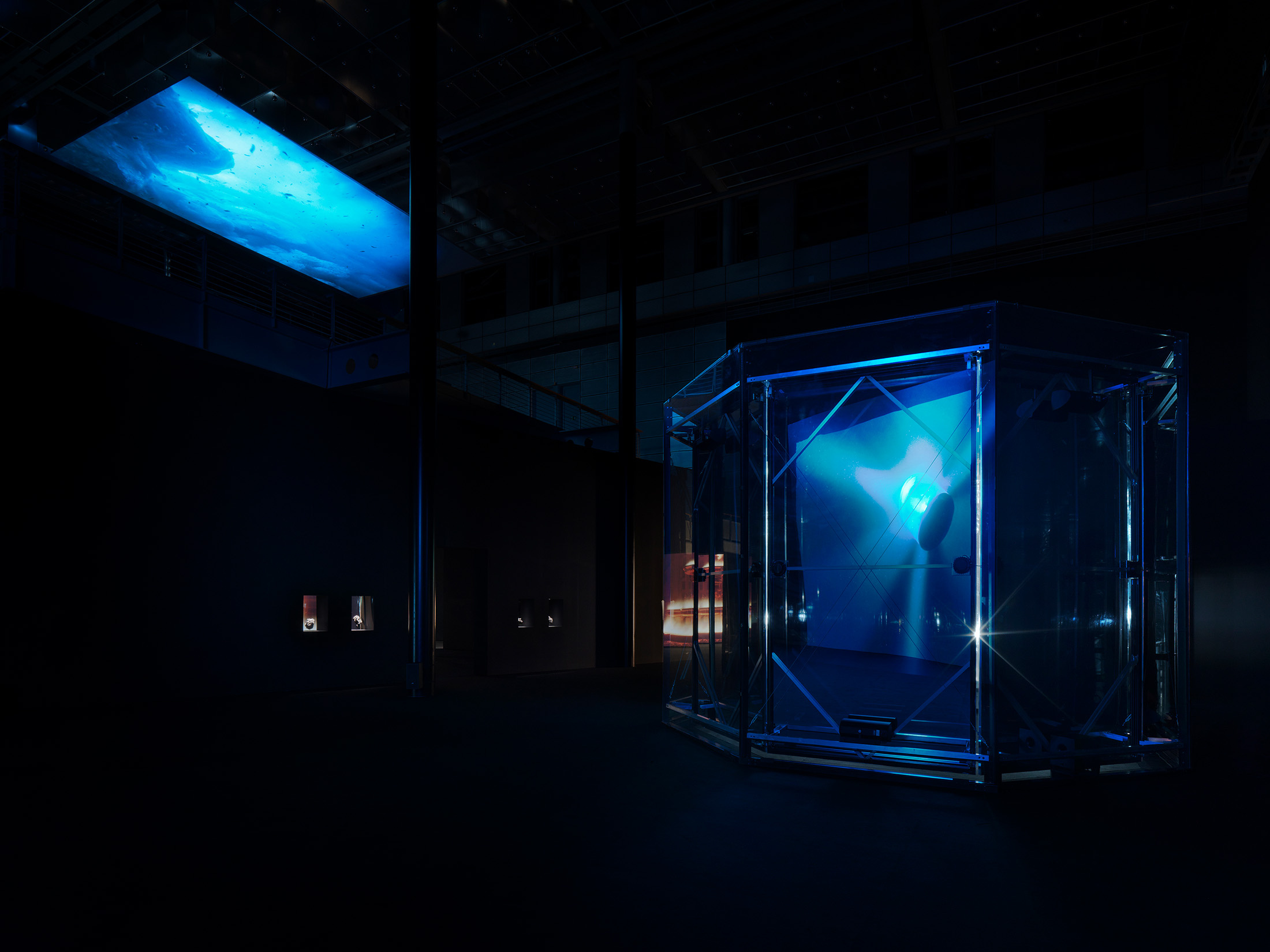
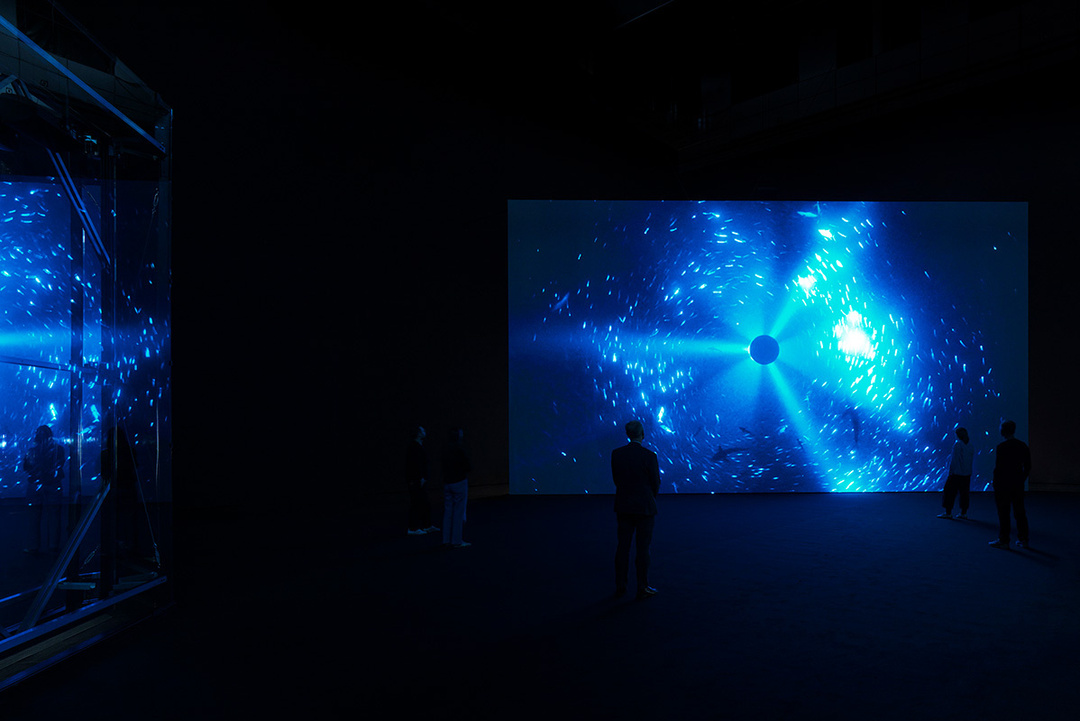
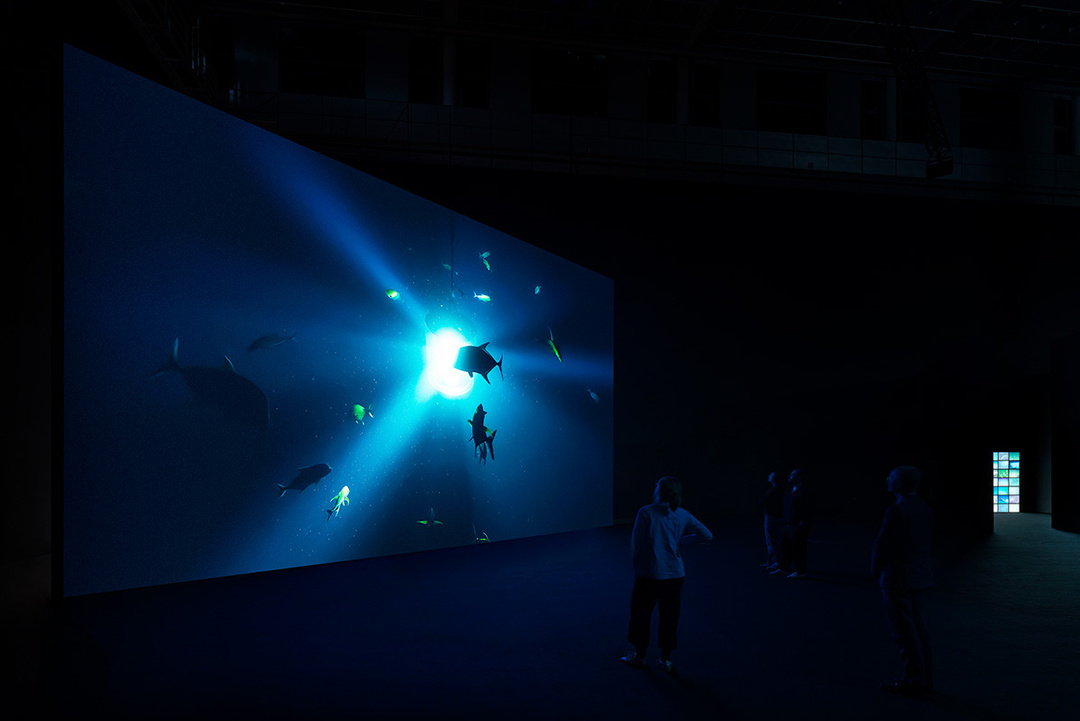
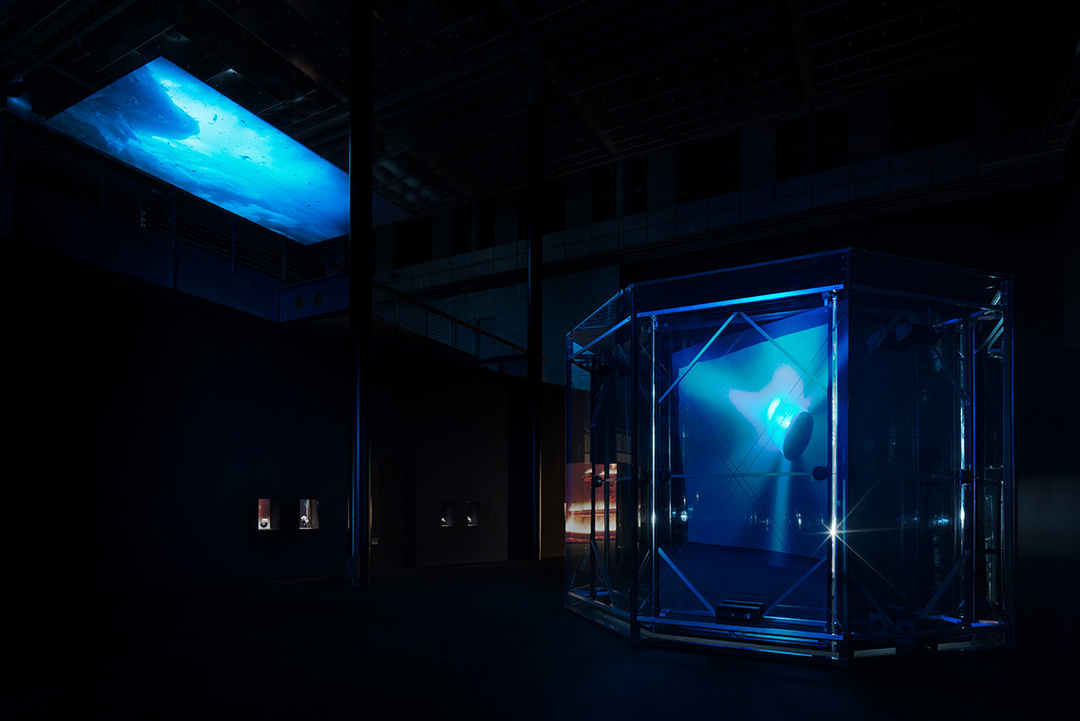
Darkness. Naked bodies float, gliding into a mist-like layer before vanishing. The black space is a cenote—a water-filled limestone cavern—containing crystal-clear, invisible water. The bodies belong to freedivers, and the opaque zone is the chemocline, where fresh and salt water meet but do not mix. Water lies at the heart of Midnight Zone, the unsettling yet intoxicating solo exhibition by the French-Swiss artist Julian Charrière, which has just concluded at the Kunstmuseum Wolfsburg. His multimedia practice blends art and science; his works often emerge from field research conducted in locations with distinct geophysical identities—volcanoes, glaciers, the deep sea. This is exemplified by the spectacular video-and-sound piece that gives the exhibition its title, in which a Fresnel lighthouse lens—followed by the camera of a remote-controlled drone—glides into the pitch-black void: the midnight zone of the Pacific.
In the case of the Where Waters Meet photo series, the setting is the water-filled caves of Mexico’s Yucatán Peninsula. It’s a fascinating phenomenon: over millennia, rainwater seeping through the plateau’s porous limestone has carved out a vast underground system of rivers and caves—a freshwater reservoir. Collapsed cave ceilings create open access points known as cenotes—sinkholes that can plunge to depths of more than 100 meters. Of the estimated 8,000-plus cenotes—many located deep within the jungle—only a fraction are open to the public.
Where Waters Meet was created in one such cenote. The images evoke a sense of weightlessness and disorientation—sensations that are not only familiar to Charrière, a diver himself, but are also central to his work. "Diving is a state in which individuality dissolves and the body merges with its surroundings," he says. «Underwater, the structures that underpin our experiences on land—gravity, direction—disappear. Currents envelop the body, absorbing and buoying it, as if one were not moving through the water but becoming part of it. Mass and volume are no longer fixed; one does not move through space, but within it. Here, perception begins to shift. Unlike movements on the earth's surface, which are bound to a single plane, diving is multidirectional. Orientation is no longer defined by certainty—without a fixed horizon, up and down are relative, undefined. Unlike the sky, which remains a distant canopy, the sea is a medium that completely envelops you—you do not move through it, but are contained within it."
One becomes absorbed; the boundaries between body and medium dissolve—and with them, the audience is released from a familiar perspective. For Charrière, the question of space and body represents, above all, a stance—one he demonstrates here, on this unusual stage, in a radically complex manner. The divers in Where Waters Meet are naked, free of cultural markers or discernible gender. The body is reduced to its most elemental form; in this state, it encounters water—one of the fundamental elements of life on Earth. Its nakedness heightens the vulnerability of the situation.

An interesting parallel is drawn in the visually striking companion volume to the exhibition: the ambivalence between freedom and hubris evokes the figure of Icarus. Here, too, the theme is the transgression of boundaries—the desire to leave one’s familiar environment and explore new realms. Yet while Icarus strives upward, Charrière’s work leads into the depths. The difference may also lie in the nature of the movement: Icarus flies toward the sun, borne by a technological invention he does not understand. The divers, by contrast, know and trust their bodies and the medium itself. The cenotes reinforce this interpretation. As geological formations shaped over millennia, they embody their own sense of time. For the Maya, they were gateways to the underworld—places of transition between different planes of existence, between nightmare and ecstasy.
Julian Charrière: Midnight Zone, Museum Tinguely, Basel / Kunstmuseum Wolfsburg, 272 pp., in English, Walther König, Cologne, 2025;