Content

Close-Up

Eye Candy

For the first time, Alexei Ratmansky stages a production for the Hamburg Ballet: Wunderland is a journey through Lewis Carroll’s dream world

by Falk Schreiber

Mid-June. A sweltering heat hangs over Hamburg. And it seems swelteringly hot on the stage of the Hamburg State Opera, too. Alice’s sister (Alice Mazzasette) sprawls on a small grassy mound—clad in a summer dress, sunglasses, and a straw hat—picks up a book, and makes it clear through her entire posture that she does not wish to be disturbed for the next few hours. Not even by Alice. But things are not that simple with a little sister—especially one danced by Olivia Betteridge, whose youthful energy clearly needs an outlet. So, down the rabbit hole it is—opening up right beneath the mound.

Nonsense Literature
In 1865, the British part-time author Lewis Carroll published Alice in Wonderland—originally a gift for a friend’s daughter that, following expansions, became a global success, a trailblazer for nonsense literature, and a work that continues to influence cinema, pop culture, and theater to this day; the sequel, Through the Looking-Glass, followed six years later. Alice in Wonderland has also left its mark on dance: Christopher Wheeldon created a version for the Royal Ballet in 2011 (which was subsequently staged by the Bavarian State Ballet six years later), and Mauro Bigonzetti created one for Gauthier Dance in 2014. Now, Alexei Ratmansky has created a production titled Wunderland for the Hamburg Ballet—the company’s first major narrative ballet since Cathy Marston revived her Northern English-style Jane Eyre there in 2023 (a somewhat uninspired restaging, according to tanz 2/24). It serves as the finale of the "Dance Triennial" as well as the opening of the "Hamburg Ballet Days"—acting, in effect, as a bridge between the new and the old.

Then again, Ratmansky’s aesthetic has never had much to do with contemporary dance. The 57-year-old specializes in reconstructing classical ballets—he rarely presents original creations (such as Kallirhoe in Vienna)—and in Wunderland, too, he relies on the classical movement repertoire, which the Hamburg company executes with unerring, almost sleepwalking confidence. Yet, anyone who has truly mastered this repertoire also possesses the tools to stretch it, view it from a new perspective, and place it in different contexts. And that is precisely what Ratmansky does here, delighting in leading the audience down false trails—an approach that perfectly suits the literary source material.
The Heat!
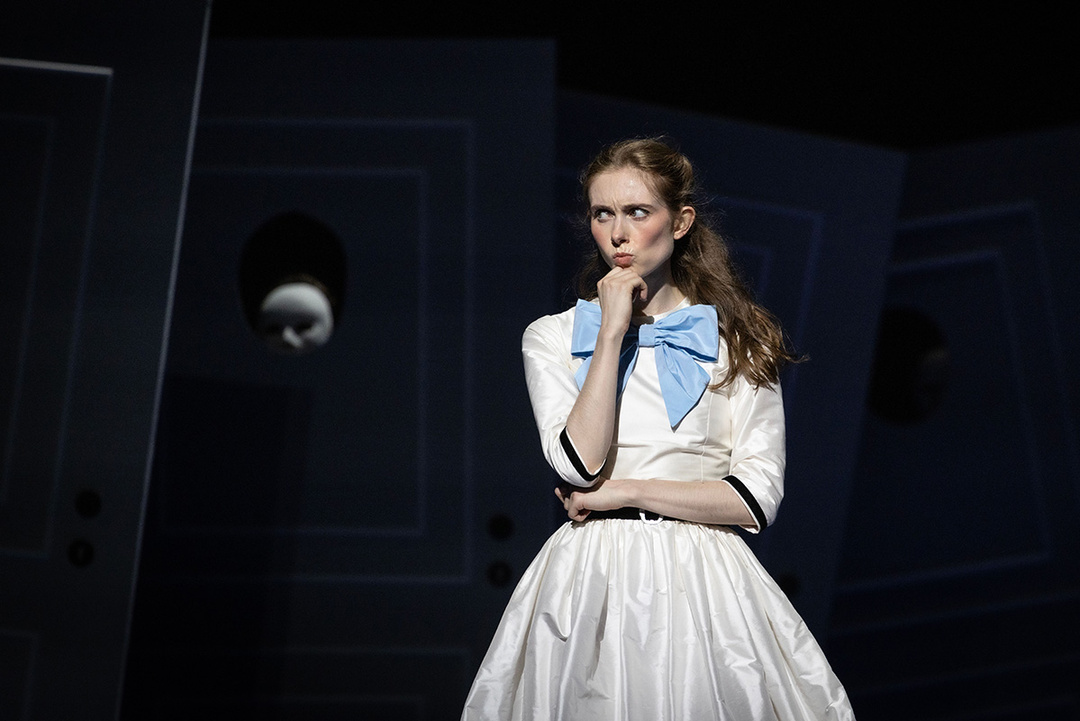
So, when Betteridge initially dances on pointe and barely perceptibly stumbles on the final step, one’s first thought is: Of course—the heat! But moments later, one realizes that Alice, too, is suffering from the high temperatures in the play; furthermore, she is a little girl who isn't executing a perfect pirouette here, but rather trying to channel her excess energy—and sometimes, things just go slightly awry. It is a finely crafted touch, because the production doesn't make a meal of the mistake, but instead lets it play out within the subtext. And because a performer as charming as Betteridge shines in the title role, one happily allows oneself to be led onto thin ice—or rather, into Wonderland.

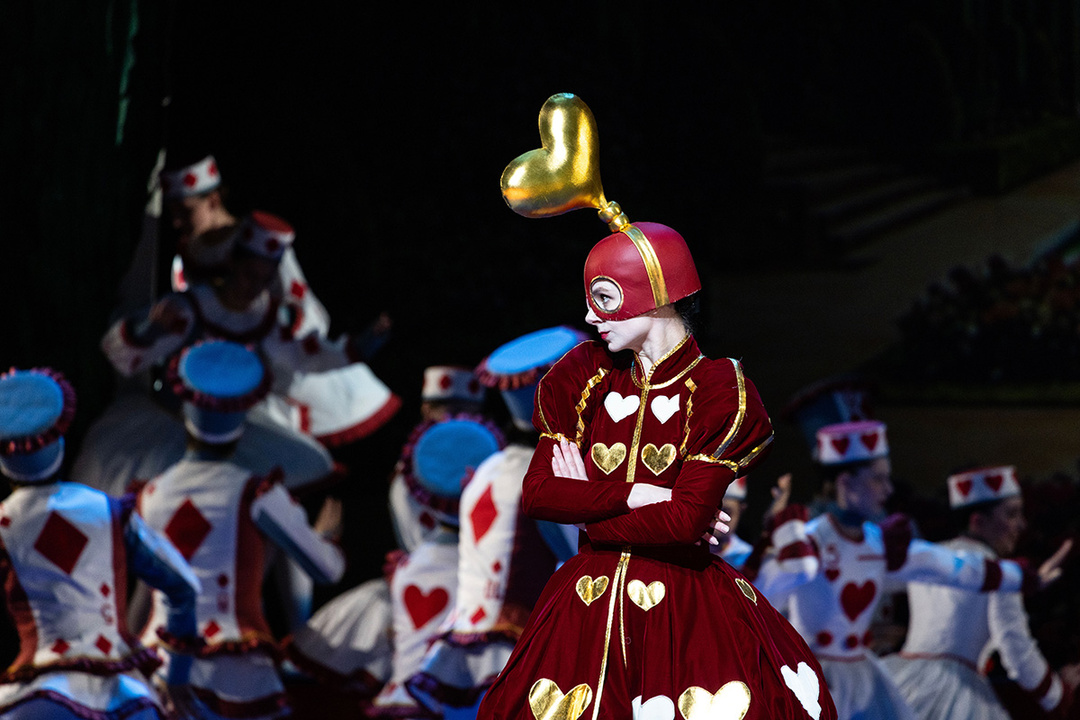
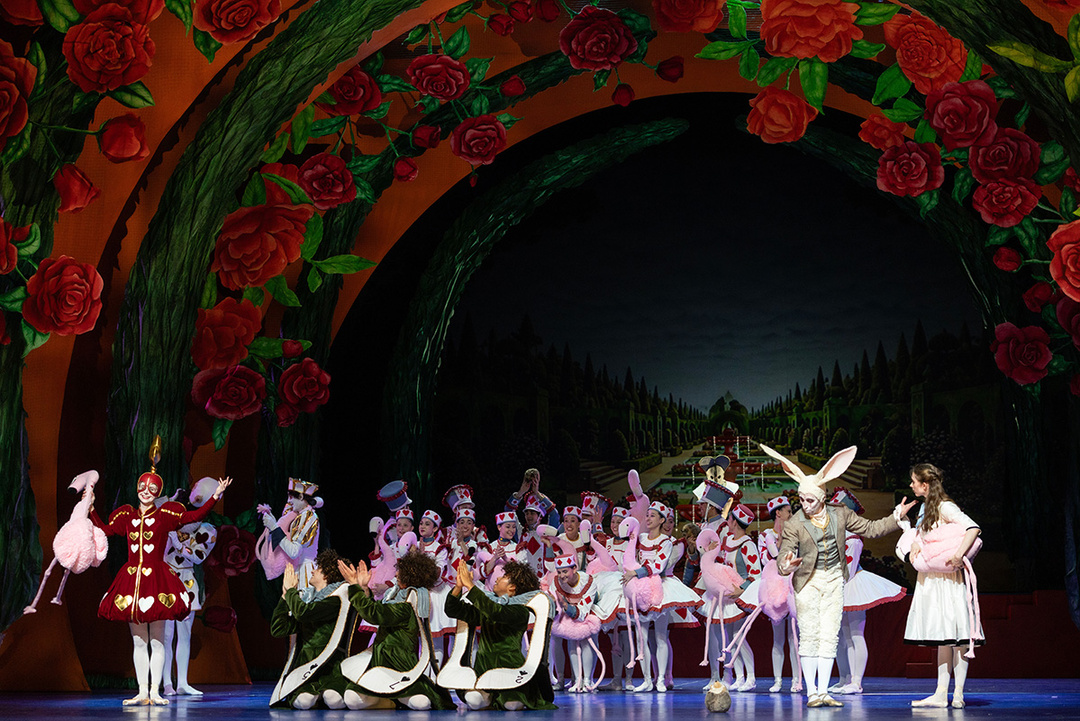
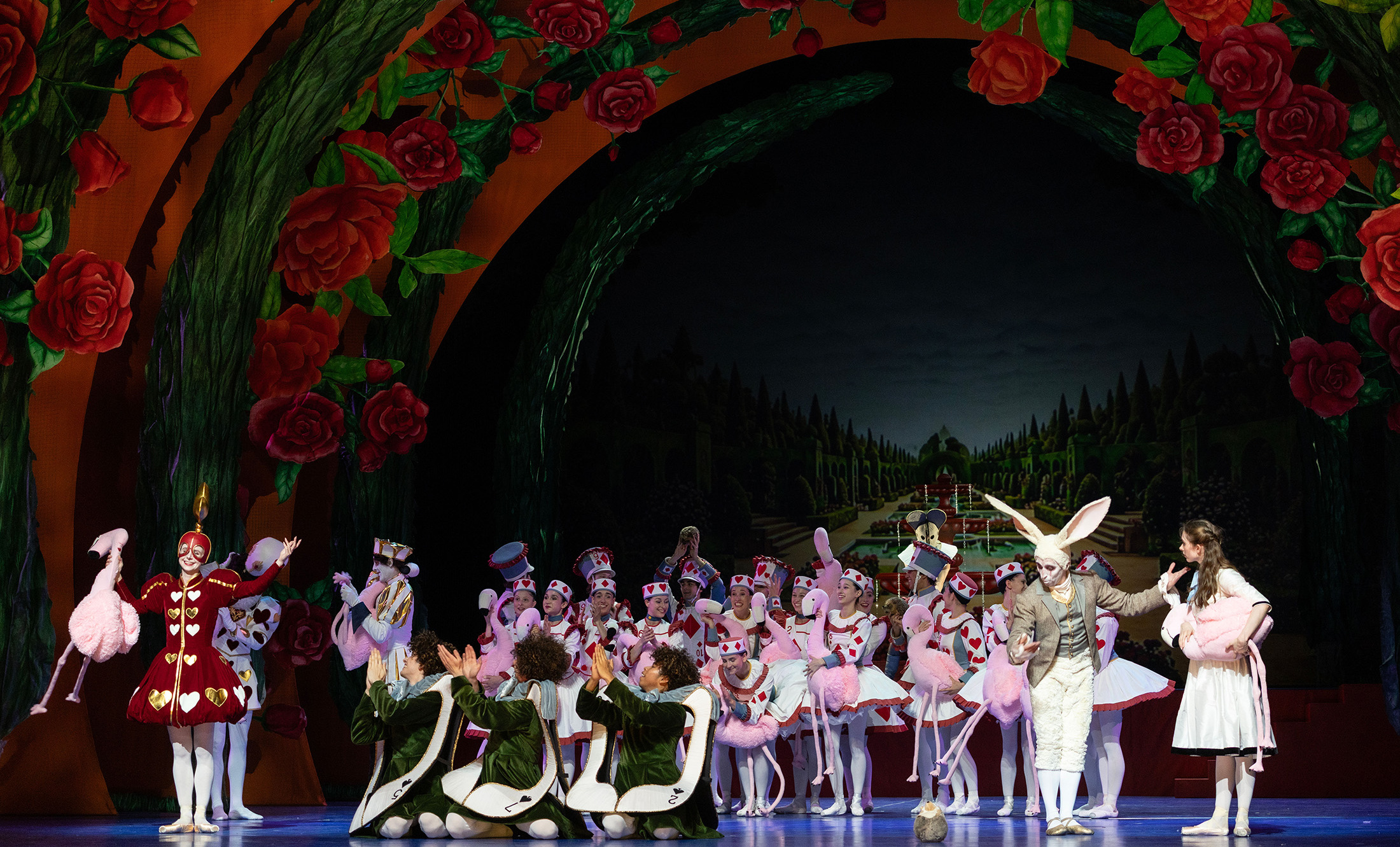
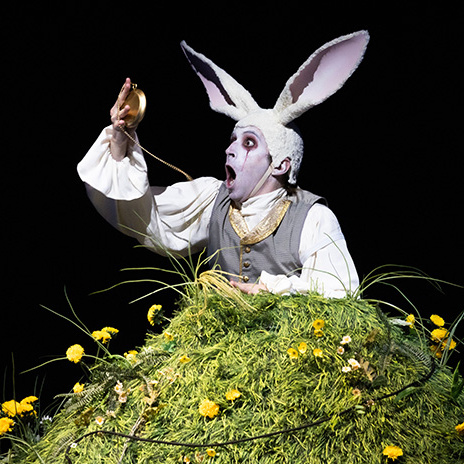
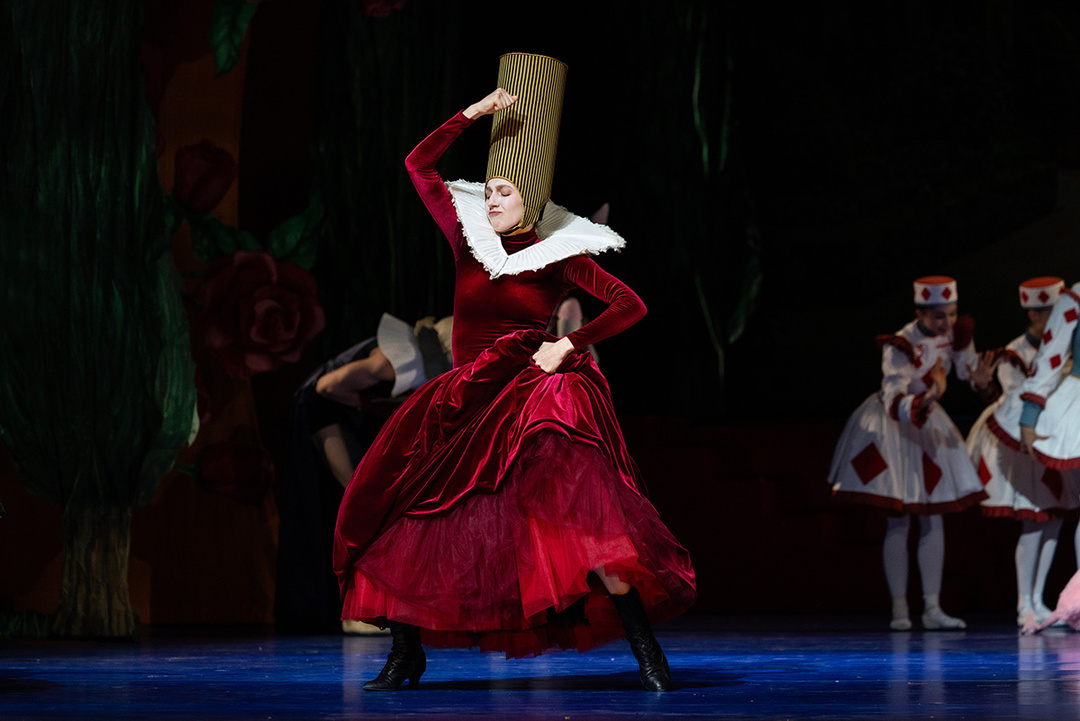
Ratmansky’s Wunderland proves to be a series of whimsical situations familiar from Carroll’s original novel. Alice follows a perpetually stressed rabbit (which, given its long ears, seems more like a hare in Aleix Martínez’s portrayal—but never mind), tumbles through a psychedelic tunnel, and encounters, among others, a chainsmoking caterpillar (Caspar Sasse), the Cheshire Cat (Daniele Bonelli, supported later by the corps de ballet acting as a pack of cats), and the chaotic tea party of the Mad Hatter (Gabriel Barbosa). And finally, she lands in the reign of terror of the Queen of Hearts (Ida Praetorius)—more or less the center of this novel, which actually has no center at all, but rather meanders according to dream logic. This also means, however, that Ratmansky’s ballet version cannot rely on a genuine dramaturgical structure. On stage, it takes on the character of a variety revue: one excellent scene follows another, yet the elements struggle to coalesce into a unified whole. And because Ratmansky approaches each scene differently in musical terms (music by Philip Feeney, assisted by the choreographer’s son, Vasyl Ratmansky), sooner or later, a sense of being hounded by emotional contrasts sets in: Béla Bartók stands alongside Johann Strauss, Romantic string textures beside electronic signals, and in between—during the tea party— a cacophony that grates on the nerves rings out. It is all carefully conceived, yet the rapid succession of events leaves no chance to adjust to the constant shifts in mood. Which is likely the point. The dream world through which one accompanies Alice may be imaginative and ultimately harmless, but that doesn’t mean one can afford to get too comfortable there. Ratmansky’s classical approach to ballet lulls the viewer into a false sense of security—the feeling that one can settle into the conventions of a fairy tale—but the music then makes significant demands. On the one hand, the Philharmonic State Orchestra Hamburg which—under the direction of Vello Pähn—must master these stylistic hairpin bends with verve; and then there is the audience, which has to follow along on this breakneck ride. Things grind and rattle quite a bit along the way, and the fact that one emerges from the first part feeling both disheveled and inspired is a testament to the quality of the evening.

Fanciful Nonsense
With its recent narrative ballets, the Hamburg company had maneuvered itself ever deeper into a certain self-important solemnity. This may have had something to do with long-serving artistic director John Neumeier, who wanted to see his life’s work brought to completion; yet the trend continued with pieces such as Marston’s Jane Eyre or Aleix Martínez’s Äther in the double bill Romantic Evolution/s, which attempted to depict the climate catastrophe through dance. Ratmansky now counters this with the sheer joy of movement and nonsense. For that is precisely what Wunderland is: a celebration of fanciful nonsense that makes sense on its own terms, yet immediately lets that meaning dissolve into thin air. In the process, it can at times be hard to bear—the dream Ratmansky shares with the audience occasionally veers into nightmare, and the fact that the choreography allows for this demonstrates just how well the concept works. At least until the intermission.

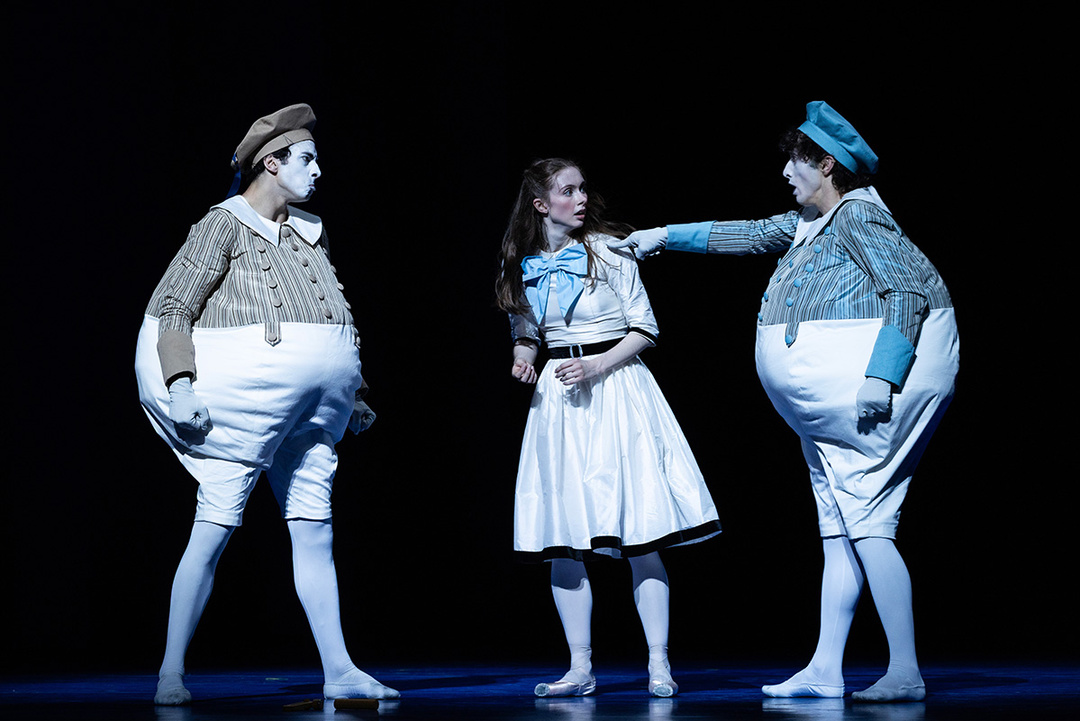
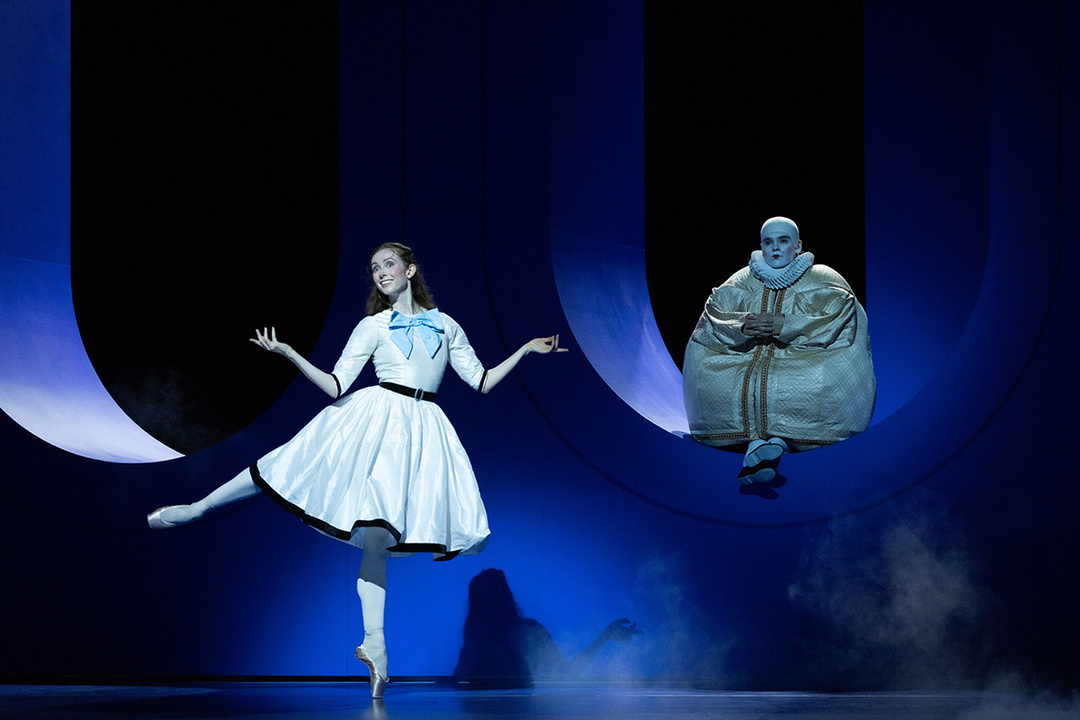
This is followed by Through the Looking-Glass, which essentially retells the story—only in a more mature, focused manner. Betteridge’s Alice travels to Wonderland a second time, though this time not through the rabbit hole, but rather by a step through a magic mirror. This creates a lovely pas de deux with a mirrored double (Greta Jörgens), but it also makes the narrative more conventional, because the mirror introduces a metaphor that—unlike the rabbit—is already well-worn. Moreover, the anarchic fun of Martínez’s rodent is missing here. The card game from the first part transforms into a game of chess (nicely choreographed, though ultimately somewhat tiring), while the pack of Cheshire Cats becomes a menacingly buzzing insect ballet. Once again, individual encounters in Wonderland are delightful: Caspar Sasse, for instance, plays the egg-shaped fellow Humpty Dumpty (referred to less poetically as "Goggelmoggel" in the German version of the novel) as a charming, wobbling roly-poly toy. And the twins Tweedledum and Tweedledee are arguably a highlight of the evening: Even if one—like the author of this article—harbors a certain aversion to clown-like aesthetics, one has to acknowledge the sheer joy in precise movement and perfectly executed leaps with which Francesco Cortese and Louis Musin approach this performance.

Non-violent Conflict Resolution
The Red and White Knights, however, present a more ambivalent picture. Matias Oberlin and Daniele Bonelli initially perform the duel between the two in the expected manner—as a classic choreographed fight—only to conclude it with surprising playfulness, featuring dangling legs and gentle harmony. This shift may well be more than just a choreographic surprise—of which the evening offers several; perhaps Ratmansky, a staunch opponent of Putin (he left Russia following the 2022 invasion of Ukraine), is here emphasizing that there are also non-violent ways of dealing with conflict. Consequently, the military element—which in Carroll’s work repeatedly encroaches upon the child’s dream world—is present here only in traces, such as in the courtly entourage of the first part and the cavalry of the second. It is a pity, however, that the scene culminates in a love duet between Alice and the White Knight that feels almost too adult—partly because Daniele Bonelli’s vitality largely cancels out the charm of Olivia Betteridge’s youthful, carefree performance. Above all, though, it is because Ratmansky here sacrifices the source material’s queer content to a heteronormative structure for no apparent reason. Admittedly, this reflects the times: in Hamburg, (neo-)classical ballet was long understood as a queer art form, yet queer elements in new productions have since been reduced to a minimum.

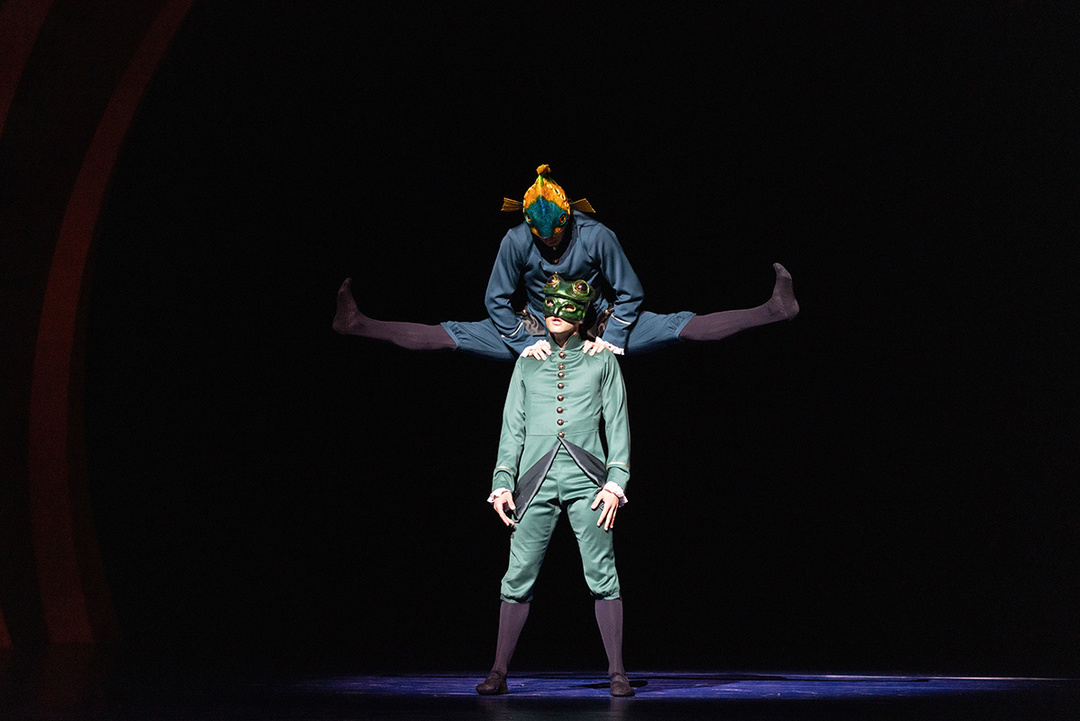
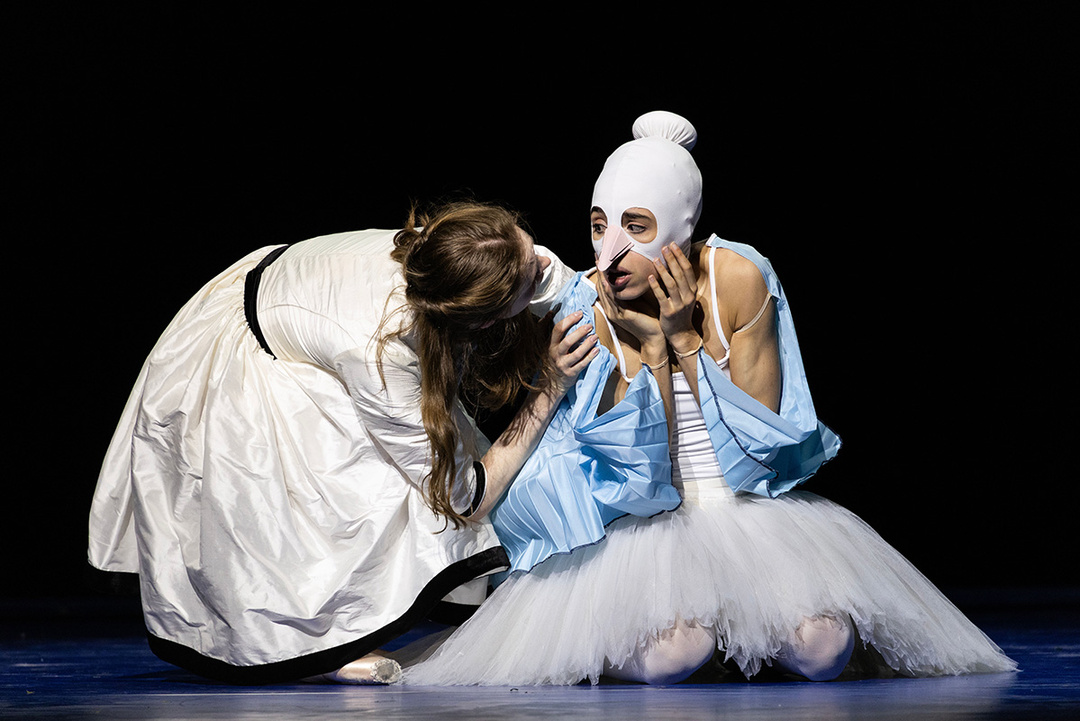
Accordingly, the lavish production design—Wunderland is reportedly the most expensive production the Hamburg Ballet has ever mounted—proves to be more of a visual feast than an exercise in true camp. Though it is a truly rewarding visual feast: Sebastian Hannak makes full use of everything the Hamburg stage has to offer, from dollhouse-like sets to abstract video projections; in one drug-hazed sequence, Betteridge’s head—atop a serpent’s body—weaves its way across the stage for minutes on end. Yet the real showstoppers are David Szauder’s costumes, which lovingly outfit even the smallest roles (such as the crab danced by Lormaigne Bockmühl!).

The guinea pigs! The flowers! And not least, the wonderful mushrooms in their tight costumes! One can never tire of looking at these characters and the imagination with which they were brought to life, and it makes for a lovely conclusion that most of them get to return to the stage for the finale. The one most missed is the Rabbit from the first act, but Martínez is already inside the Lion costume—some things inevitably get left behind. In the final scene, Alice is sent back to the real world through the looking-glass, more or less unceremoniously. Just as at the very beginning, Erik Satie’s Gnossienne No. 3 plays once more; somehow, the heroine must now come to terms with mundane reality. Yet Betteridge’s smile suggests she has taken a few memories from Wunderland with her. Those should last for a while.

Further performances at Hamburg State Opera; 30, 31 October; 6, 10, 12, 13, 18, 21 November; 20 March 2027;

www.hamburgballett.de