When Boris Charmatz took over the artistic direction of Tanztheater Wuppertal Pina Bausch, it was by no means a mere quirk of history. Beyond possessing a profile that was almost brazenly well-suited to the role, he had a very concrete and urgent agenda: he wanted to take Pina’s dance, her impressive repertoire, and her world-famous dance theater on a journey into the 21st century. His ideas would surely have sufficed for many years to come. But things turned out differently. After less than three seasons—albeit seasons of intense activity—Charmatz returned to Brussels. There, he has now exposed the dance world to a roaring, isolating silence: Muette—mute—is the title of his new solo piece. One might just as well call it Sourd—deaf—because, by the end of these fifty minutes, one is no longer certain: Was Charmatz mute? Or were we, perhaps, simply deaf?
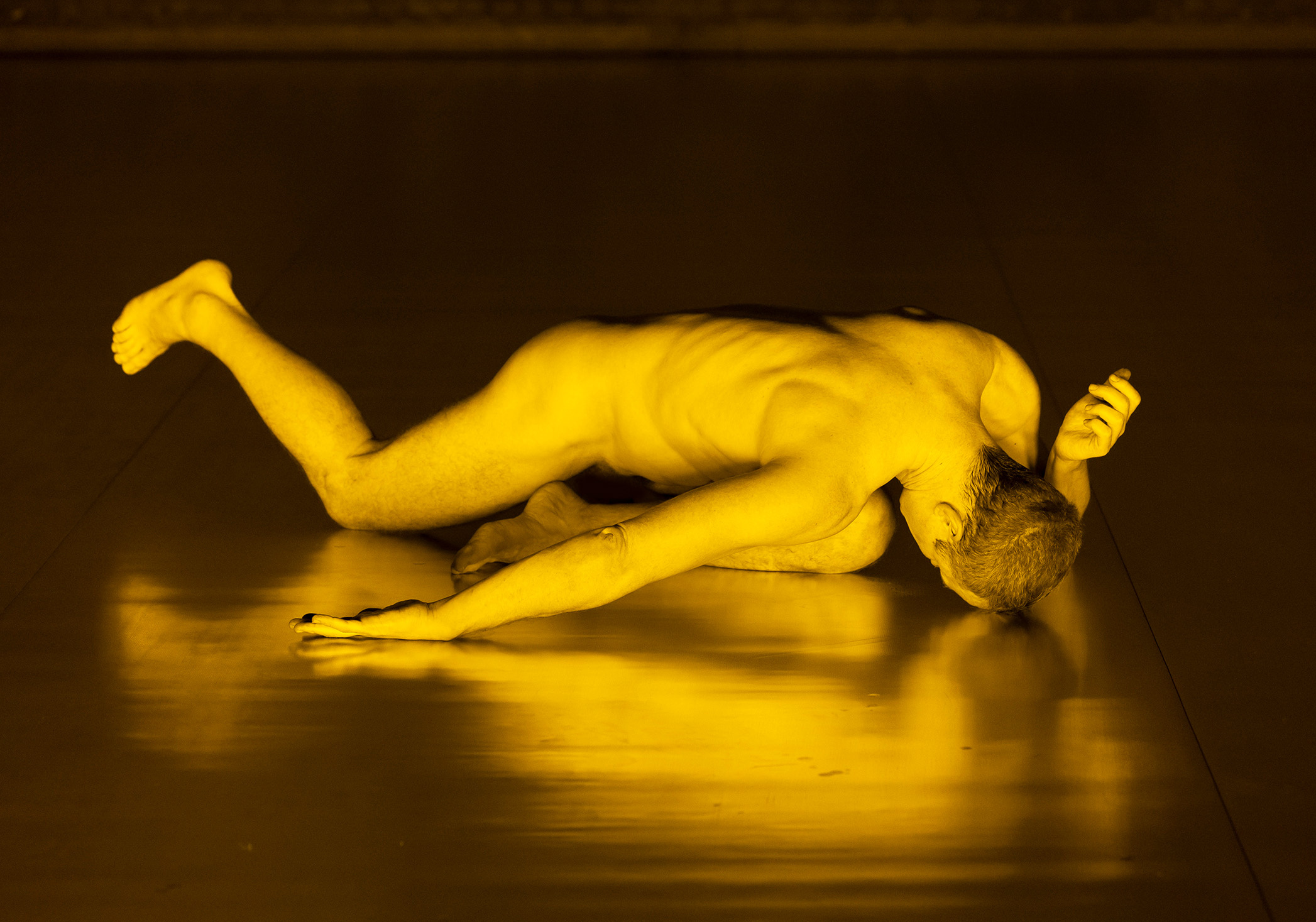
The doors to the foyer of Brussels' Kaaitheater are closed, the audience has fallen silent, the sulfur-yellow light dimmed, when Charmatz, from the right, with a measured, powerful stride, cuts across the empty stage diagonally and positions himself in the left, rear corner, facing the wall. He takes off his black T-shirt, then his long trousers. He lingers, letting this first image hang for a long time: a man undresses, feels shame. And after this setup, it would be: time. Time for movement, words, music. Time for a second beginning. For something sudden, raw, hitherto unknown. For a principle established in festival shows or premieres of this kind. But none of that happens. Charmatz simply leaves us sitting in this space. For fifty minutes, we inhabit his universe, where—gesture by gesture—he begins to construct an entire world, underworld included, whose silence strikes us with a multitude of tones.
Dance Alphabet
Almost imperceptibly, the spectator shifts from a state of probing inquiry to one of passive, meditative receptivity. The dance suddenly reveals itself to be far more literal—literally more readable—than initially assumed. The gleaming metallic floor transforms into a blank page upon which Charmatz’s body and movements appear like characters. Like so many breathing, sweating, twitching letters, like a silent glossolalia, like a captivating dance alphabet, rich in references and self-quotations.
A for be ashamed. B for the bubble of saliva he balances with his mouth, for Butoh or boxing match. C for chaos. The chaos of total exertion is so absolute that it borders on stillness. H for Hans Holbein’s The Body of the Dead Christ in the Tomb. H for the big heart he painted on his chest as if love were his only garment. M for mal aux jambes, mal à la gorge, mal au coeur—everything hurts. And, of course, N for Nijinsky’s L’Après-midi d’un faune. P for Pina, who is present in her absence. S for strength. W for—I WANT to say something, but I can’t. W for “Who owns the dance legacy?” And Y for Yvonne Rainer’s thoughts on minimal dance. With Doing Nothing, Nothin’ Doin!, she raises the question of what remains when dance strips away everything—its potential for virtuosity, spectacle, and drama.
10,000 Gestures—one of the major, pivotal works in Charmatz’s oeuvre dating from 2017—keeps shimmering through this evening in Brussels. What distinguishes a gesture from a movement? That was the question back then. “A gesture can be a sign,” said Charmatz, “a wish, a movement, a position, an act, an action, an image, a word.” Today, that sentence reads like a working note for Muette. Dancing in order to speak without words.
Speaking of language: one might also have expected Charmatz to return, after a brief respite, with a solo combining speech, dance, and theater. After all, in Wuppertal, stories are told through dance: there is speaking, singing, shouting, and laughter. Everything has to come out—all the memories, fears, desires, and tormenting spirits. Yet talking isn’t his thing. Two summers ago, Charmatz could already be seen in a silent, somnambulistic séance during the revival of Café Müller with a new cast. He had made the role of Jan Minarik his own—the one who, in the man-man-woman scene, dances the part of the "lifter and holder." Like a good magic trick, it made one wonder: How can one dance like a rock amidst the surf? How can one make something heavy appear so light, elegant, and—impatiently—effortless? And perhaps, during those weeks, the speechlessness inherent in that famous forty-five-minute piece of dance history rubbed off on him, seeping into his body like a warm, bittersweet rain that has since been metabolized.
Emotions and Movement
At the very least, an arc of light falls from this vantage point onto the essence of his work. The secret heart of his dance is the transformation of emotions into movement. How do emotions unfold within our bodies? In the bodies of lovers, of children, of people fleeing, of people who have experienced violence. How does a tired, fearful, angry, or abused body move? As has often been the case, Muette leads us into a twilight zone between the everyday and the everynight of being, to shed some light here with the body; to probe—with every fiber of their being—unresolved events and experiences; to examine from all angles images we have locked away from our waking world, to devour them, to spew them back out, to scream them out, to shake them off, and to transform them into a dance. As in enfant (2011), that early masterpiece dealing with violence against children. Or in Danse de nuit (2016), when the choreographer and six dancers—following the attacks on the Charlie Hebdo editorial offices—ran through the dark of night in Paris, screaming and dancing out of grief, out of rage, and without solace. In 2023, at the St. Mary’s Cathedral in Neviges (in the Bergisches Land region), he and the dance theater ensemble attempted to banish the dark side of Catholicism. Liberté Cathédrale is a furious, collective witches’ dance. Here, too, the subject is a rupture in civilization. And it is not the first time that a European Jew is spelling it out anew. Not regarding the Holocaust, but rather the abuse of children and young people by the clergy. Why is that? Perhaps because his work deals with the memory that follows memory—what the literary scholar Marianne Hirsch once termed "postmemory." With images, narratives, and years of silence that—as fears—inscribe themselves in bodies. Of archives that must dance to stay alive.
Charmatz’s major long-term project, Musée de la danse—launched at the Centre chorégraphique national de Rennes et de Bretagne—could just as well have borne the subtitle "Understanding Modernity" or "The Future of the Past." He founded it in 2009, the year that saw the deaths of first Pina Bausch and, just a few weeks later, Merce Cunningham. Here, too, it was not mere coincidence at play, but rather Charmatz’s seismographic instinct for places and people of history—and for the question of how all those inscribed, stored memories might be written out, danced away, whistled out, and transformed into a more unconstrained version of ourselves. We do not merely have a memory; our bodies are our memory. This observation is universal—applying equally to dancers and non-dancers—and served as the cornerstone for the Musée de la danse.
From Charmatz’s Museum of Dance, it is but a short leap to a completely different, astonishing archival item. In 1971, the magazine Les Lettres françaises published a piece on theater. The author is Louis Aragon, and his text takes the form of an “open letter” to his late friend and rival André Breton. The director Robert Wilson was visiting Paris with his silent opera Deafman Glance, where he was hailed as a neo-surrealist and a magician. Quite apart from the fact that it is hard to believe the elderly Aragon and the then-young Wilson were contemporaries for a time—how fantastic is that!—the letter to Breton is a document of rapture: "The miracle has occurred—the one we expected, the one we spoke of; it has occurred just when I had long since ceased to believe in it. It was called Deafman Glance, my friend. The world of a deaf child opened up to us like a mute mouth." Aragon experiences Wilson’s theater as the rebirth of Surrealism in the form of the deaf, mute boy.
Understanding and Not Understanding
Returning to Charmatz: the form of this letter also resonates in the écriture of Muette. This concerns, firstly, his burning fascination with a body language that requires neither hearing nor voice. And with people who have mastered this language and thereby unlock spaces for us—spaces we may never have visited before. Realms of heightened and diminished reality, new spheres of understanding and not understanding. And secondly, there is the freedom—the incandescent freedom—that arises from the limitation of the senses. Aragon speaks of "our healing from 'frozen' and 'learned' art" and describes Wilson’s piece as a machine de liberté—a freedom machine.
The Kaaistudios are a small, windowless theatrical box. Tonight, they take on the quality of a soundproof liminal space between life and non-life. Yves Godin’s fading neon light—alongside Charmatz’s body, the floor, and the brick wall—is the most effective theatrical element of the evening. By the end, only a rear row of lights is still flickering. The space transforms into a cell, a dungeon, a burial chamber. The outstretched, seemingly motionless body rears up sharply one last time before settling into stillness, allowing—breath by breath—the deepest calm to descend upon the hall, until all we hear is Yvonne Rainer’s voice whispering: "In art, doing nothing is never truly nothing." Yet even this voice is merely a figment of the imagination; after all, the piece is titled "Mute," and we are listening to the vast silence. With its pure, unamplified presence, it advocates for unadorned being—for naked existence. For the rebirth of a "poor theatre"—the most valuable and wisest of them all—because it is here that the human creature finds its place to dance. During the final bow, one’s gaze falls once more upon the painted heart on Charmatz’s chest. Though the outlines have become blurred from the dance with the elements of his inner world, they remain clearly discernible— poised between chaos and sketch, between greeting and graffiti.
Reflecting on it a few days later—after letting the evening pass before my mind’s eye once more, letter by letter—I read Muette like a love letter, a letter from the heart. “Dear audience, hello world—I am a dancer and dance is my life, my burning freedom, and my utopia.” Perhaps there were simply too many ghosts in Wuppertal pursuing him. Yet none of that could diminish his freedom or his love for dance. Boris Charmatz trained at the Paris Opera. As a ballet dancer, he might well have stopped performing years ago. With his concept of dance as art brut, he has pushed the boundaries far beyond the conventional. And yet, he lays the vulnerability of his body at our feet, alongside the beauty, the urgency, and the finitude of his profession. One senses: there is so much more to come. And of that abundance, this is the beginning.
Further performances in Rome, Romaeuropa Festival, Mattatoio, 2–4 Oct.;
Florence, Centro di Produzione della Danza Cango, 7–8 Oct.;
Milan, Triennale Milano, 10–11 Oct.;
Montpellier, Studio Bagouet22–24, Oct.;
In 2024, the author published the book Nahaufnahme. Boris Charmatz with the Tanztheater Wuppertal Pina Bausch.