
At A Glance
Side Steps
Jack Bannerman, Palais Garnier, National Dance Awards, Daniel Léveillé – and more

Jack Bannerman; photo: Maks Pallas
Newcomer
Jack Bannerman
He had effortlessly made it to the finals of the "International Choreography Competition Hannover." His experimental duet, Is this the place you wanna be?, skillfully interweaves speech, sound, space, and movement. Yet, many were surprised when Jack Bannerman ultimately left empty-handed. Interestingly, the Australian—who lives in Dresden as a freelancer—had never even considered choreography when he first started dancing at the age of eleven. He earned his bachelor’s degree in dance in New Zealand, arrived in Germany in 2017 following a stint in Poland, and was hired as a dancer at the Landestheater Eisenach. Up to that point, his background was rooted in classical ballet, but his time in Eisenach changed that completely: "I worked with several choreographers there who showed me that it isn't dance technique that defines what I do; it has much more to do with energy."
Categorization based on distinction does not work for Bannerman. He created his first original duet during lockdown, almost as a form of occupational therapy. It was presented at the Tanzplattform Rhein-Main, followed by works at Tanzhaus Basel, in Oslo, and at TanzFaktur Cologne. And eventually, he also realized the shift in perspective that comes with choreographing. The view from the outside simply suits him better. It was only logical, then, for Bannerman to earn a master’s degree in choreography at the Palucca Hochschule für Tanz in Dresden.
Now, his duet is set to expand into a full-length trio. He will have the opportunity to develop it further during a residency in Copenhagen this November. At 33, Bannerman uses his work to reflect on contemporary influences—such as the question of the "image" of dance as an aesthetic perception—as digital media increasingly overlay the analog experience. He speaks of authenticity as a guiding principle, in contrast to common practices of self-marketing. Here, the impact of social media comes into play. That is why he views the two dancers in his duet "as avatars—simulations of human beings." At its core, he says, the work raises the question: "How do we feel we must present ourselves?"
Rico Stehfest
www.jackbannerman.com
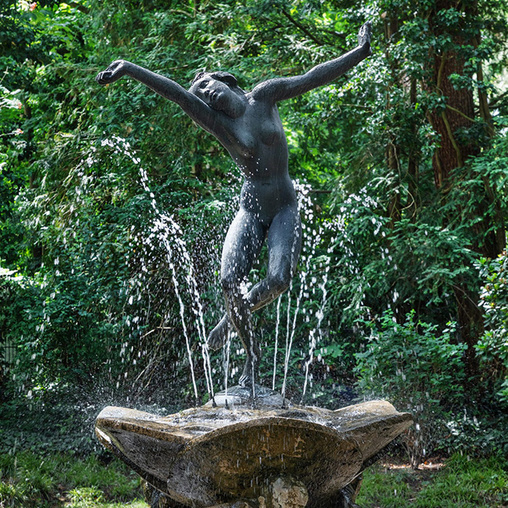
Photo: Enric Duch
Georg Kolbe
Dancer Fountain
The dancer no longer performs in the garden of Berlin’s Georg Kolbe Museum. Since the late 1970s, the bronze figure had balanced on a single pointe above the flower-shaped fountain basin, her slender legs gracefully crossed and her arms raised in playful equilibrium. The sculptor, who frequently drew inspiration from dance and dancers, created the fountain in 1922 on commission from the Jewish art collector Heinrich Stahl. Persecuted by the Nazis, the director of Victoria Insurance was forced to sell his house, grounds and the fountain far below their value. He later died in the Theresienstadt concentration camp.
In 2024, the Georg Kolbe Museum launched a provenance research project into the fountain’s history, concluding that it had been looted during the Nazi era. The work was subsequently restituted to Stahl’s Jewish heirs. Most recently, the fountain was auctioned for four million euros at Berlin’s Grisebach auction house. The identity of the buyer has not been disclosed. All that is known is that the sculpture now graces a private garden in the United States. The Georg Kolbe Museum was unable to raise the funds required to acquire it. And so the dancer had to leave her home in Berlin’s Westend.
Katrin Bettina Müller
Nelken; photo: Vincent Berenger
Open Air
Pina Bausch’s Nelken
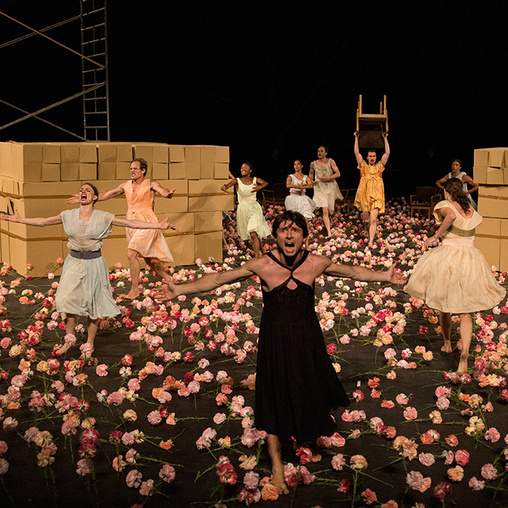
The cicadas stopped their singing right on cue at 10 p.m. Now, silence reigns in the mountains above Toulon on the coast of southern France. The sea and the lights of Toulon can still be seen glimmering in the background. Only a few frogs croak, as if commenting on those peculiar ladies and gentlemen in evening wear who are running and teetering through a sea of carnations, dancing in a line—sometimes standing, sometimes sitting, sometimes lying down. They seem strangely out of time here at Châteauvallon-Liberté, a sandstone amphitheater. Despite having 1,200 seats—all sold out, of course—the performance feels almost intimate, given how close the audience is to the action.
A young generation of dancers from Tanztheater Wuppertal has made Pina Bausch’s 1982 piece their own—and little wonder, for it is both cheerful and menacing, playful, and rich in scenic ideas; visually striking, too, and a magnificent ensemble piece featuring the choreographer’s famous line dances. Take, for instance, the “Carnation Line”—a gestural depiction of the four seasons that is performed by non-professionals all over the world. It is one of the few pieces by Pina Bausch suitable for open-air performance, since nothing falls from above—no water, no petals. And it remains a hit export for Tanztheater Wuppertal Pina Bausch. At the end of the impressive evening, pink seat cushions rain down. A unique feature at Châteauvallon: those who enjoyed the performance throw their cushions onto the stage as a sign of appreciation.
Marion Meyer
www.pina-bausch.de
Immersion
Palais Garnier
A tour of the Palais Garnier is no longer limited to publicly accessible areas such as the marble staircases, the foyer, and the auditorium with the circular fresco by Marc Chagall. Until the end of November, you can also follow the daily life of a danseuse étoile. Bleuenn Battistoni allowed a film crew to follow her for a day, in the corridors, during training in the mythical domed studio, or at a costume fitting. A very real everyday life—with one major exception: a walk on the roofs of the building. There, the dancer stands on her pointe shoes above the abyss, while the breathtaking panorama of the metropolis is gilded by the sunset. The film was made using immersive 3D technology from Apple for Apple Vision Pro headsets.
You put on the device and immerse yourself in Battistoni’s world for about ten minutes. You can seemingly touch the ballerina as she dances in the studio or tries on the Lady of the Camellias costume. But we also follow her into the orchestra pit, the auditorium, and onto the stage, where the set for John Neumeier’s production is already in place. In this way, the documentary serves as a tribute to both the building and the Opéra institution. The concept came from Matthieu Genre—himself a fan of the Paris Opéra ballet company and founder of INIT Lab, a studio specializing in film formats designed specifically for the Apple Vision Pro.
Thomas Hahn
Harvey Littlefield as Younger Elizabeth in Mary, Queen of Scots, Scottish Ballet; photo: Andy Ross
A Flurry of Awards
National Dance Awards
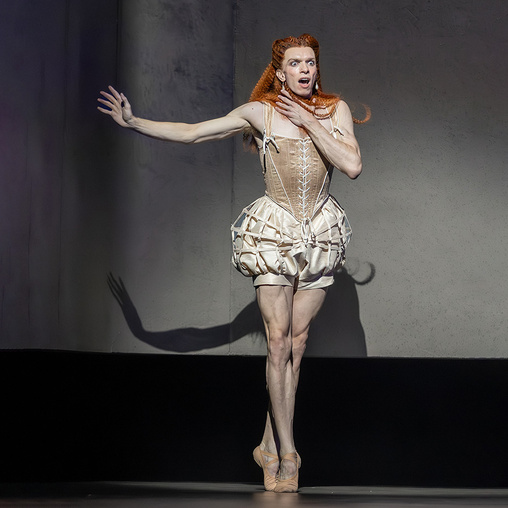
Britain’s "National Dance Awards" are eagerly awaited every year. While it is impossible to list the winners in every category, it is notable that several recipients are well known to tanz readers. Among them is the London City Ballet, celebrated as "Best Independent Company" for the second consecutive time. The award for "Best Classical Choreography"—for Mary, Queen of Scots—also went to a work previously covered in our magazine: choreographer Sophie Laplane took home the honor, as did Roseanna Leney, recognized as the outstanding performer in this drama about the queen, produced by the Scottish Ballet. Conductor Maria Seletskaja was delighted to receive the award for "Outstanding Creative Contribution," while choreographer Wayne McGregor won the "Best Dance Film" accolade for On The Other Earth.
www.onedanceuk.org
Hanover
International Choreography Competition
A fortieth anniversary for a competition is quite an achievement. They pulled it off in Hanover: in June, the "International Choreography Competition" celebrated a milestone anniversary with a record-breaking prize purse. The final took place at the Theater am Aegi—featuring vastly different styles, approaches, and themes. A wonderfully diverse mix, which also clearly revealed the choreographers currently shaping the mindset of the next generation: Khan, Shechter, Pite, and Morau. There was a hint of disappointment when the results were announced: strong entries came away (almost) empty-handed—including Jack Bannerman and, above all, the only team incorporating "disability moves": Lesego Abigail Dihemo, Sbusiso Gumende, and Tebogo Lelaletse.
The main prize—the "Tanja Liedtke Award Choreography Hannover," endowed with €25,000—went to the pas de deux Arrival at the Edge by Jiani Wang and Weidi Feng (China), a piece that was as elegant as it was unpretentious; the duo also received the Theater Chemnitz production award. "The Ruth Schwieger Award," accompanied by €8,000, went to the exceptionally inventive team of Boris Orihuela and Jessica Castellón for Current Accounts, a work that plays with the surreal nature of everyday professional life. Ulm’s dance director also recognized the potential here: Annett Göhre awarded her production prize to the Spanish duo. Well done. Other entries, however, came across as calculated rather than artistically groundbreaking. Perhaps some fine-tuning can be done in the decade leading up to the fiftieth anniversary
Dorion Weickmann
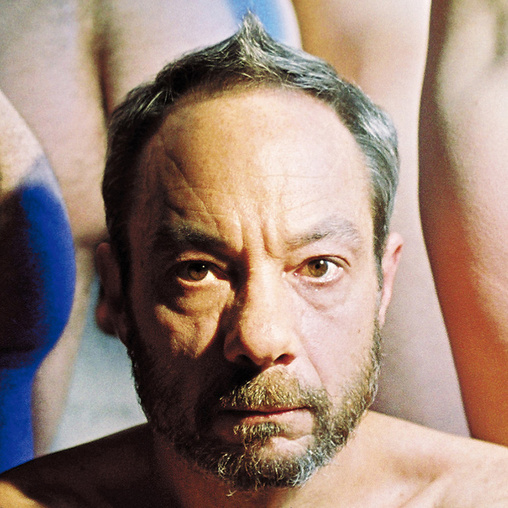
Daniel Léveillé; photo: Rolline Laporte
Farewell
Daniel Léveillé
Daniel Léveillé (1953–2026) was a leading figure in Canadian contemporary dance. A choreographer and teacher, he created nearly thirty works presented across Québec, Canada, and more than twenty-five countries. Trained with Groupe Nouvelle Aire under Martine Époque, he also danced for Françoise Sullivan before turning fully to choreography. From the late 1970s onward, his often raw and radical works explored solitude, desire, and the limits of the body. In 1991, he founded Daniel Léveillé Danse, directing it until 2018, and developed an aesthetic marked by nudity as a means of revealing human vulnerability. A professor at the Université du Québec à Montréal from 1988 to 2012, he shaped generations of artists. Awarded the Grand Prix de la danse de Montréal in 2017, he leaves a body of work that pressed the dancing body toward exhaustion, exposure, and a stark, unvarnished humanity.
Philip Szporer
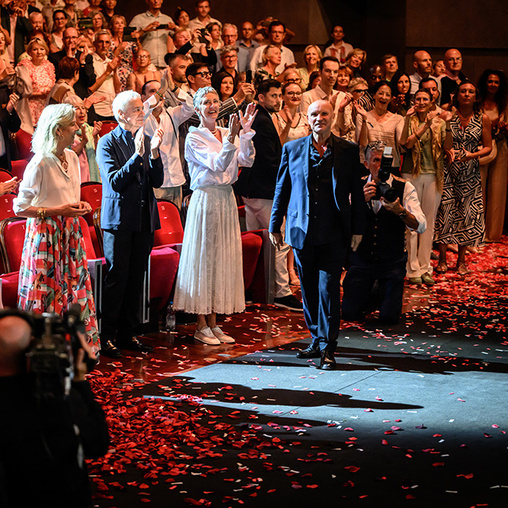
Photo and background: Alice Blangero
Gala Surprise
Ballets de Monte-Carlo
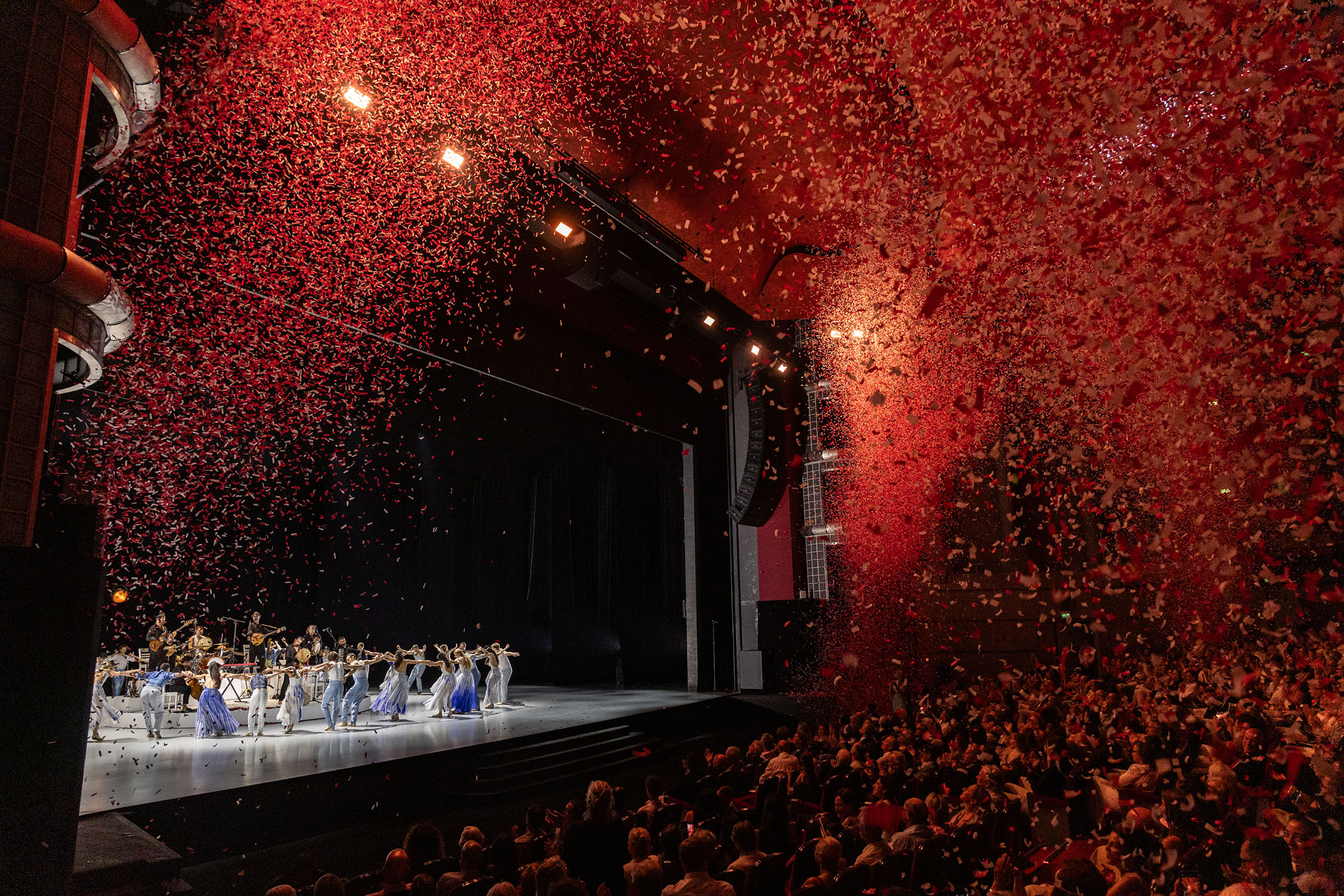
Not just any gala. Because the star of the evening was the company and thus, not least, Caroline, Princess of Hanover, who forty years ago founded Les Ballets de Monte-Carlo in rememberance of the Ballets Russes tradition. Eloquently, their director, Jean-Christophe Maillot, guided the audience through the well-composed, uninterrupted evening, which brought the past to life without ever losing sight of the ensemble's future. For example, one creation about Benjamin Britten, which Marco Goecke created in honor of the company’s founder. Seemingly an allusion to Uwe Scholz’s Jeunehomme—featured in the same program—it is in reality a deeply personal, highly sensitive message to the dedicatee, as if Goecke were trying to physically grasp her favorite music. Also featured: John Neumeier with Opus 100 – Für Maurice. Visibly moved, the Princess accepted the tributes, including a homage from her two daughters. And the Ballets de Monte-Carlo danced with tremendous power, joined at the end by many former company members. It was not only Neumeier who wished them another forty years.
Hartmut Regitz
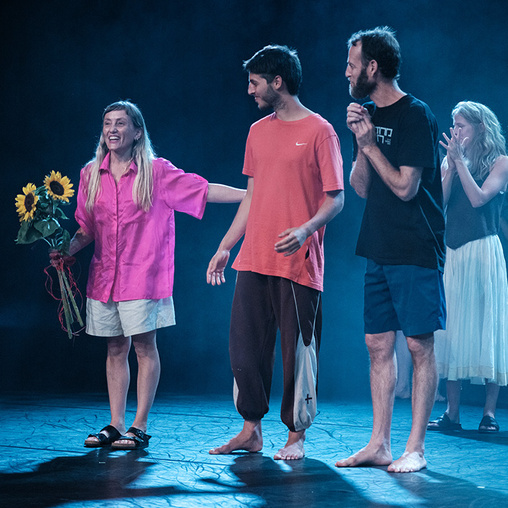
Olivia Court Mesa receiving Bern Dance Prize for Naked Men; photo: Marvin Mears
In Short
- Werner Schretzmeier, head of Theaterhaus Stuttgart, and Eric Gauthier, artistic director of Gauthier Dance, will receive the Civic Medal of the state capital of Stuttgart.
- Isaac Wright will become a Principal Dancer, Tene Ward a Second Soloist at the National Ballet of Canada.
- At the Hamburg Ballet, Charlotte Larzelere, Olivia Betteridge, and Louis Musin are being promoted to Principal Dancers, while Callum Linnane joins the ensemble as a Principal Dancer.
- At the Semperoper Ballett, Elena Karpuhina is advancing to Principal Dancer; Soomin Kim, Nastazia Philippou, and Kristóf Kovács are becoming Demi-Soloists; Johannes Goldbach and Vincenzo Mola are being promoted to Coryphées.
- Principal dancer Valentino Zucchetti is leaving the Royal Ballet after 16 years to focus on his career as a choreographer.
- Meanwhile, “Kammertänzer” Flavio Salamanka has bid farewell to the Leipzig Ballet.
- Awards for: Anastasia Kobekina and Sasha Waltz (“Opus Klassik” in the “Innovative Concert of the Year” category for Bach Cello Dance), Olivia Court Mesa (“Bern Dance Prize” for Naked Men), Jason Reilly (“John Cranko Medal”), Sophie Burke (“Karlsruhe Dance Prize”), Nancy Osbaldeston and Erik Kim (“Dance Prize of the Friends of the Zurich Ballet”), Leroy Mokgatle (“Daphne Prize” from TheaterGemeinde Berlin), Thomas Krähenbühl (“Golden CISA Premium Award” from Theaterfreunde Augsburg), Guillem Rojo i Gallego (“Professor Balzert Prize” for digital and analog choreography).