Close-Up
Fearless
Requiem for a resistance fighter: Lillian Stillwell choreographs Jeanne d’Arc at the Theater Münster
She was a peasant girl from the village of Domrémy-la-Pucelle near Orléans in Lorraine. Even as a child, Joan of Arc (1412–1431) is said to have had visions of the Archangel Michael, who commanded her to liberate the city of Orléans from its occupiers. The Hundred Years' War (1337–1453) was raging between England and France. At just 17 years old, Joan of Arc led the French camp as standard-bearer. With her enthusiasm she actually succeeded in liberating the city. After the triumph, Dauphin Charles VII was crowned in Reims Cathedral. The new ruler also owed his nickname "le Victorieux" to the resistance fighter. However, the Maid of Orléans, a victim of intrigues by the Catholic Church, was burned at the stake in Rouen as a witch two years later. The Church later rehabilitated the national heroine; in 1909 Pope Pius X beatified her and in 1920 Benedict XV canonized her.
Today, Joan of Arc is considered not only a visionary resistance fighter, but also an early feminist icon. Lillian Stillwell, dance director and chief choreographer at Theater Münster, has long been fascinated by the historical figure. With the work Jeanne d’Arc, simply titled "Dance Evening", she has dedicated a magnificent total work of art to the title heroine and her legacy. "The temple above the Oracle of Delphi bears the inscription 'Gnothi seauton' — 'Know thyself.' The poet Pindar said: 'Become who you are.' These are radical ideas. Joan of Arc lived them," Stillwell says of the heroine in an interview. She trusted her voices and followed them. The choreographer: "She saw the future. She led soldiers to victory, won the throne for a king, and her country was united." What particularly impressed her: "When Joan of Arc was on trial as a political prisoner two years later, she refused a lawyer and spoke for herself. She preferred death to a life in prison, separated from her voices."
The American, who has been in Westphalia since the 2022/23 season, has transformed the city of Münster into an inspiring dance destination with her idiosyncratic, interdisciplinary art — one that, incidentally, is also committed to sustainability. After her dance career in the United States, she realized experimental productions across Europe as a freelance choreographer, incorporating various art forms, including musicals and revues. This is where she now continues. When Stillwell concludes her foreword in the Münster program booklets with "Enjoy the Show!", it’s a commitment. The "show" lasts only an hour, but the evening is so dense that it feels considerably longer.
Powerful Formations, Dynamic Architecture
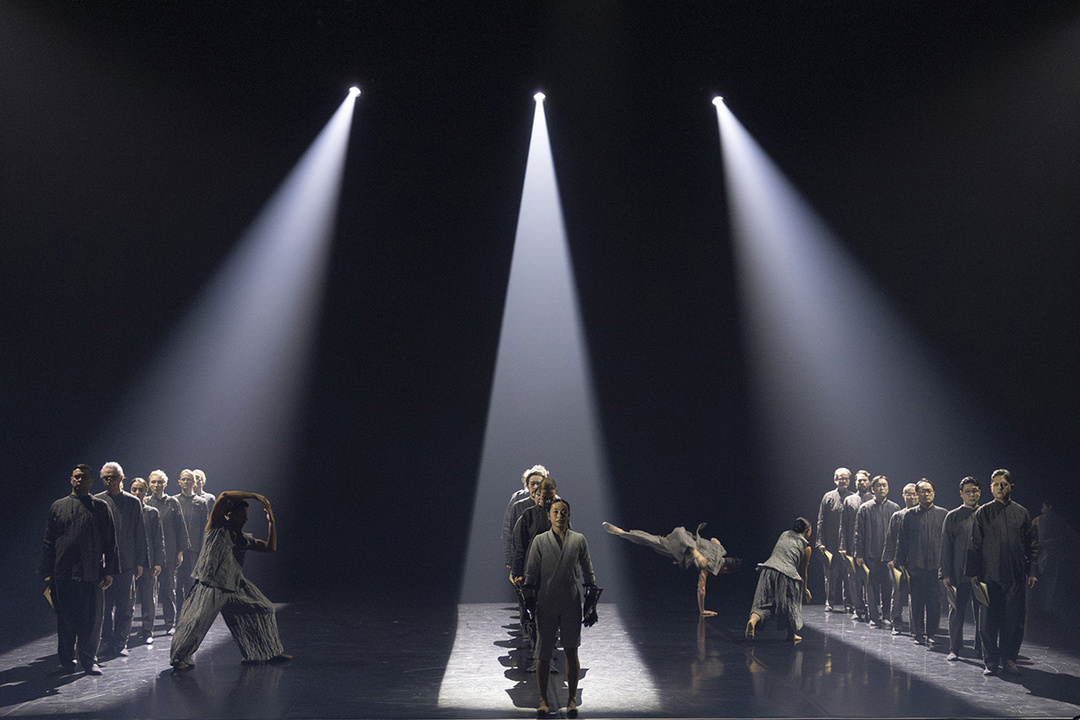
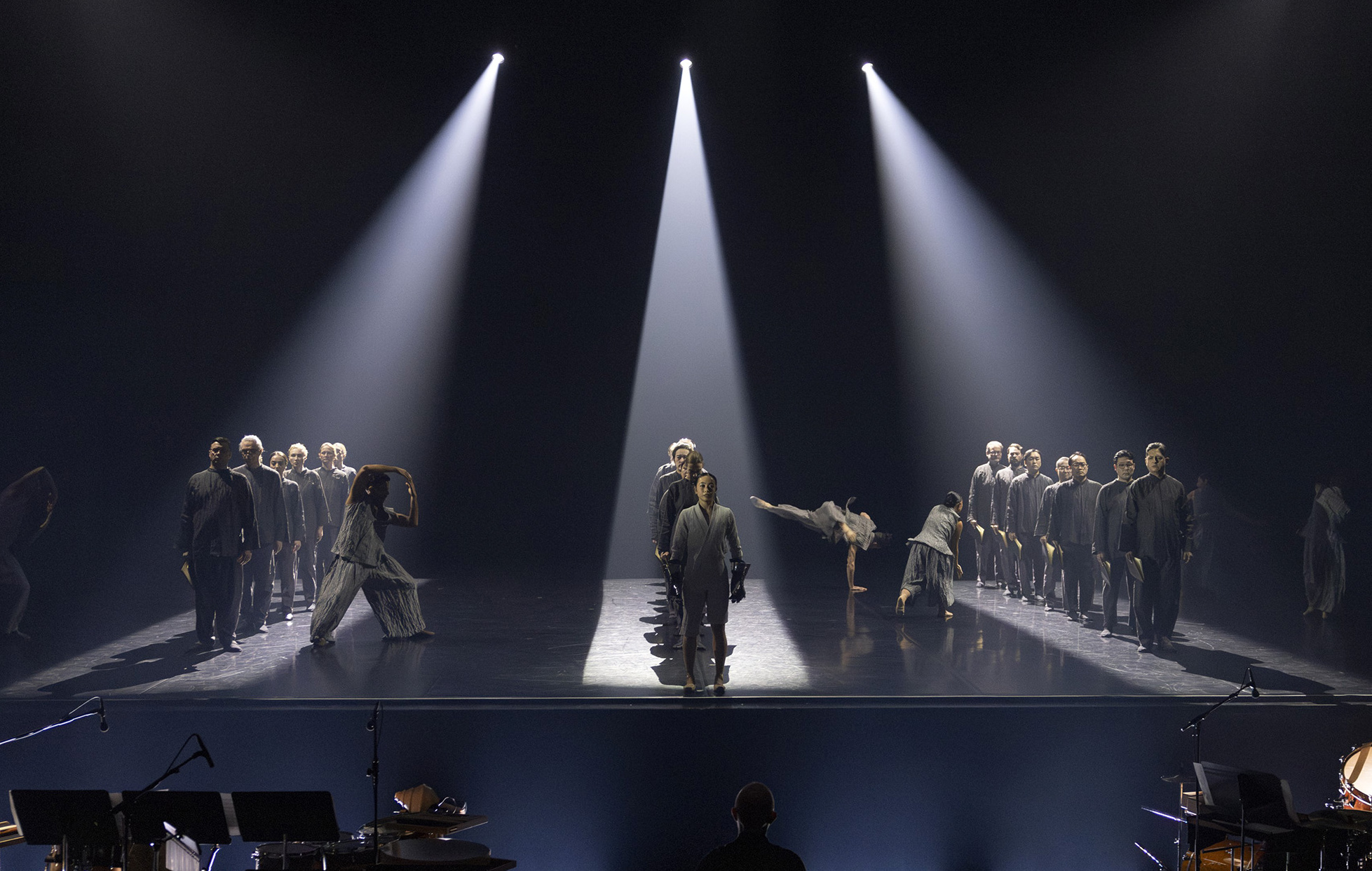
The opening scene is captivating — one feels transported into the atmosphere of Umberto Eco's novel The Name of the Rose. Dark figures gradually enter the mystical, fog-shrouded stage. Singing, they form formations. "L'homme armé doibt on doubter" — "The armed man must be feared" — they warn in the martial French chanson from the 15th century. Ghostlike, the singers appear in their simple, anthracite-colored robes that look like abstract monk's habits. Indeed, they are the visionary voices of Joan of Arc. "Voices" is also the title of the first of three scenes. Stillwell has chosen two extraordinary ensembles. The already visually impressive opera chorus, which sings exclusively a cappella, simultaneously represents the stage design. The piece generally relies on reduction to focus on movement, sound, light, and acting. In constantly changing, powerful formations, the choir fills the space like a moving architectural structure. Conducted by choir director Anton Tremmel from the orchestra pit, it interacts with the dance and the original percussion of the Münster Symphony Orchestra: a deep, powerful skin drum, a conch shell, and two pairs of clapping hands. The star of the evening: the young percussionist Relmu Levalle Campusano.
Like a wall, the mixed sound corpus moves toward the audience, only to reveal a dancer on the floor as she steps backward in the center: the Maid of Orléans, cross-legged, wrapped in a light, martial-arts-inspired jacket. The delicate Maid rises. She dances on pointe in a predominantly classical style, initially hesitantly, then with increasing virtuosity, through the sound world of Beat Furrer's a cappella compositions Enigma I–IV to prophetic texts by Leonardo da Vinci. The notes reach a sharp high pitch — Joan covers her ears.
Percussion as Partner and Antagonist
It is the powerful voices, rising again and again in a variety of timbres, that admonish, urge, and prophesy dire omens. "Courage" is the theme of the second part. And although she is surrounded by a touch of otherworldly aura, the youthful heroine remains rather colorless. This isn't necessarily due to Valerie Yeo. Rather, it's due to the fact that the rarely concise choreography is embedded in a convincing, complex overall concept consisting of this wonderful a cappella choir, inspiring light art, and the simply overwhelming percussion. Lillian Stillwell has brilliantly brought these art forms together.
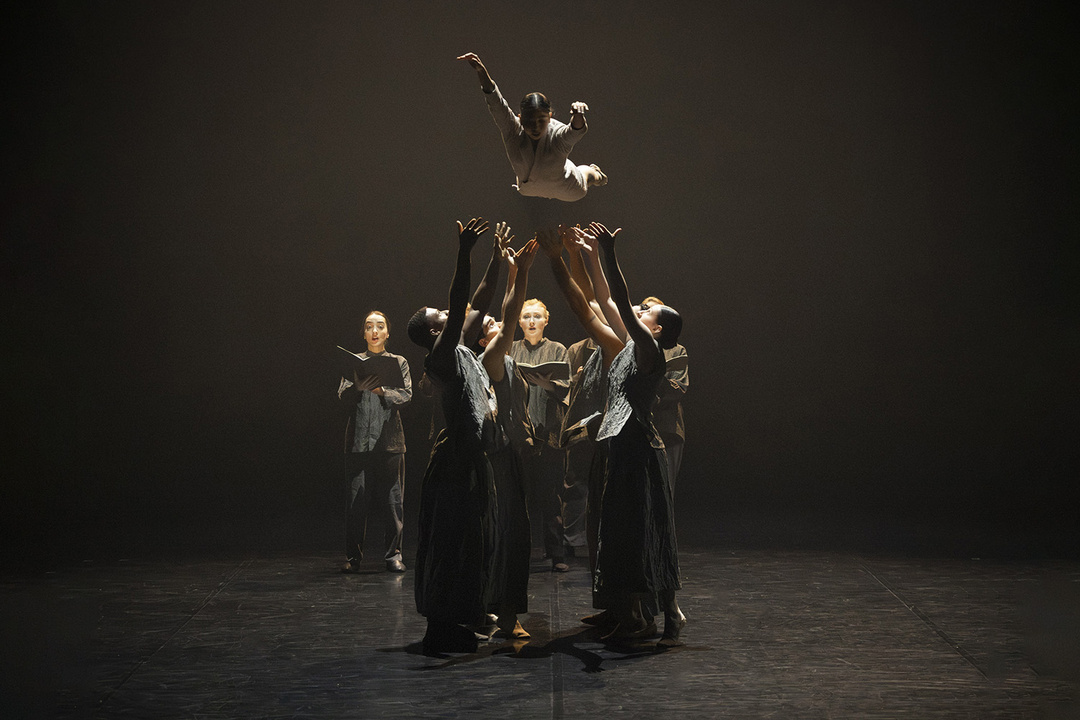
The story of Joan of Arc is hinted at in powerful images: the girl beneath a dome of light heralds enlightenment, iron gloves refer to the fighter in battle, and burning torches herald the funeral pyre. In one special moment, Joan of Arc, eyes closed, head held high, enjoys Steve Reich's Clapping Music for two pairs of clapping hands — a rhythmic, acoustic experience. Then she wrestles with herself, dancing with a small ensemble in a vocabulary that integrates ballet and martial arts. This is where Stillwell touches on the revue; this is where her choreographic strength lies. In an enchanted forest of lilac and white beams of light (Marco Vitale) placed across the stage, she appears to be going into battle with the ensemble. Shortly afterwards, the betrayed warrior is seen leaving the stage with three abstract tree trunks on her back. A magnificent percussion solo (Variations on Fuga C II by Peter Sadlo) accompanies the scene.
The young musician Relmu Levalle Campusano captivates the audience with his drumming artistry. On a deep, large skin drum, he drives Jeanne forward, aggressively and loudly, with powerful rolls and hard beats. Levalle Campusano has previously demonstrated his mastery of the quiet, delicate beats. The percussion is Joan's source of strength, a partner, but also, in her darkest moments, an antagonist.
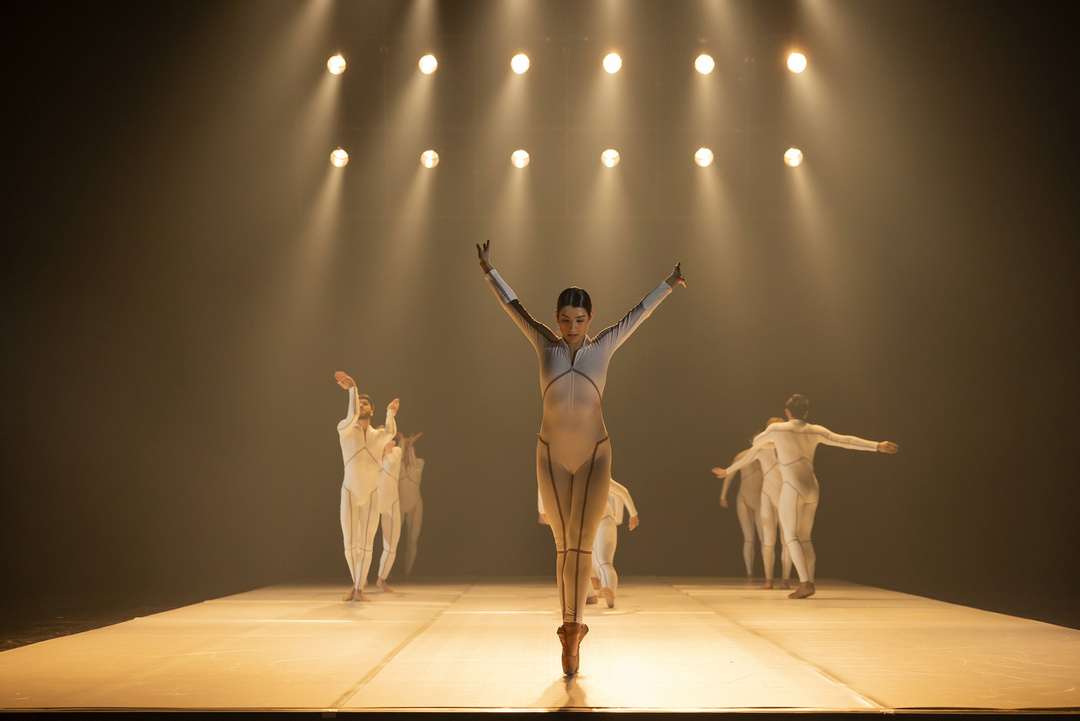
The final scene "Future" leads into a clinically white world. Here, a group of ten dances almost robotically in white full-body suits. Lillian Stillwell calls her finale "algorithmic choreography." She carries her heroine's legacy into the technological world. It is an attempt, as Lillian Stillwell says, to imagine an oracle in an inorganic world. Ports de bras, turns, balances — nothing touches. Here, too, it is the percussionists Thomas Korschildgen and Campusano who captivate the audience with drum and conch. Even in the wildest whirl, the latter maintains contact with the stage by looking over his shoulder. The choral singing is reminiscent of a requiem, first enigmatic, then sweetly comforting — David Lang's again (after ecclesiastes). The stage fills. Standing out from the crowd, a male and a female dancer offer hope. They wear iron gloves. What does the Maid of Orléans have to say to us today? Lillian Stillwell: "Be fearless. One life can change the world. Or in the words of the ancients: 'Know thyself. Become who you are.'"
Again on 3, 16 April and 10 May;
www.theater-muenster.com