
At A Glance
Side Steps
Adriano Bolognino, Glitzer in Hamburg, historical selfies – and more

Photo: Francesco Aurisicchio
Newcomer
Adriano Bolognino
Instinctive, abstract, rhythmic, painterly: the dance of Adriano Bolognino — the thirty-year-old Neapolitan choreographer who shot to fame on the Italian scene seven years ago — is the result of speed and discipline. Blessed with dramaturgical sensibility and a creative perfectionism, including a passion for fashion and colour, Bolognino has developed a significant body of work in a remarkably short space of time. Freelance by choice, counter to the general trend for choreographers to found their own companies, he collaborates on a project basis with leading companies and dancers, and is supported by Orsolina28 Art Foundation and Körper/Centro di Produzione Nazionale della Danza, Naples.
After his early accolades and awards, Marie Chouinard invited him to choreograph for the Venice Dance Biennale when she directed it in 2020. He then moved into the international circuit Aerowaves 21 with Gli amanti, a duet inspired by casts of figures unearthed at Pompei, entwined in an embrace rendered eternal by death. Then came works such as Come Neve, a ‘ritual’ duet conceived for non-conventional spaces; and Rua da Saudade, a colourful female quartet inspired by the poetry of Pessoa. As his projects have scaled up, so have the number of dancers involved: several bodies speak simultaneously in his painterly Yellow, commissioned by Eleonora Abbagnato for the Rome Opera Ballet; Skrik, inspired by The Scream by Edvard Munch, is for ten dancers of the MM Contemporary Dance Company, while La Duse is a piece for ten female performers, based on in-depth research into one of the most iconic actresses of all time, Eleonora Duse. In their bodies, Bolognino — supported by his partner, dancer Rosaria Di Maro — captures Duse’s poses and hand gestures, and particularly the emotional resonance produced by the actress’s talent for portraying pain, turning it into a rarefied, abstract, nuanced universal picture of the female experience. Bolognino has always been interested in that experience, but he also works with male dancers and tackles questions of gender, hinted at in Gli amanti. His recent projects include the sextet SAMIA, which uses micro-movements, fragmentation and emotional depth to translate a battle for freedom and quality into choreography; it’s inspired by the tragic story of Samia Yusuf Mar, the young Somali athlete who perished in the Mediterranean while attempting to reach Europe and pursue her Olympic dream. Last by not least is Bolognino’s sensitive relationship with music: he sees himself as a choreographer in which surprise moments, silences and pauses set the pace of the dance, and his latest choreographic series, Into us – bruciare, is dedicated to great musicians, starting with Chopin. His much awaited new 2026/2027 production, shortlisted for the prestigious Fedora – Van Cleef & Arpels Dance Prize 2025, will be dedicated to Ravel.
Maria Luisa Buzzi
Samia, Fribourg, I libri sulla scena, 4 April; Come Neve, Padua, Prospettiva Danza Teatro, 10 April; Gli amanti, Barletta, Italy, 16 May; www.bologninoadriano.com

Pansy St. Battie, Model and burlesque performer; photo: Xenia Curdova, © Pansy St. Battie
Pop Culture
Glittery and Colorful
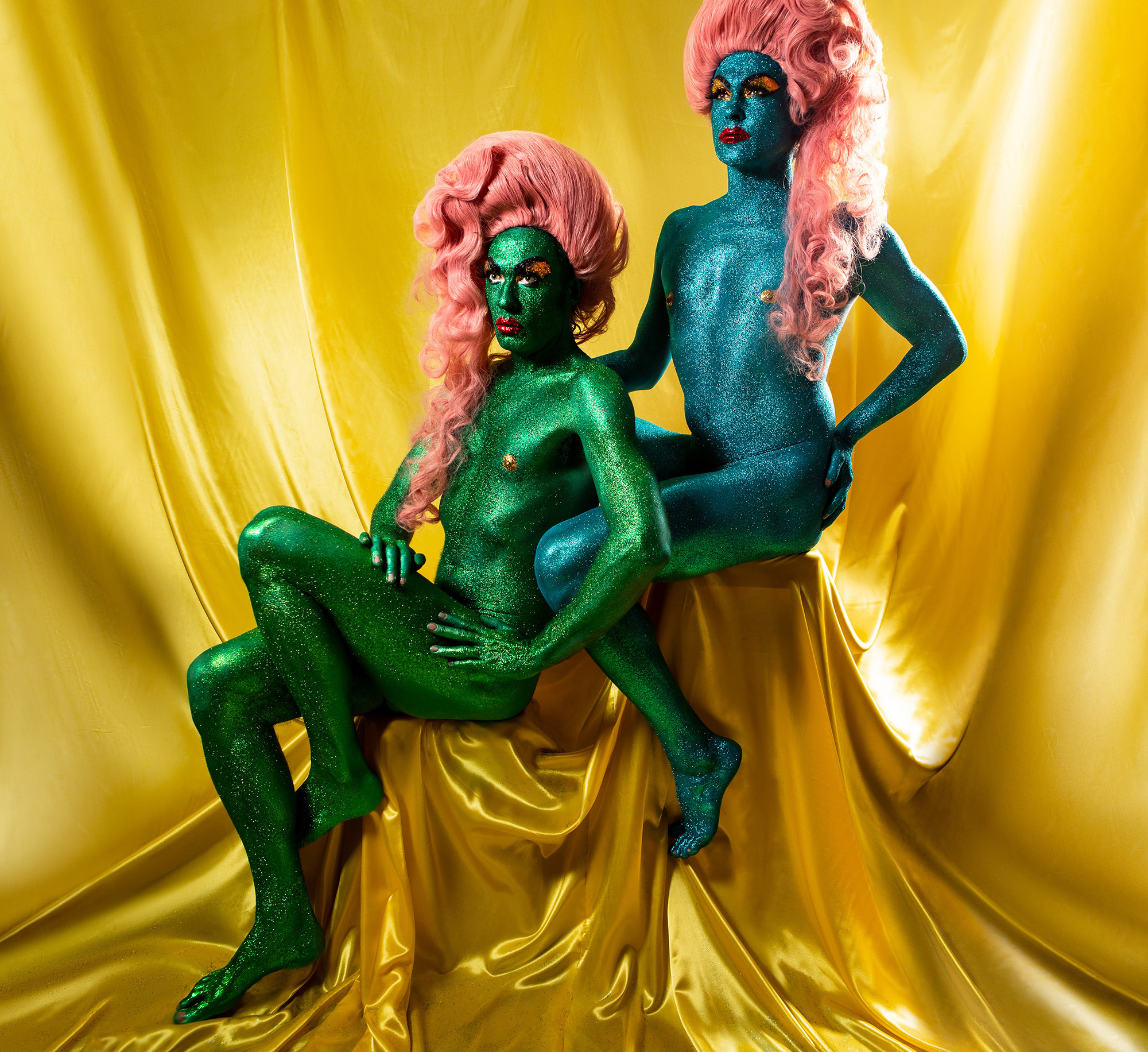
Tulga Beyerle seems a bit embarrassed after all. "Even though it's important to us to collect outstanding design and preserve it for posterity, we're also fascinated by design in forms that have social relevance," writes the director of the Hamburg Museum of Arts and Crafts. "Now, these don't always have the most elegant form." It sounds as if the topic has to be addressed because it's simply part of the story. But it's not something one likes to do, like inviting one's shabbily dressed and petty criminal cousin to Easter breakfast every year because he's part of the family. Enter Glitzer (glitter): a mixture of tiny, reflective plastic, glass, and metal particles, often mixed with paint. Industrially produced since 1934, today, as microplastics, it's an ecological problem. And as a material with feminine connotations, it's a chic way to break down binary gender boundaries.
The exhibition Glitzer at Beyerle's museum shows how glitter became part of pop culture, how the LGBTIQ movement empowered itself through glitter, how glitter became omnipresent from children's bedrooms to Hollywood, and how glitter developed protest potential with "glitterbombing". Xenia Curdova's photograph of model and burlesque performer Pansy St. Battie adorns the cover of the current print issue of tanz. It's a bit of a shame that the glitter aspect of dance and clubbing is only hinted at in the exhibition, but you can't have everything, and at least the otherwise extremely worthwhile exhibition tends to be limitless. It has already been announced that the charming robot vacuum cleaner installation Puff Out by the Turkish-Belgian collective :mentalKLINIK will be moving from Istanbul to Hamburg starting around 5 June.
Falk Schreiber
Until 26 October; www.mkg-hamburg.de

Historical Aesthetic / Multiple Digital Altetions; © Deutsches Tanzarchiv Köln
Historical Selfies
Dancing Ego
Hardly any dance citizen can get through life today without Instagram and TikTok: There's never been so much self-representation! Or has there? The Deutsches Tanzmuseum in Cologne has once again scanned the rich holdings of the archive, to which it is affiliated, for an interesting question: It's me is the title of the new annual exhibition which transforms the interplay of dance, photography, and film into a sensual adventure. Because Self-Drama in Dance, as the expanded title suggests, is of course anything but a new invention. The historical photo on the left, which was distorted by AI, testifies that posing in front of the camera and showing off one's best side has long been part of the inventory of the art of movement. Find out more from 1 May until the end of March 2026 in Cologne's Media Park at the Dance Museum's location.
Dorion Weickmann

Choreographer Charlotte Mclean; photo: Malin Lewis
In Short
- Sasha Waltz will receive the 2025 Helmut-Schmidt-Zukunftspreis, an award for cultural innovation and commitment to democracy. In addition to the choreographer, there is a second prominent award winner, the visual artist Ólafur Elíasson.
- The Queensland Ballet in Brisbane has a new director: Ivan Gil-Ortega, long-time principal dancer with the Stuttgart Ballet, has taken over as company director.
- Frédéric Olivieri, already director of the renowned academy, is now also taking over as director of La Scala Ballet in Milan. His predecessor, Manuel Legris, apparently left the company on somewhat unfriendly terms, and star ballerino Roberto Bolle is expected to take over the leadership position in the foreseeable future.
- Charlotte Mclean received a Future Award from the British Arts Foundation. The choreographer explores queer aspects of Scottish Highland dance.
- David Dawson is the new resident choreographer of the National Ballet of Canada.
- Heide-Marie Härtel, founder and director of Deutsches Tanzfilminstitut Bremen, has been awarded the Order of Merit for her services to archiving and promoting the art of dance.
Background photo: The Huxleys, Places of Worship, 2021 © The Huxleys