
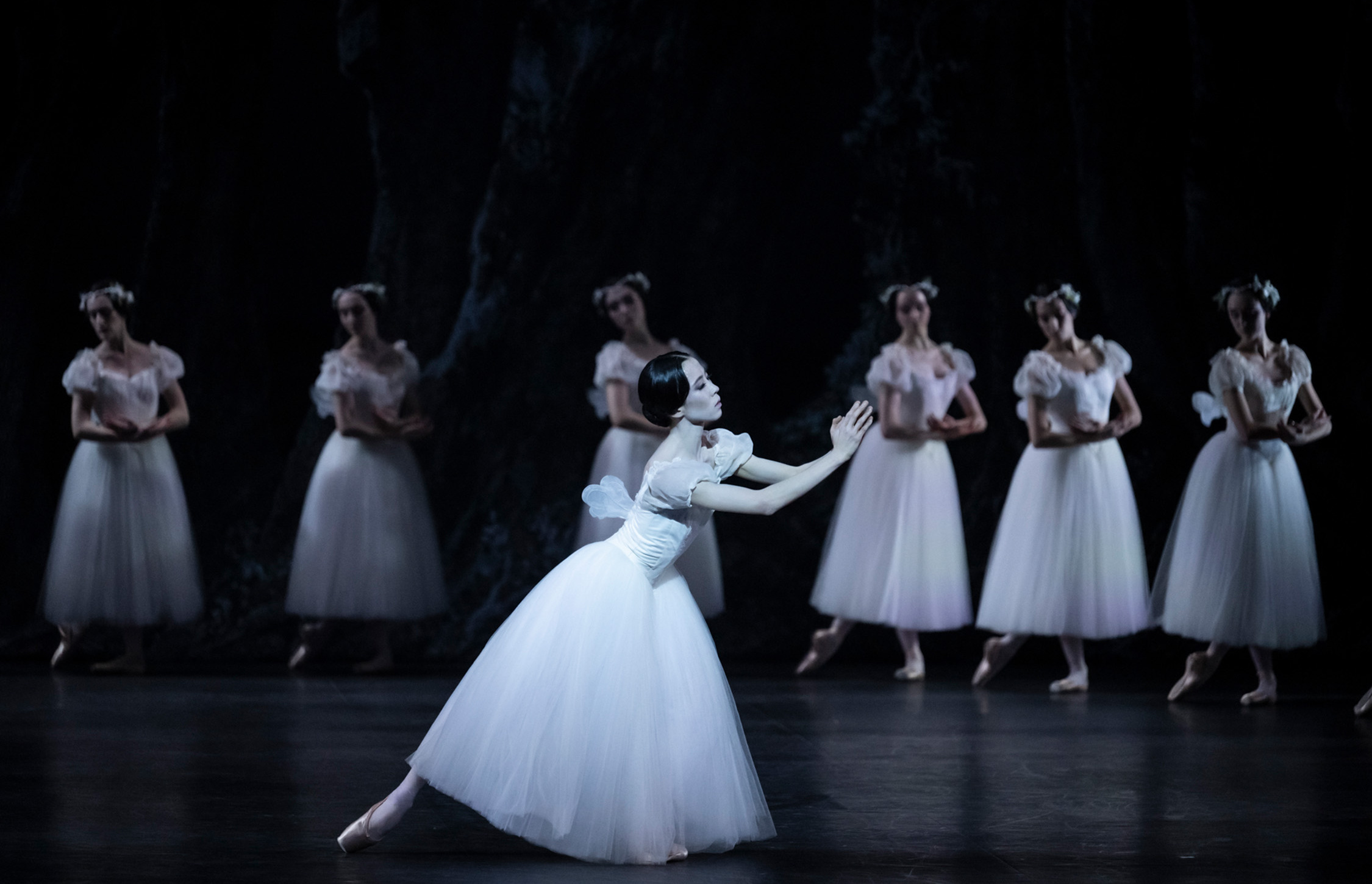
In South Korea, people agree on many things. For example, when the novelist Han Kang received the Nobel Prize for Literature in the fall. All of her novels were sold out in an instant and the university where she studied appointed the writer who was suddenly in the spotlight an honorary professor. The hype is reminiscent of the hype that surrounded the ballerina Sae Eun Park when she was named Danseuse étoile at the Paris Opéra in 2021. As the first Asian to reach the zenith of the ballet firmament, she became a symbol of a turning point at the Opéra: she was also the first star in this sky without a European genealogy. Park wrote dance history, although she actually only wanted to advance her own. This history, however, is also taking on increasingly significant forms, for example as Park grows into a kind of ambassadorial role between Paris and Seoul. In July 2024, she personally curated a gala program with six Parisian étoiles at the Seoul Arts Center, including a duo that she danced herself with Guillaume Diop, the first black Danseur étoile. He had received his doctorate exactly one year earlier, on the stage of the LG Arts Center in Seoul!
With foresight, Park says she wants to return to her homeland at some point. This is not unusual, because deep down all Koreans who settle in Europe miss the feeling of home and a lived cultural community. But before that, Park explained in 2021, she wants to leave her mark and become a ballerina who will be remembered in Paris even after her career. In Seoul, the newly crowned ballerina had to give "five or six interviews a day for two weeks, until I was completely exhausted," she said after her return to the Seine. Life as a national heroine can be so exhausting!
Nutcracker as a Door Opener
But how did she even get to Paris, to the Opéra and finally to the flowers and tears of emotion that are simply part of being crowned Étoile? Originally, she did not seem destined for a great career in tutus and pointe shoes. "I only started when I was nine, so quite late," she remembers. On the other hand, her connection to classical music was almost predetermined: "My mother is a piano teacher and my father is a great lover of classical music. So I grew up in a very musical environment." And a little kitsch is allowed: "One December day, my father took me to a performance of the Nutcracker. It was my first ballet, and I was fascinated by the costumes and the tiaras." So overwhelmed, she naturally wanted to become a dancer! After all, her parents were not averse to classical music. That's how little Sae Eun got her first ballet lessons. Not just anywhere, but at the Korean National Ballet School. She attended schools that promote artistic talent and completed her senior year at Seoul Arts High School. She then went to the famous Korea National University of Arts, or K-Arts for short. A national symbol that founded the K-wave that is now sweeping all over the world: K-pop, K-food, K-drama ...
K-Ballet is not yet an official term (it is actually the name of a Japanese company), but the Korean potential is considerable. Sae Eun Park won the Prix de Lausanne in 2007 and was subsequently engaged for two years in the junior company of the American Ballet Theatre. After returning home, she naturally joined Korea's national ballet, where she was named the youngest soloist of all time in 2009. She won the ballet competition in Varna in 2010 almost in passing.
Her partner at the National Ballet was Korea's then-outshining international ballet icon, superstar Kimin Kim who moved to the Mariinsky in St. Petersburg in 2012, where he was the first non-Russian to be appointed principal dancer. The path to Russia was actually more logical, as the training in Seoul follows the strict rules of the Vaganova School. "All the teachers who teach there are former stars of the Mariinsky, while in New York a mixture of many styles is danced and in Paris, of course, the French school is taught. But Vaganova is a good basis for adapting to all other styles," says Park. She reached the pinnacle of competitive culture when she won the Benois de la danse in Moscow in 2018, two years after Kim. Park is now 35 years old and Kim is only 32. Which in turn shows that she was a relatively late starter in the race.
Tough as Nails
For fourteen years, Park had not danced a single full-length piece in her homeland. Then came La Bayadère, with her as Nikiya. Once again. Like in 2010 at the Korean National Ballet, with Kimin Kim as soloist. The remake in October 2024: a special kind of reunion. He from Russia, she from Paris. The tickets were sold out within three minutes, as the Korean press reports. The couple also sent a strong signal that the world is a better place when you dance together instead of dropping bombs on your neighbors. And of course there is cultural solidarity. As she revealed in a press conference in Seoul in 2024, Park supplied Kim with Korean food in St. Petersburg when she performed there with the Paris ensemble.
That was in 2015. The piece: La Bayadère. She in the role of Nikiya, he in the audience. In the same year, Benjamin Millepied, then head of dance at the Opéra, brought Kimin Kim and his partner at the Mariinsky, Kristina Shapran, to the Seine as Solor and Nikiya. Park was sitting in the audience. So how could they have come together in Seoul in any other piece? It is almost a personal relationship, to the work and to each other: "As Nikiya, I don't have to pretend." She describes the character's characteristics as modesty, dignity and inner strength.
Park is hard as nails anyway. She repeatedly explains that her success is not based on a once-in-a-century talent, but on a will to succeed and meticulous work. These are characteristics that South Korean society has absorbed in recent decades and transformed into a culture of constant competition. Dance, cooking, influencer and other talent shows are extremely successful on South Korean TV today. The Netflix series Squid Game which has painted a disturbing picture of this merciless society is also making a significant contribution to the current boom.
Korea on the Seine
For Sae Eun Park, competition with others, but also with herself, is part of her DNA, even as an Étoile: "The greatest danger is to think that you are a star and have therefore reached your goal. Ballet is about constantly pushing yourself and working on your weaknesses," is her credo. She could have had a straightforward, automatically upwardly mobile career in Seoul. But she preferred to apply in London and Amsterdam, to English National Ballet and Het Nationale Ballet — when the door to the Paris Opéra opened at the same time. And Park was not above completing the open competition in 2011 with 150 candidates and starting again at the very bottom of the hierarchy, in the corps de ballet! After that, she quickly and steeply climbed the hierarchy, step by step and exam by exam. And on the side, she studied French grammar every morning. Paris had always been her dream.
Nevertheless, it’s a good thing when home remains a little present in everyday life. So Park moved to the 15th district, the stronghold of the Korean community. She loves the area: "It has the best Korean restaurant in Paris, and there is even a Korean bakery." Not to mention the supermarkets where you can get almost all the ingredients for K-food dishes. "That's important because I like to cook Korean food." She is married to a Korean man who moved to Paris as a child. The couple have had a little daughter of two years, so she has to be a mother in addition to her professional life. This was only possible because as an Étoile she is no longer required to take part in the Opéra's internal competitions in order to climb the next step on the complex career ladder. She also no longer has to share her dressing room with another dancer, as she did as a Première danseuse. "That promotes concentration and allows me to devote myself even more intensively to the characters." Like Odette/Odile in Nureyev's Swan Lake which has just been filmed in IMAX format for the cinema. What she still dreams of is dancing Giselle. Or contemporary, in pieces by Pina Bausch, William Forsythe or Crystal Pite. "You see, my interests are very wide-ranging," she says — as if she still had something to prove. Day after day, she demonstrates how a new, more colorful time has dawned for the ensemble at the Opéra under the direction of General Director Alexander Neef, who came to the Seine from Toronto in 2019.
To be seen as Tatiana in Cranko's Onegin (with Germain Louvet) on 24, 26, 28 February; as Aurora in Nureyev's Sleeping Beauty (with Paul Marque) on 2, 5, 8, 11 April; www.operadeparis.fr
Background photo: Giselle at l'Opéra National de Paris; © Julien Benhamou