
Deep Dive
Global Spotlights
Across Paris, Lagos, New York, Tokyo and Buenos Aires, dance reflects a season of political upheaval, social change and artistic transformation
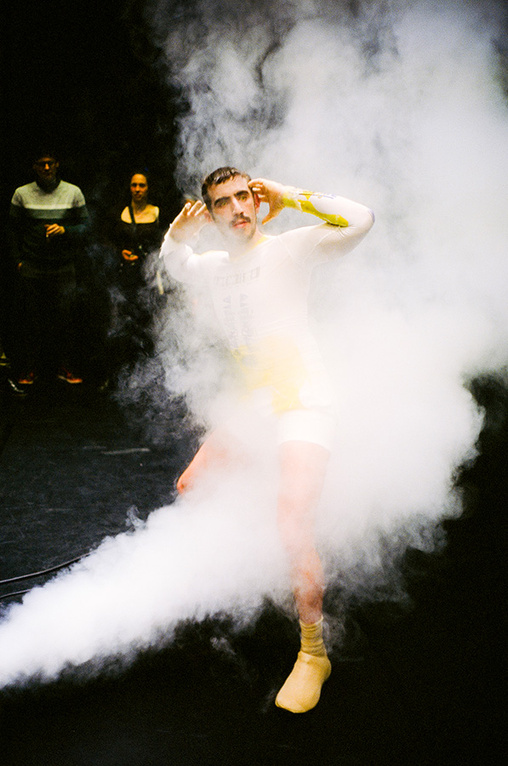
At Artdanthé: Juan Pablo Cámara in his choreography ?lat1n0, 2026; photo: Janek Kindel
Paris
A mayor deprives his city's theater of its livelihood. After protests, he changes course. What does this say about the former Grande Nation?
It was early June when alarm bells rang out across the cultural scene. The suburb of Vanves lies south of Paris, just a few metro stops from Montparnasse station. The small town is home to a theater that, for thirty years, has organized a festival with the complex name Artdanthé—a play on the words ”art”, ”danse”, and ”théâtre”. However, for a long time now, 90 percent of its programming has consisted of dance and performance art. Then, in early June, Mayor Bernard Gauducheau—freshly re-elected—prepared to
present the Théâtre de Vanves management with a fait accompli: the 2026/27 season for dance and theater was cancelled—though cinema and children's theater were exempt—and the municipal theater was expected to completely reinvent itself. Gauducheau did not announce his decision publicly; the news came to light only because the theater management had to inform the affected performance companies of the cancellation.
After all, this amounted to the most brutal and radical blow dealt to French art and culture to date. Yet Gauducheau—who was re-elected with 54.5 percent of the vote in the first round—does not even belong to the Rassemblement National (RN), a party with little affinity for culture; instead, he is a member of the center-right UDI, which is aligned with President Emmanuel Macron. Presidential elections are now scheduled for 2027. What would an RN victory mean for culture if a center-right mayor—in office since 2001 and a long-time supporter of the theater and, by extension, the Artdanthé festival—suddenly moves to slash funding so drastically? A storm of protest erupted within France’s cultural community; Gauducheau subsequently backed down, though he hinted that a postponement did not mean the plan had been abandoned.
Of course, Gauducheau is neither the first nor the only politician in France looking to leave artists high and dry. The Le Channel theater in Calais is also facing a spending freeze and the cancellation of its program for at least six months. It is quite possible that others will follow suit. Theoretically, Le Channel—operating as a "Scène nationale"—could ask the Ministry of Culture in Paris for a financial injection, but new cuts are constantly being announced there as well. This plays right into the hands of those who consider culture dispensable anyway. And what does it mean for Europe if France—once a proud Grande Nation with grand cultural ambitions—curtails, slashes, and penny-pinches away at that very culture?
After all, Vanves is no mere dim speck in the brilliant firmament of dance. For three decades, the Artdanthé festival has served as a seismograph and a champion—above all—of the future of dance. It has nurtured the nascent careers of major figures such as Boris Charmatz and Emmanuel Eggermont—formerly a star dancer for Raimund Hoghe and now one of the country’s most compelling choreographers. Anyone who believes they can erect barriers at the political center simply by mimicking the far-right’s skepticism toward culture—and acting accordingly—will reap a storm surge. The protests surrounding the announced downsizing of the theater in Vanves have made this abundantly clear.
Thomas Hahn
Continue reading with the DIGITAL MONTHLY SUBSCRIPTION to tanz – international edition

- Access all articles of tanz – international edition instantly online
- Optimized reading experience on all devices
- Full access to the complete online archive