
Mixed Media
CDs, Books, Streaming ...
CD of the Month
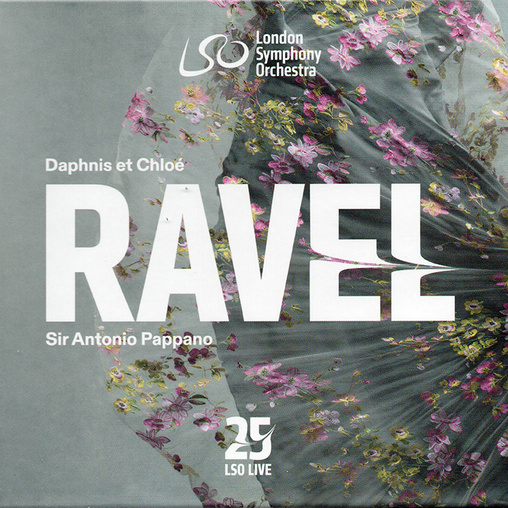
Daphnis et Chloé
Every note is perfectly placed, yet the sound seems to melt away. Especially when you realize how meticulously Maurice Ravel worked on the details of his composition, "drop by drop," as he himself put it, you are continually fascinated by how his musical watercolor unfolds so naturally as you listen. There is nothing superfluously colorful, no added splashes of color. Although constructed symphonically, "according to a very strict plan and using a small number of motifs," the Greece of Ravel's dreams seems to emerge as if by itself: not an island of the blessed, but nevertheless a piece of ecstatic, indeed divine nature. It is not for nothing that Pan plays a crucial role in the ballet Daphnis et Chloé.
Originally created in 1911/12 as a one-hour choral symphony commissioned by the Ballets Russes, the work has since become an indispensable part of the concert hall: a challenge not only for the orchestra, but also for the participating choir which is intended to imbue the instrumental sound with something transcendent. On this CD, Sir Antonio Pappano conducts the London Symphony Orchestra and the vocal ensemble Tenebrae. The result is a soundscape so atmospheric, visually powerful, and at the same time sensitive in its instrumental details that one hardly misses the dance.
Hartmut Regitz
Maurice Ravel: Daphnis et Chloé, London Symphony Orchestra, conductor: Antonio Pappano;
www.lso.co.uk

Photo: Estelle Hanania
Photo Book
This Causes Consciousness to Fracture
The photo book This Causes Consciousness to Fracture by choreographer Gisèle Vienne and photographer Estelle Hanania is as large as a record sleeve; With the panels unfolded, it takes up to one meter of space. Two, three, or four photographs next to each other create their own rhythm and pull. Relationships emerge from image to image: staggering bodies. Young people celebrating. A stationary car. Disturbed earth. Garbage. Fallen bodies. Connectivity within a group. But also loneliness.
While the book uses images from pieces like Crowd and Extra Life, it combines them into a standalone visual narrative. The alternation between long shots and details and the work with colored light create new sequences. Some scenes appear painterly, illuminated in the style of the old masters, almost creating still lifes. Abundance alternates with emptiness, elated energy with periods of exhaustion.
The anger of young adults who face challenges in the struggle for separation as well as in the search for belonging has long been Vienne's theme. As a visual artist, she recently staged youth culture scenes with dolls in two exhibitions in Berlin. The photo book is another impressive format for continuing the story.
Katrin Bettina Müller
Gisèle Vienne, Estelle Hanania, Elsa Dorlin: This Causes Consciousness to Fracture;
www.spectorbooks.com
Clip of the Month I
Queen Blood
The Afro-House performance Queen Blood was one of the last productions by dancer and choreographer Ousmane Sy, aka Baba or Babson. Born in Paris in 1975, his roots stretched back to Mali. His career began on the streets: in football and urban dance. Sy won four times in the hip-hop category at the "Juste Debout" competition and launched a sensational career: From 2019, he was co-director of the Centre chorégraphique national de Rennes et de Bretagne as part of the FAIR-E collective. But one year later, he died, suddenly and unexpectedly.
The ARTE media library features the finale of the performance, which the ensemble Paradox-Sal, founded by Sy in 2012, presented in 2021 in memory of their mentor: Queen Blood, featuring seven powerful women, all battle winners. Sy lets them shine with house music, and the dancers' interplay recalls this origin, because house works as an exchange and togetherness: Sometimes the style of a dancer shines (in addition to Afro House, krump, dancehall, popping, and locking are represented), sometimes the power of the group captivates. Over the music, you can hear the dancers cheering each other on. Originally shown live at the Orfèvrerie in Saint-Denis, even the recording is brimming with the shared energy. Eleven minutes — perfect for the start of spring.
Mascha Wilzopolski
Clip of the Month II
Bittersuite
Hand in hand, in a long chain, the dancers battle a wind machine, thus drawing us into the Museum Voorlinden near The Hague. Clean exhibition spaces, paintings, and sculptures form the backdrop for the latest creation by Sergio Reis and his CDK Company. Known for commercials for Gap and Calvin Klein, and music videos for Troye Sivan and BTS, Reis also produces stylish clips independently. Most recently, the video for Gotye's Somebody That I Used To Know was a hit, and now it's Billie Eilish's turn with her song Bittersuite. And this clip, too, has viral potential: In pastel sweaters and 1960s-style pageboy haircuts, the dancers give vent to their inner turmoil. After lightning-fast, then suddenly bubblegum-like movements at the beginning, the moves subsequently mutate into puppet-like motions. A museum-worthy masterpiece!
Johanna Rau

Novel
Der Ewige Tanz
Anita Berber: an excessive, even ecstatic existence, into which only a novelist can breathe that almost casual closeness that creates a connection with the protagonist. Steffen Schroeder, an actor with a Claus Peymann past, tells the brief biography of Anita Berber from her deathbed in Der Ewige Tanz. Born in 1899, the scandalous "nude dancer" of the Weimar Republic died in 1928 — diagnosed with "galloping pulmonary consumption". Her star was already on the decline when she collapsed during a performance in Damascus. She ended up in the Bethanien Hospital in Berlin, which today operates as an artists' residence. The Berber, whom Otto Dix immortalized with a kissing mouth in luscious red in 1925, was just that: an artist from head to toe — and at the same time a person full of dreams, longing, and emotion.
Schroeder effortlessly performs this psychological balancing act because he ties together the loose ends of this existence. He connects her childhood with her grandmother in Dresden with the deathbed, where the moribund woman receives her final caresses from a nurse: "She doesn't have to do that. No one else does that. But this small touch gives an astonishing amount of strength." Schroeder has written a great, tender book, set against the backdrop of a torn era.
Dorion Weickmann
Steffen Schroeder: Der Ewige Tanz, Rowohlt, Berlin 2025;
Film still
Cinema
Aeon Oz
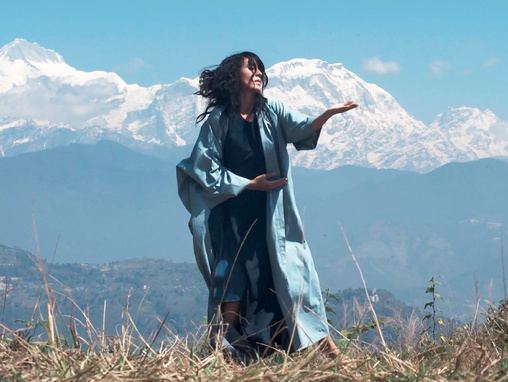
The world is pretty much out of joint, we all know it. Letting yourself be carried away on the wings of imagination for an hour is like a small escape. And yet it's a great comfort. Aeon Oz by Heinz Kasper doesn't come across as a spectacular event, yet it develops an irresistible pull within the first few minutes. A tribe around a campfire, then a woman in a red dress dances through the desert — anyone who loves Dune and Timothée Chalamet will be amazed.
For Juana del Mar Jiménez Infante, dancer and choreographer, merges with the sand, the wind, the sun, as if she were a daughter of nature. But at the same time, her body resists, never allowing itself to be absorbed by the elemental power of the landscape, gigantic rock formations, meandering waterways, dark forests, or Far Eastern temple architecture. In twelve chapters, twelve stations, the film tells of the magic of dance between primal force and embrace, meditation and passion — without a single word. A minimalist soundtrack accompanies the dancer around the world, from Kathmandu in Nepal to Colombia, orchestrating her expressive swings as well as the gentle waves into which her silhouette occasionally seems to dissolve.
Towards the end, her voice rings out, reciting a mantra: "We are here to grow, this is the right place to unfold and express ourselves ... No borders, just freedom, ready for transformation and unity." Viewed in the light of the present: too good to be true. And yet, Aeon Oz has a cathartic effect. Because the images block out all transience and immerse one in a flow of existence that knows no beginning and no end. The camera transforms it into a total work of art, which has not been honored with numerous awards for nothing.
World Dance Day on 29 April is usually more of an insider event. This year, however, Aeon Oz is coming to movie theaters and transcends the usual framework: a tribute to life, to planet Earth, and to the art that never stands still. A high mass for all those who enjoy breathing in transcendent flows. All the rest will fall under the spell of beauty and no longer sing the blues. For sixty minutes.
Dorion Weickmann
www.aeonoz.com
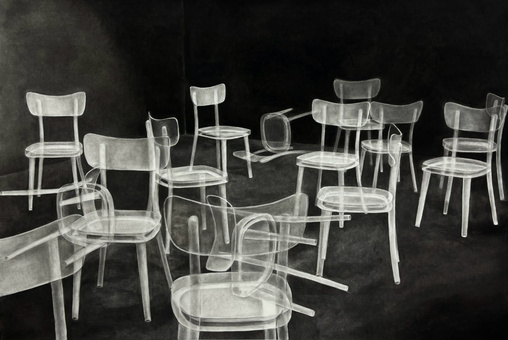
Drawing and background: Spontane Phänomene II by Saioa Fischer Abaigar
Exhibition
Proberaum Pina
Pina Bausch would have turned 85 on 27 July. This is an opportunity to finally honor the dance theater visionary in her hometown: Until the end of the month, the Solingen Art Museum is presenting the exhibition Proberaum Pina. Bausch's radical understanding of art is also reflected in the curatorial approach: It's not just about the mere presentation of Bausch artifacts; Proberaum Pina is an interactive approach to the choreographer's work which only takes shape in the moment of presentation.
Over 30 students from the Cologne Kunsthochschule für Medien are interpreting Bausch's legacy here. Together with the Tanztheater Wuppertal Pina Bausch, its stage design and costume archive, and the Pina Bausch Archive, they are creating works of art that span the entire spectrum from painting to sculpture and video to performance, as an "interplay of artistic forms, space, and movement". And: urban space, one might add. Bausch grew up in Solingen as the daughter of an innkeeper, and she remained connected to the region throughout her life. This influence is also reflected in her art: "Some of the things I experienced as a child can be found much later on the stage," she is quoted as saying on a commemorative plaque at the former Café Müller in the city center.
Falk Schreiber
Until 25 April;
www.kunstmuseum-solingen.de