
Close-Up
Labyrinth
The Dresden Frankfurt Dance Company turns A Land Within into a philosophical reflection at the Festspielhaus Hellerau
In the beginning was the word. One could also phrase it this way for A Land Within, only here the word is the basis of creation. The artistic director of the Dresden Frankfurt Dance Company, Ioannis Mandafounis, met the French philosopher Maxime Rovère some time ago. While he was fascinated by Rovère's books, the personal, spontaneous exchange with Rovère was even more inspiring. By then, the idea of creating a "promenade performance" for his company had already taken root in his mind. There would be various stations that the audience could freely move through, where they could linger, watch, reflect, or simply drift along. All that was missing was a theme. And that, in essence, was provided to Mandafounis by his own company. Since taking over leadership of the ensemble for the 2023/24 season, Mandafounis has worked continuously to develop it. He dedicates this work primarily to artistic empowerment, enabling the dancers to achieve fundamental creative independence. However, this doesn't work for everyone. Mandafounis has by now assembled a group with whom he says he can implement the idea very well. Nevertheless, in a group of 17 dancers, such a collaboration will never be free of friction. Conflicts, the dancers dealing with them, and, ultimately, the act of forgiveness now form the core of the new work A Land Within.
Floating Lightness
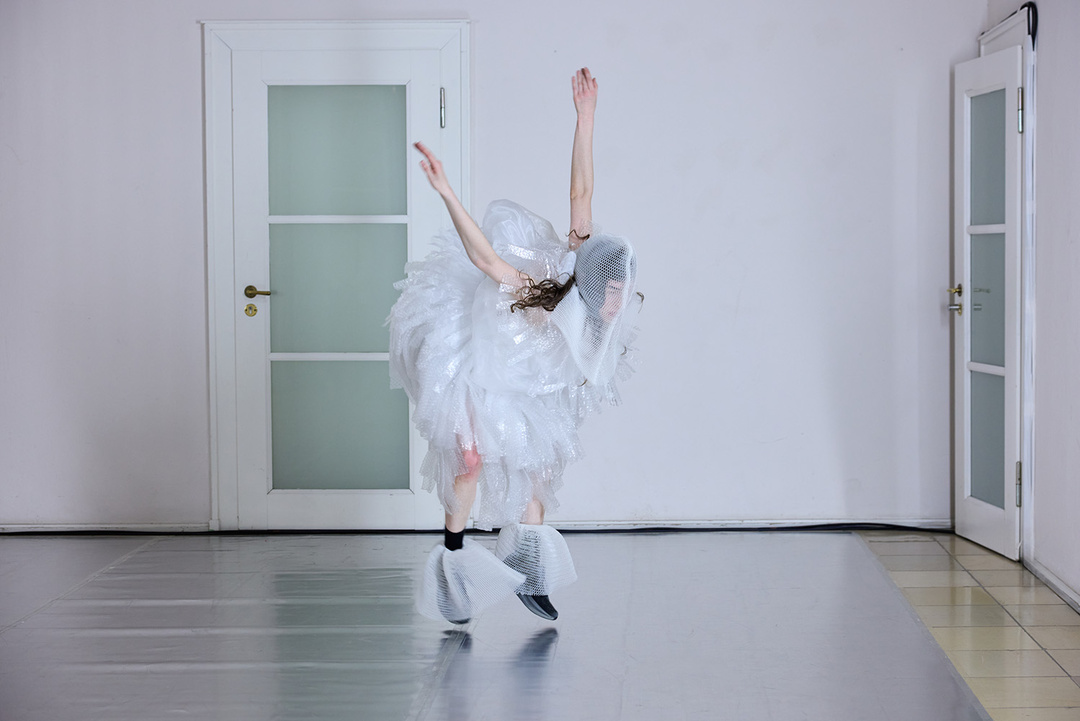
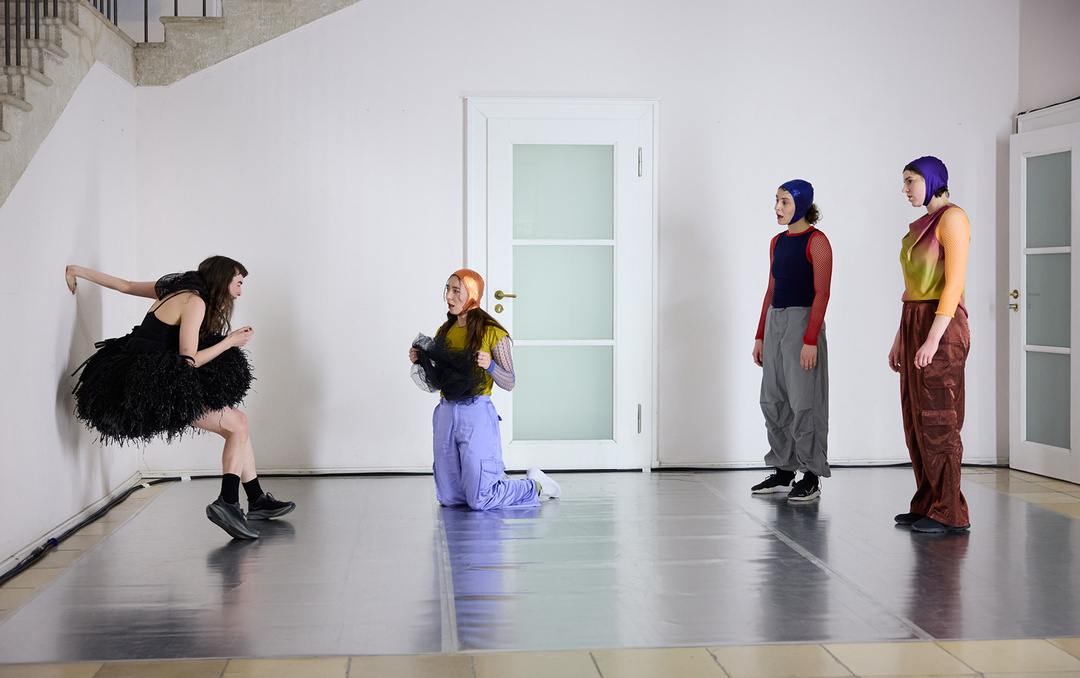
The starting material was an audio file by Rovère: He locked himself in a room for several hours and recorded whatever came to his mind on the topic. Fragments of this file are visible, audible, and tangible throughout the evening. Distributed across seven very different stations throughout the rooms of the Festspielhaus Hellerau near Dresden, individual aspects of Rovère's reflections can be found. These stations have names like "Erratic Geyser," "Smokey Valley," and "Black Pit." And these titles really do mean what they say: Louella May Hogan is the geyser that can tip from euphoric laughter to loud howls within seconds. The smoky valley is the East Corner Salon of the building, filled to the ceiling with stage fog, so that you can barely see your hand in front of your eyes. Only a shadowy figure, almost like an exotic snake, Ichiro Sugae appears out of nowhere, coiling around the terrified audience, only to immediately disappear again into the fog of vagueness. Rovère's voice can be heard from off-screen. And the pit is a veritable black box, a nearly five-meter-high black box into which the audience can peer from the side gallery, witnessing — whether willing or not — a seemingly never-ending, futile battle between two antagonists who seem imprisoned there.
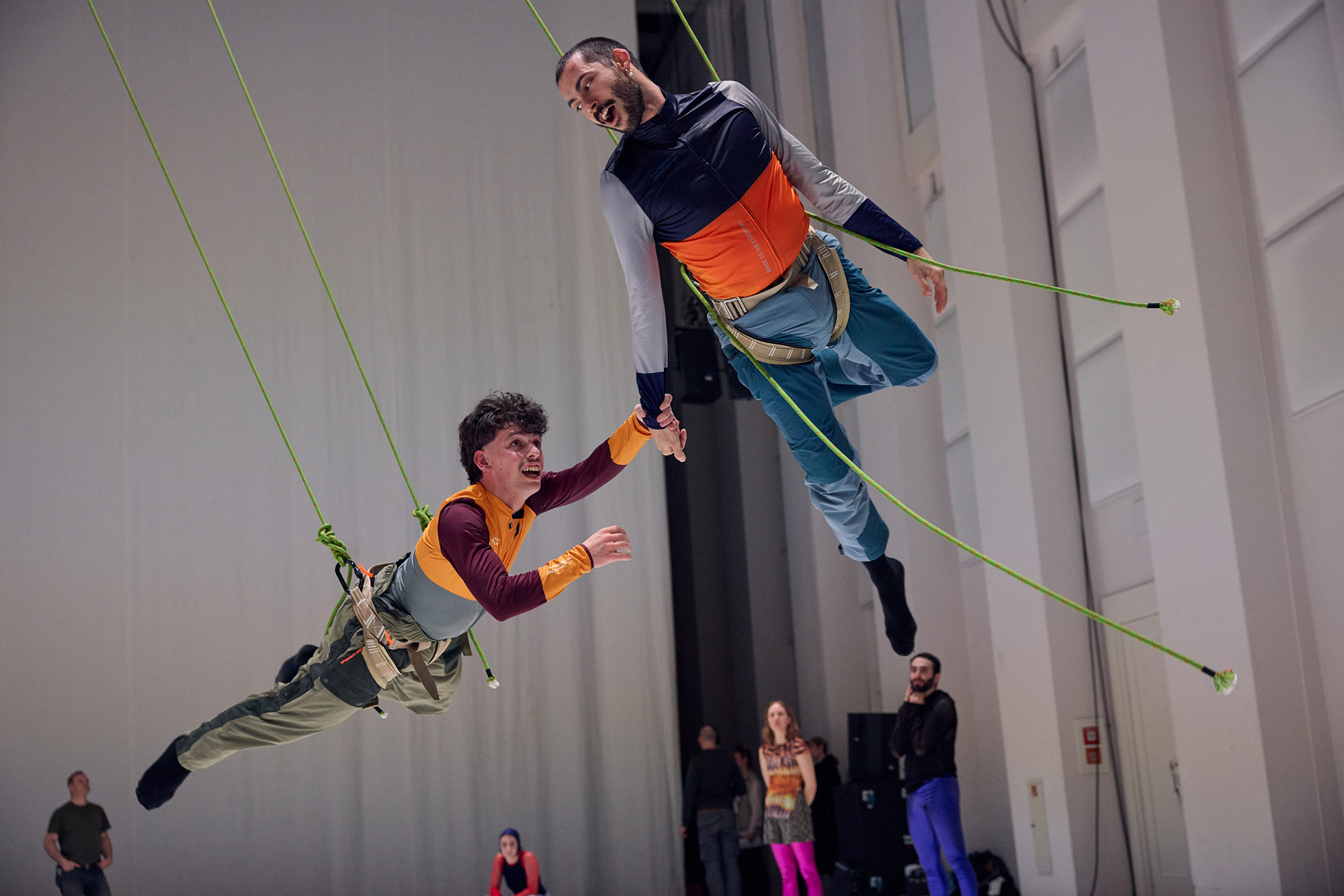
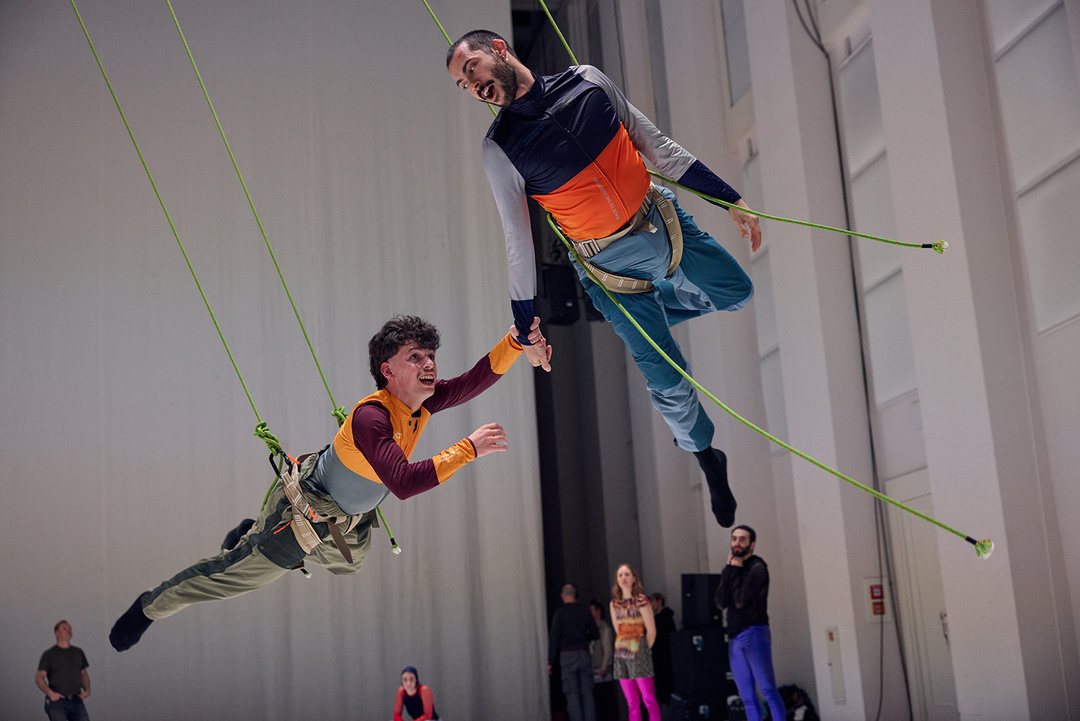
The spectators, by contrast, move quite freely through this labyrinth of reflections. Time and again, one encounters members of the audience either with an amused smile on their faces or, almost expressionless, seemingly lost in thought. Thoughts and feelings, especially here, cannot be separated. At the very latest, when one develops the feeling that one might miss something at one of the other stations, it becomes clear: It is the simultaneity of all things that is (also) important here. Although everything happens independently, everything is there simultaneously. These stations can therefore be interpreted like the individual activities of a human brain. While many things are frequently passing through our minds, none of us are free from contradictions. What Emanuele Piras and Emanuele Co' offer in the large hall is almost something like reconciliation: wearing climbing harnesses, they hang from long ropes just above the ground, touching it with their feet and pushing off. Many choreographic works have attempted this idea, and quite a few have failed. Here, however, the floating lightness succeeds in the open emptiness of the high, white hall. "High Peak," the name of the station, could thus be loosely translated as soaring flight. One can finally let go. The possibility of forgiveness seems tangible.
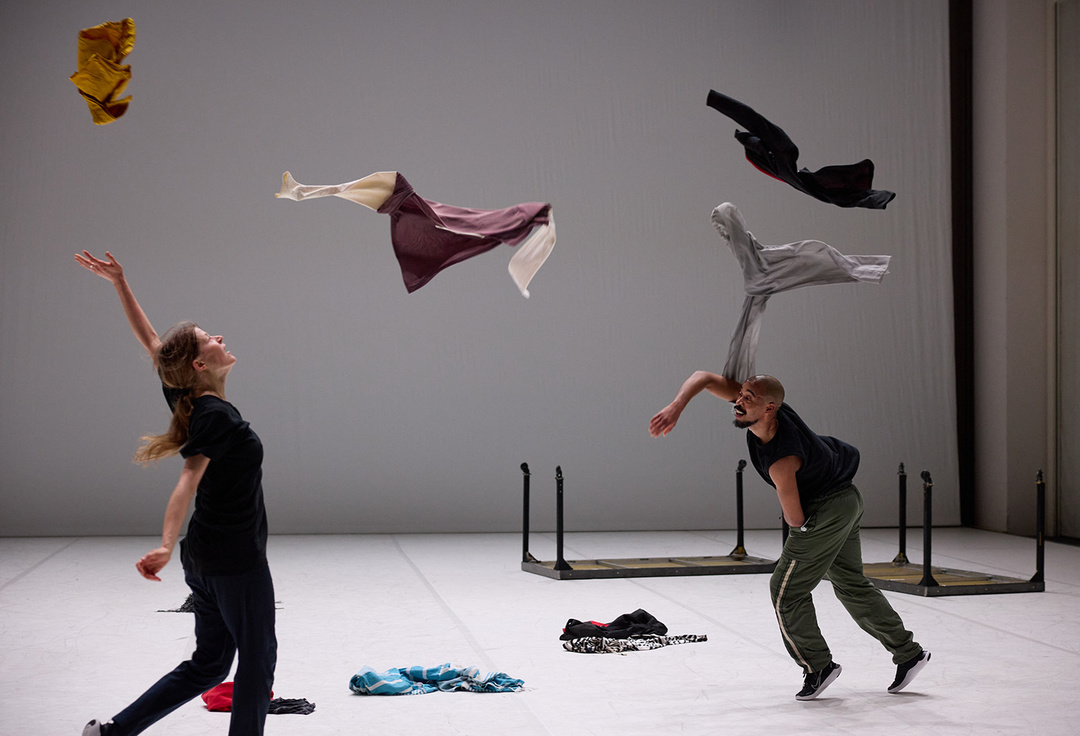
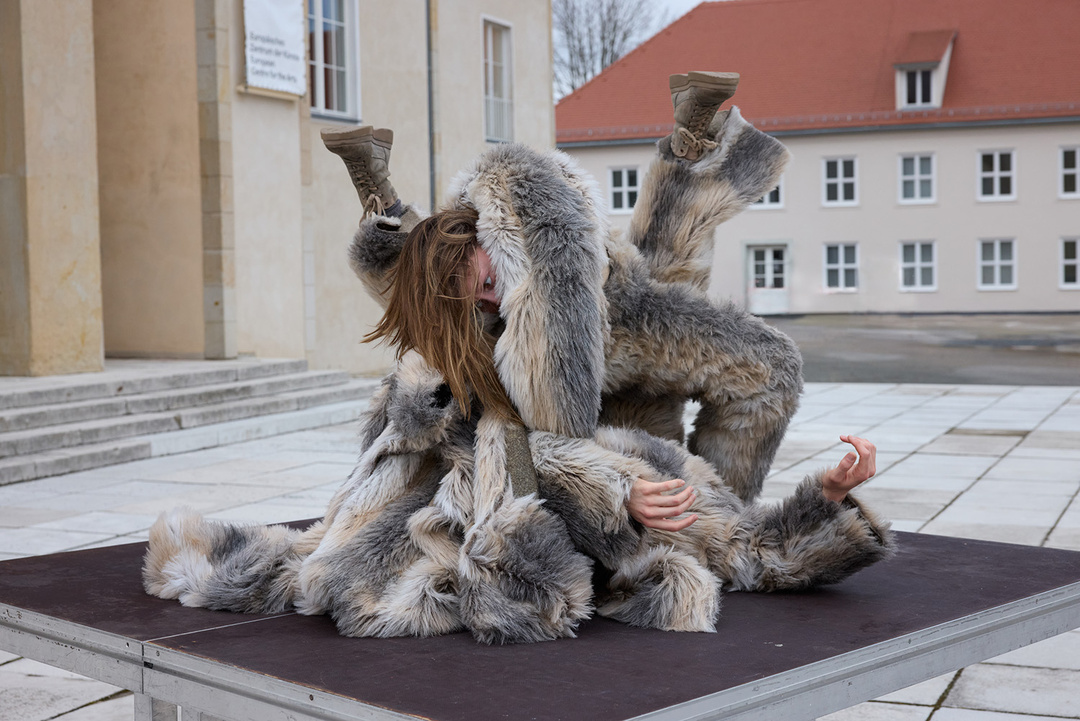
A concluding trio by Nastia Ivanova, Yan Leiva, and Samuel Young-Wright finally brings the audience to take a seat in the auditorium. Some elements of the stations reappear, directly or indirectly. Costume pieces, scattered individually on the floor, are recognizable. Rovère's voice, with its reflections, once again takes center stage, flanked by Sibelius' Valse Triste and a melancholic Sometimes I Feel Like a Motherless Child in Ruby Elzy's version. The complexity of this, but also the emotional immediacy of the artistic realization, seemed to have deeply touched the premiere audience. The final applause took a few moments to set in, but then turned out to be downright warmhearted.
Openness and Spontaneity
This finale reveals the philosophical possibilities of reflection inherent in the body. Mandafounis's self-developed improvisation technique which he calls "live choreography" forms a wonderful basis for the dancers' high level of individual presence. Their openness and spontaneity offer scope for the moment. At the same time, in light of these movement techniques, one may also ask whether they translate sufficiently for the audience if one cannot or does not want to follow the reflections in the background. This is a question that fundamentally applies to Mandafounis's working method. The improvisational technique comes across as quite self-referential. This is open to criticism: What does this movement vocabulary want to express other than itself? Expression for the sake of expression? It’s the balancing act of an artistic director who wants to transform the members of his company into artists rather than mere performers while simultaneously getting as close to his audience as possible. The movement vocabulary itself, as Mandafounis says, is not at all his priority.
Again on 4 April, Frankfurt/Main, Bockenheimer Depot; www.dfdc.de