Content

Close Up

Bollywood

Cancel or modernize? The question certainly arises when it comes to La Bayadère. In Dortmund, Xin Peng Wang is staging a colorful mix

by Angela Reinhardt

For twenty-two seasons, Xin Peng Wang has built up a large, curious dance audience at the Dortmund Ballet. Now the 68-year-old is retiring. His farewell gift is Germany's first modern production of La Bayadère, a mixture of parts of the old classic and newly choreographed scenes, of Marius Petipa and Hollywood, Ludwig Minkus and ragtime, sometimes dramaturgically way off the mark, but of considerable spectacle value. In addition to 22 dancers from his ensemble, the twelve-member NRW Junior Ballet, 13 guest ballerinas, two guest soloists from Het Nationale Ballet in Amsterdam (including a world-class Solor), and a fine set by Jérôme Kaplan recycled from the Berlin State Ballet are involved: it is an exciting evening.

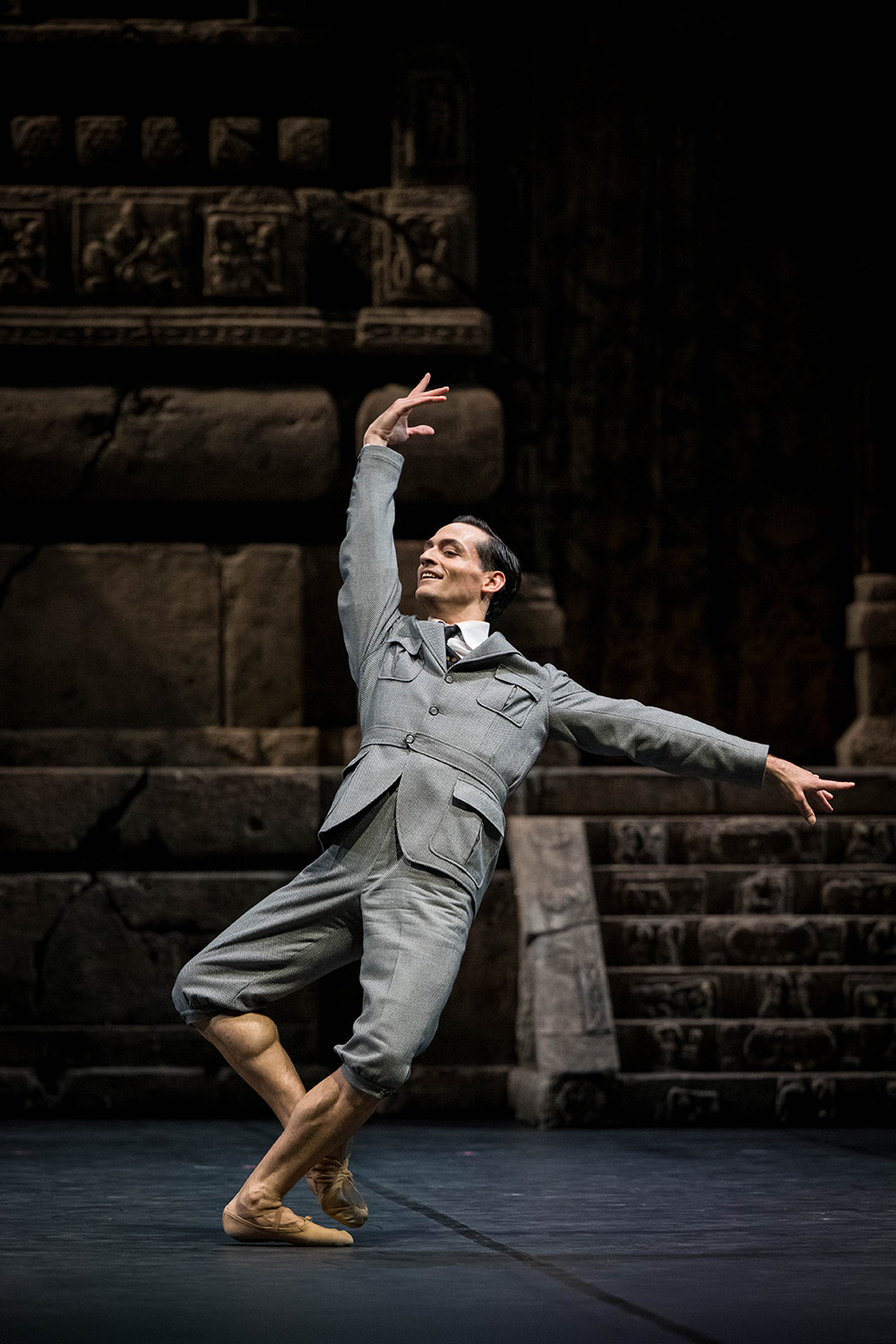
Wang transfers the action to Hollywood, where the ballet La Bayadère is being filmed. He superimposes the love triangle from the old Indian story with the same constellation — two film stars who are already romantically involved and an innocent newcomer. In this way he creates a play within a play and can still stage the pathos of the well-known plot as such (we are in the silent film genre of the 1920s), but in a way pushes the blame for Orientalism back a century into the past and sometimes has quite a bit of fun with his source material.

Comedy and Drama
The handsome actor who plays the warrior Solor falls in love with an unknown starlet whom the film producer presents as the cast for the role of the temple dancer Nikija shortly before filming begins. This sparks the jealousy of the leading actress (who happens to be the director's daughter), who kills her rival on set with a poisoned cocktail, whereupon the leading man takes hallucinogens, dreams himself into nirvana and meets his dead lover in the "Kingdom of Shadows". Instead of an earthquake, the studio burns down. Almost all of the film scenes show the traditional steps according to Marius Petipa, but the "reality" on set has been newly choreographed. Xin Peng Wang cleverly draws parallels using just a few images — the lascivious film producer, for example, emerges from the temple and quickly turns out to be the jealous High Brahmin from the original, the workers on the film set dance around the fire like fakirs, the ever-helpful studio manager is Solor's confidant and replaces the servant who is painted brown in the Russian versions (and also in Berlin).

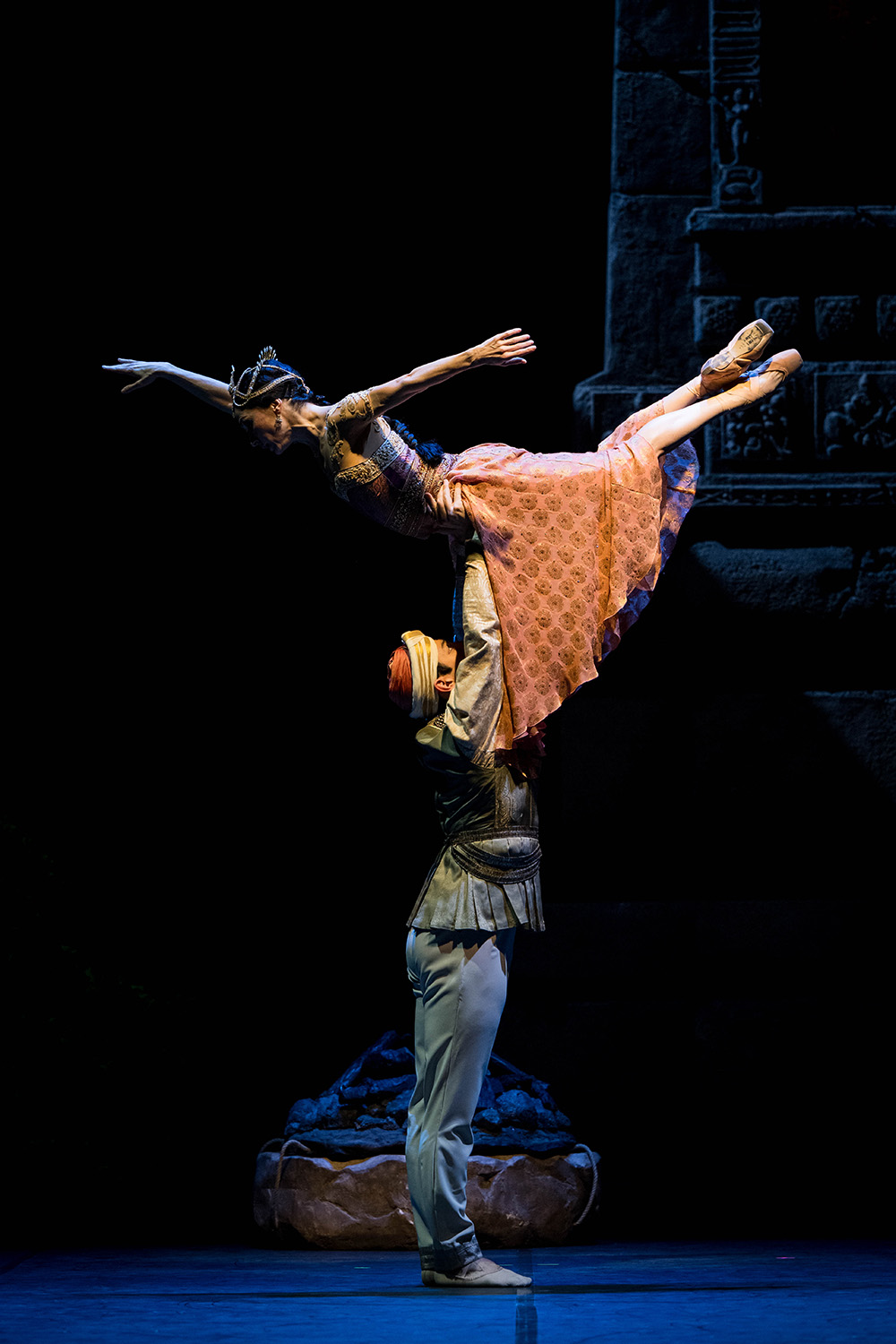
The de facto doubling of the number of dancers, for which we certainly have to thank Tobias Ehinger, the former company manager and current managing director of the theater, is topped by the luxurious furnishings. Kaplan uses the beautiful, rich costumes from Alexei Ratmansky's Berlin Bayadère from 2018, but only part of the stage sets. They become a film set, there are director's chairs and dressing tables everywhere, the curtain falls again and again and short interludes bridge the changes. A pianist then plays ragtime or jazz, sometimes black and white images flicker along with the old intertitles from silent films. While the men look good in knickerbockers or Gene Kelly trousers, Kaplan has put the two film actresses in rather dowdy dresses.

The choreographer repeatedly uses the scenes in front of the curtain as a comic relief to contrast with the dramas on and behind the stage. The director is vaguely reminiscent of Groucho Marx, the studio manager handles the clapperboards with his outstretched arms, and the famous Bayadère elephant does not triumphantly cross the stage but stands in the corner, its tow rope dangling from its trunk. The abrupt change of setting does not always fit, so the ragtime tinkles painfully into the eternal fantasy of the 24 descending shadows. Xin Peng Wang not only retains many steps from the original, but unfortunately also the old-school pantomime. The film producer threatens just as villainously as does the Brahmin in the Russian productions (which ballet master Cyril Pierre executes with death-defying purity of style), and the actress of the 1920s does not run her fingers across her throat to demand the death of her rival, but instead crosses her hands.

Fire in the Studio
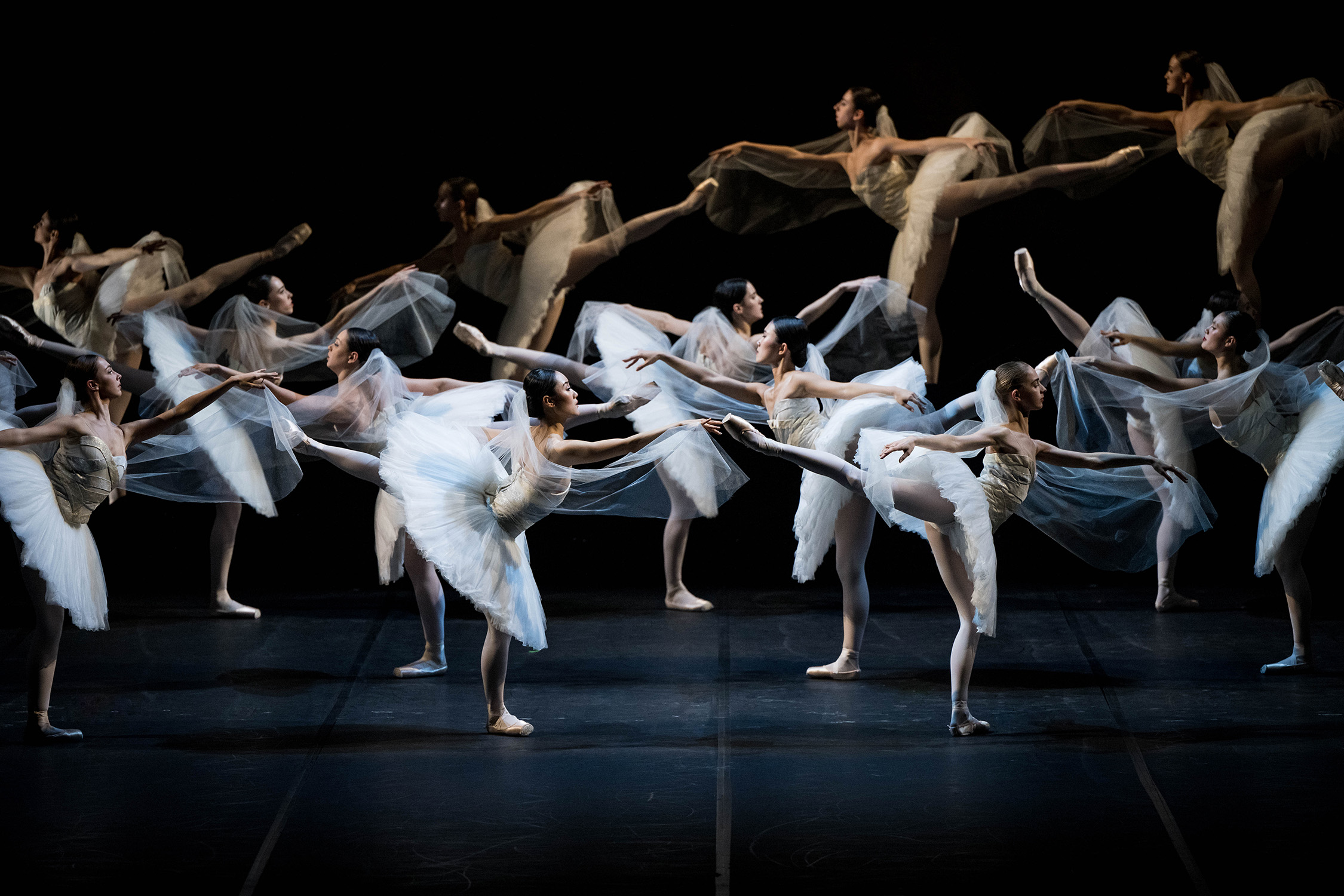
In Dortmund, the complete shadow act in front of a wonderfully cloud-covered Himalayan image has been retained from Petipa, or rather from the more virtuoso, already revised Soviet versions of the work. Large parts of the second act have also been preserved, such as the D’Jampe dance with the veils attached to the legs and the large pas de deux for Solor and Gamsatti with demi-soloists. The solo of the golden idol, which had mostly been located in the fourth act since Natalia Makarova's first western version of the work, has been moved back into the large engagement parade.

When Wang choreographs something new, he often quotes lifts or poses from earlier times, such as in the romantic pas de deux for Nikiya and Solor in the first act, which now moves away from classicism going higher and all the way down to the floor. A quartet for the three actors and the producer seems overdramatic when they wander around falteringly, and the pleading solo of the actress playing Nikiya in the second act (unfortunately the film stars are not named) borders on Soviet drama ballet with its pathos. The actor playing Solor is just as cowardly as his character, but is allowed to express his desperation in many whirling turns as the choreographer gives the men more to dance throughout than in the traditional version. The film workers are constantly on the move, elegant soldiers with sabers march through the film again and again, and they also perform the effective drum dance in the second act, which previously attracted negative attention due to brownfacing. The men from the Dortmund ensemble leave the best impression. The solo actor also has a lot to do in the short fourth act as he goes mad with grief. Then his previously rather cheerful friend, the studio manager, holds up a match out of empathy and sets the studio on fire, which leads to the really funny scene in which the ethereal shadows in their tutus collide with the arriving fire brigade. After a huge explosion, Nikiya waits at the top of the famous slope and pulls her lover up by the white scarf that no longer just connects the here and now, but also fiction and, well, reality.

Modernization with Marshmallows
The idea of ​​modernizing the work which premiered in St. Petersburg in 1877 and only came to the West a century later is not entirely new. While Shobana Jeyasingh’s Bayadère - The Ninth Life sought the Indian origins in London in 2015, just as Daniel Proietto did in Antwerp in 2020 with Rasa to new music and with a built-in gender swap, the choreographer Etienne Frey had already moved the work to present-day India in 1999. In his small-scale production with the Geneva Ballet, a modern Indian couple was reflected in ancient history.

The adaptation Star on the Rise: La Bayadère ... Reimagined! which premiered at Indiana University in Bloomington in March 2024, sounds suspiciously similar to the Dortmund idea. It was created by Phil Chan and Doug Fullington — that is, by Mr. "Final Bow for Yellowface" who has been fighting against the orientalism of the old classics for years, and by the reconstruction specialist who has so far been revered as serious and is known, among other things, for his work on the Munich Corsaire.

They too moved the action to Hollywood in the 1920s, but went about it much more decisively, having cowboys dance, turning the engagement picture into a rodeo parade and the shadow act into a glittering ballet in the style of Hollywood choreographer Busby Berkeley. Even Minkus' music was jazzed up, but there is a happy ending between up-and-coming actress Nikki and film star Sol, despite the intrigues of the evil Pamela Zatti. Fullington made sure the Petipa steps were correct, so the cowgirls in the first act dance around the temple fire as per the textbook, however not without roastin their marshmallows; the D’Jampe dancers stretch tambour batons over their heads instead of veils, and the Golden Idol becomes an Oscar statue. In the end, the silly production (which can be viewed as video-on-demand at iumusiclive.music.indiana.edu) feels as if someone had replaced the extroverted Soviet aesthetic with the worst American clichés, i.e. caricature with caricature. This is probably what happens when, in adoration of Balanchine's neoclassicism, one has ignored for too long the European experience in meaningfully modernizing the classics.

Psychedelic Kaleidoscopes
Why do we still want to see La Bayadère today? Hindu organizations and Phil Chan have repeatedly protested against the performances. In the USA (and now also at the Berlin State Ballet), the work has largely fallen victim to cancel culture, while elsewhere ballet dramaturges are finding a new raison d'être in contextualizing exoticism and cultural appropriation. But does anyone today actually look at the banal story of jealousy from the perspective that the colonization of India was carried out through ballet? The «Temple Dancer» was and is guilty of escapism, quite clearly, but can the inherently crazy combination of an Indian fairytale look with tutus and pointe shoes still be seriously interpreted in sociopolitical terms today? Especially when, unlike in Raymonda, the oriental identity is not confronted with the European one here.

Just like any form of black or brownfacing, the servile fakirs have also disappeared from Xin Peng Wang's work; they were another point of criticism. The title character does not appear as a potential sex worker (for which the ballet had actually been blamed as well), but (as always) as a proud priestess of the art of dance. La Bayadère survives as part of the foundations of classical dance through a multitude of the finest virtuoso variations, and because the romantic ballet's longing for rapture is even hightened by a vague Buddhism. The recently deceased Arlene Croce wrote that the shadow act shows "Elysian bliss"; with its meditative contemplation, it is certainly one of the most beautiful white acts in ballet history.

And so in Dortmund we marvel at the 24 shadows, whether as an early image of psychedelic kaleidoscoping or as the realm between life and death; ballet mistress Daria Sukhorukova has rehearsed the ballerinas precisely and musically. We admire Anna Tsygankova from Het Nationale Ballet, how she gives her Nikija beautiful balance, although she may seem a little too strict for the young starlet. We applaud the fascinating Giorgi Potskhishvili, who in every jump demonstrates the fine art of Ballon, of remaining still in the air. As an obliging partner, the Georgian manages the highest lifts and characterizes his silent film star in a noble rather than pathetic way. After the difficult manège of six perfect Doubles Assemblés at the end of the shadow act he flies once again across the stage in a breathtaking diagonal, following his dead lover in vain. This is just one of the reasons why "La Bayadère" is still being shown today.

Again on 1, 5, 8 February, 8, 22 March, 28 May, 1, 13, 19 June; www.theaterdo.de