Close Up
Dreamers
Gregor Zöllig has created a female Don Quixote for his 10th anniversary at the Braunschweig State Theater
Off to new adventures! With a scrubber in her hand as a spear and an upside-down bathtub as a vehicle, Doña Quixote throws herself into the fray. In Gregor Zöllig's latest full-length ballet Don Quijote oder Die unglaubliche Geschichte des Sancho Panza, two female dancers portray the most famous pair of friends in Spanish literature. But there are also performances in which two men take on the parts — visionary daydreaming that others consider to be madness is universal.
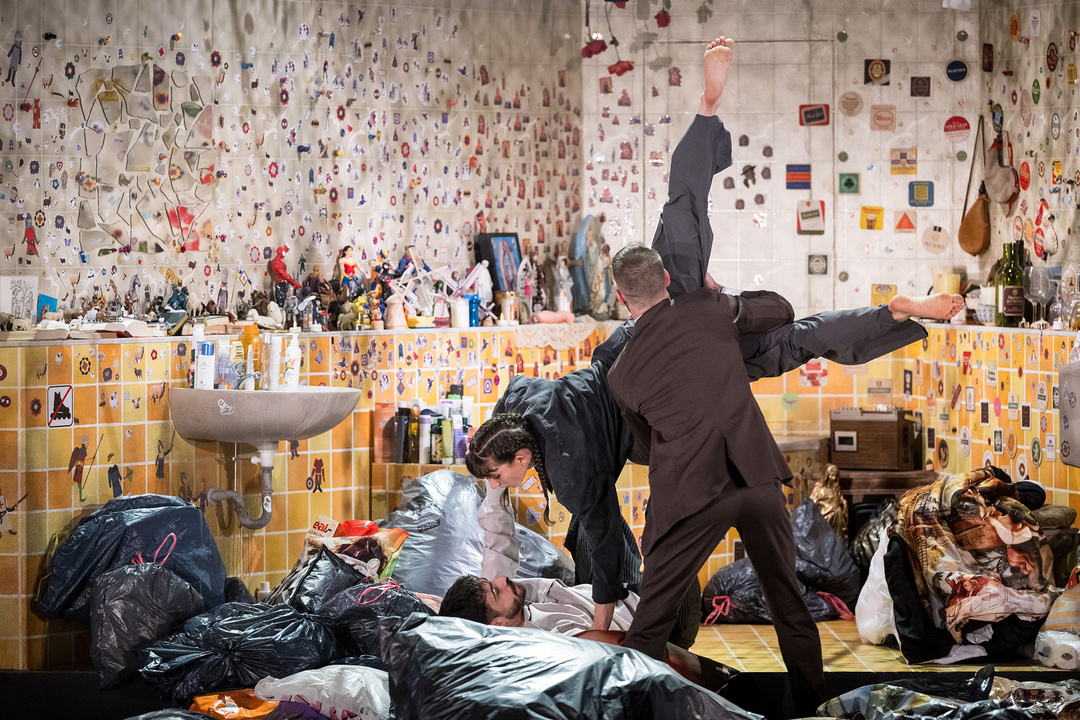
Where does she come from? In Zöllig's ballet, Quixote is a hoarder who has looted her place with Marvel comics, Superman figures, statues of the Virgin Mary and rubbish, with the Bible and Cervantes' original Don Quixote thrown in. This anti-heroine lives in her own world of adventure from which her landlords drive her out: her stuff disappears into blue garbage bags, and she immediately reminds us of a homeless person. Zöllig also shows this real facet of the life of outcast eccentrics. In everyday life, however, a Doña Quixote is not always easy to take. Troublemaking and the spirit of resistance are closely linked, and her visions, her perspectives on things, require a certain kind of submission on the part of her fellow human beings. Zöllig has interpreted the episodes of the novel: in the video fog, people appear to his protagonist like a flock of sheep, and in their everyday bickering, they appear as shadows on the screen like fighting birds. By contrast, the heroine is more of a clairvoyant in her dream distortions. But she is also a rebel when she claims her place in the established seating arrangement, stirring up everyone and causing a tussle, while the dancers, linked by arms and chair legs, form four battle lines that slash across the stage like windmill blades.
Fantasy and Psychology
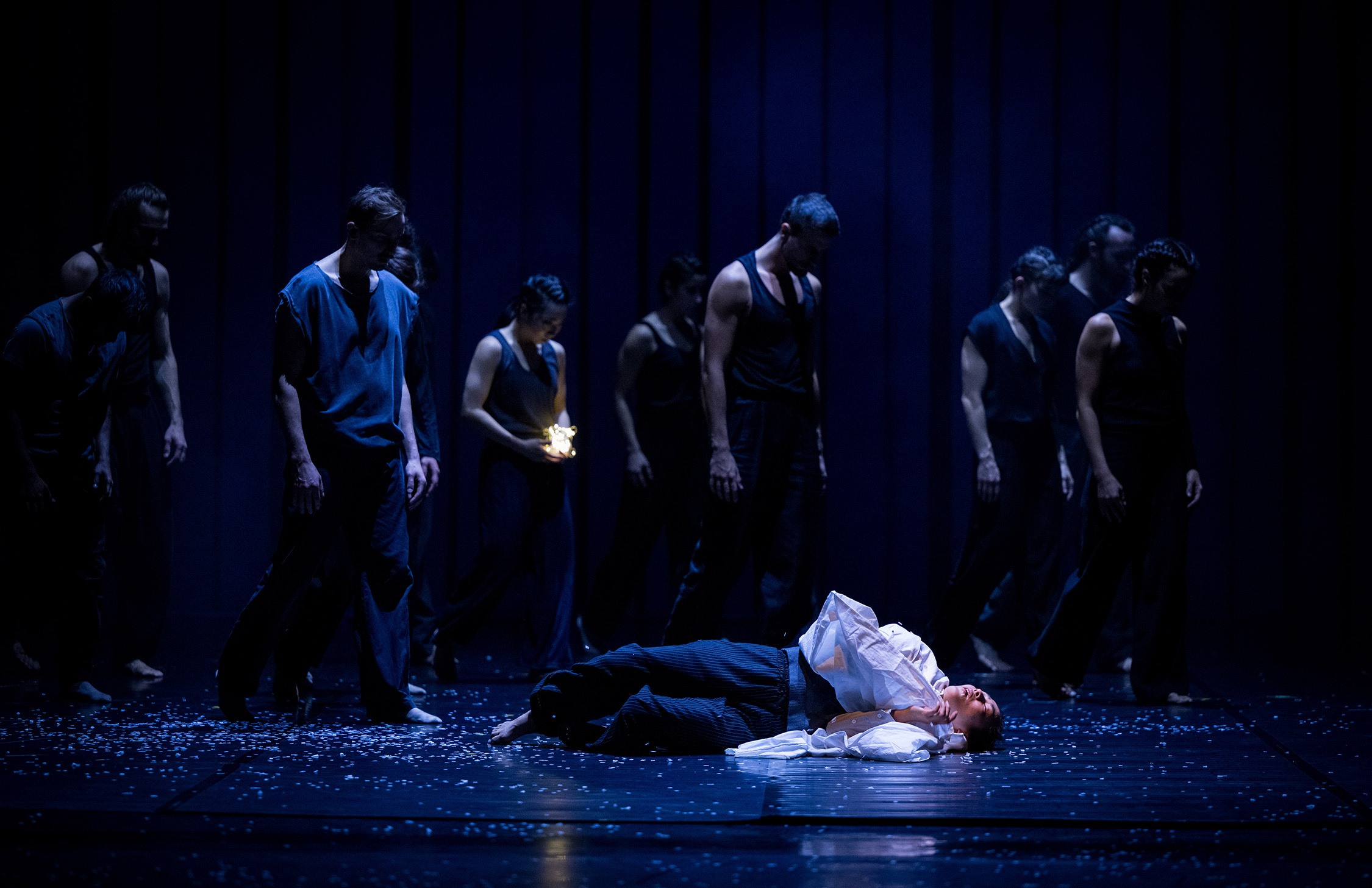
The delicate Noriko Nishidate in the title role can get quite rough. But she also has a beautiful tenderness to her when she tries to gently turn the landlord's head to her world view. Touching when, after all the fighting, she is once again completely thrown back on herself, alone under the stars, with her head pressed tightly to the ground. Zöllig sensitively illustrates how this distictive perspective can also be a quasi-autistic universe, and that the chaos in Doña Quixote's head sometimes takes on threatening proportions, leading to paranoia. The video flickering from the Marvel world materializes in people dressed in black who virtually swallow the heroine into the maw of their group before spewing her out again. Everyone grabs at her until she fights her way free with her hands and feet. A powerful scene. When she is to be cured with a fake trip to the moon, set designer Hank Irwin Kittel builds a musical paradise with flying chairs and a sparkling disco ball. Zöllig has the dancers perform in a revue-like fashion, but Doña Quijote feels at ease and is devastated when the spell is broken. It is "Teresa Panza" who brings the humiliated woman back to her old fighting spirit. However, this friendship could have been given a stronger profile. María Gabriela Luque emancipates herself from Quijote's eternal patronizing in a speech act.
The balancing act between fantasy images (that can also be interpreted in real terms) and the sensitive exploration of a particular psychological state is, however, very convincing. It is perhaps the basic approach of Zöllig's full-length dance pieces which function on both a narrative and an associative level, from the self-absorbed self-seeker in Peer Gynt to the encounters with finitude in Winterreise.
Zöllig has been doing this for ten years now at the Braunschweig State Theater, after doing it for ten years at the Bielefeld Theater and eight years at the Osnabrück Theater. His pieces dedicated to a subject or theme have existed from the very beginning, always developed in collaboration with the dancers. "Every stop off brought new artistic approaches," says the choreographer who was trained at the Folkwang School and, of course, partly owes his fascination with dance theater to his encounter with Pina Bausch. "In Osnabrück we mainly drew on ourselves. In Bielefeld we created the first evenings with a live orchestra, and starting with a dance evening on the Vier Jahreszeiten we opened up to working with amateurs. Four groups of different ages shared their views on their stages of life with us," he says. At the time they were trendsetters with their educational work, and also sought advice from Royston Maldoom whose Sacre du printemps with the Berlin Philharmonic and schoolchildren from across capital got the education wave rolling in 2004.
Networking in the City
In Braunschweig, these community dance evenings have long been established under the motto "Tanzwärts"; there are two per season, in line with the themes of the company's pieces. 1,100 people from the region have taken part, from children to adults with disabilities to pensioners. "And they are of course our audience now. But we also create networks with the city's institutions, with the schools, with the companies where these amateur dancers work. It is our form of lobbying for dance," says Zöllig. "And everyone who has taken part now knows how theater works, why you need so many people on and behind the stage." They also experience first hand the passion of the dancers who lead the "Tanzwärts" courses. New now are small dance pieces by the professionals for children, some with graduates from Essen and Zurich who are thus getting their first engagements.
But it is above all the cross-disciplinary projects that have become the trademark of Zöllig's dance theater in Braunschweig. Not only with the state orchestra and choir, e.g. in the Brahms Requiem, but also with the play for a choreographed version of the novel for adolescents Als wir träumten with dancers and actors who danced and spoke indiscriminately. For the multi-discipline version of Wagner's Ring, Zöllig designed a convincing Siegfried who became an environmental fighter against Wotan's business. And in Wagner's Götterdämmerung, where all disciplines came together, it was precisely the dance that provided the image-defining movement. The audience award for Zöllig's dance version of Carmina Burana is perhaps not surprising. But the success of the really unique version of Bartók's Herzog Blaubarts Burg by the choreographers Roni Haver and Guy Weizman, in which the dancers and the orchestra on stage created a disturbing, psychopathic atmosphere, does suggest that it was the basic work that created an audience open to aesthetic discovery. Zöllig therefore also considers guest choreographies to be important.
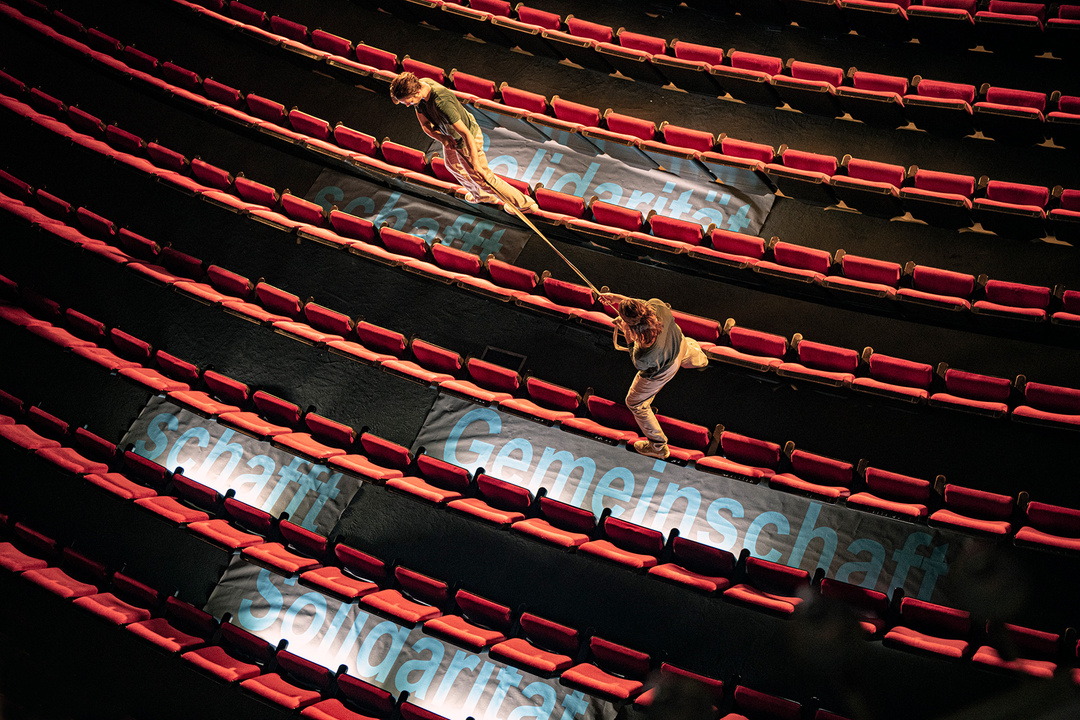
The diversity of perspectives also has a democratic meaning, he believes. "Our plays are always explorations of what is possible for social coexistence." For example, in the anniversary season he has once again included his dance course "Die Zeit ist reif" which was created during the Covid-19 period. In it, dancers try out their visions of central aspects of coexistence at various locations in the building. Zöllig has secured himself an eleventh season in Braunschweig. What happens after that will have to be decided by a new artistic director who is currently being sought. In any case, he himself still has the desire and ideas for an extension.
Don Quixote, 7 February, 21, 28 March; Tanzrausch, the dance gala for the tenth anniversary, 22, 23 February; Die Zeit ist reif, 4–6 April; www.staatstheater-braunschweig.de