
Behind the Scenes
In Limbo
The existence of Die Deutsche Tanzkompanie in Neustrelitz is under massive threat. How did it come to this?
It‘s quite a risky business when contemporary dance and acrobatic new circus meet, both physically and aesthetically. Classically trained dancers suddenly jump to unusual heights, stand on shoulders or forearms, hurl their bodies rather than swing them. But it’s a risk that’s worth it. And a risk with which the Deutsche Tanzkompanie (DTK) in Neustrelitz, Mecklenburg, demonstrates how valuable and varied their work is.
The name of the company sounds grand and (at least city) border-crossing. DTK tours as a guest ensemble, dancing up to a hundred performances a year, in the region, but also in Fulda, Hameln or Herford. The ensemble's mission is to bring dance to supposedly rural regions — and it is the only one of its kind in Mecklenburg-Vorpommern. However, state funding is running out this year, and there is still nothing more than "friendly declarations of intent," says Marco Zabel, managing director of DTK since 2022. But he cannot build a business plan or a program on that.
The uniqueness of DTK can probably best be understood by looking at its history. In the 1960s, there was a state folklore ensemble of the GDR in Neustrelitz, with 43 dancers and a singing ensemble, constantly on tour. In 1991, this folklore dance theater was closed down. A foundation then founded DTK, the state provided foundation capital and appointed the company as a cultural ambassador to keep dance alive in the small town with its 20,000 inhabitants. Financial uncertainty has always existed, says Zabel. The company has not received an increase in funding for 25 years, and at some point the ensemble had to be downsized — in 2008 there were 16 dancers in the ensemble, today there are eleven permanent positions. Large dance formats, which have long defined DTK’s profile, are difficult to implement under these conditions.
No Solution in Sight
DTK's structure is somewhere between a private and a state theater. It is formally a private foundation under civil law, but it was founded by the state to secure the dance location. The state gives 500,000 euros annually — in 2016 the previous amount of 950,000 euros was almost cut down to half — 200,000 euros come from the cities of Neustrelitz and Neubrandenburg and the Mecklenburgische Seenplatte district. "We generate a third of our budget ourselves," emphasizes Zabel. This hardly impresses politicians. The state funding was an eight-year construct, described as a bridging solution, approved until 2025. A new solution is not in sight.
Why DTK is not included in the so-called "theater pact" remains an officially unanswered question. According to Zabel, this clearly means that the ensemble is at a disadvantage. To put it in context: in 2018, the theater pact was decided to finance theaters in the northeast, including fixed state grants to the stages. "But we are hanging in the air," says Zabel. It is therefore not without ulterior motives that the three-part dance evening developed by DTK and the Cologne company Overhead Project in cooperation with the Herford City Theater and the Ernst Barlach Theater in Güstrow (also thanks to the expiring "Tanzland" initiative of the Federal Cultural Foundation) is called "Vom Schweben" (“On floating”) — even if conceptually they had Ernst Barlach's sculpture "Der Schwebende" (“Floating Angel”) in mind as a connecting link (a cast floats in the Antoniterkirche in Cologne, another in the Güstrow Cathedral). The "Tanzland" project ran for three years, and at the end the two very different companies each presented their own and a joint production. Overhead Project combined new circus and dance; in Blueprint the two acrobats first hiss, blow and flirt in and with the audience before lifting and swinging to electronic beats, whirling their strong bodies around with vivid lightness, whipping each other up as they stand on each other's shoulders. This is about the meeting of bodies like pairings, about interpersonal contact in extreme action.
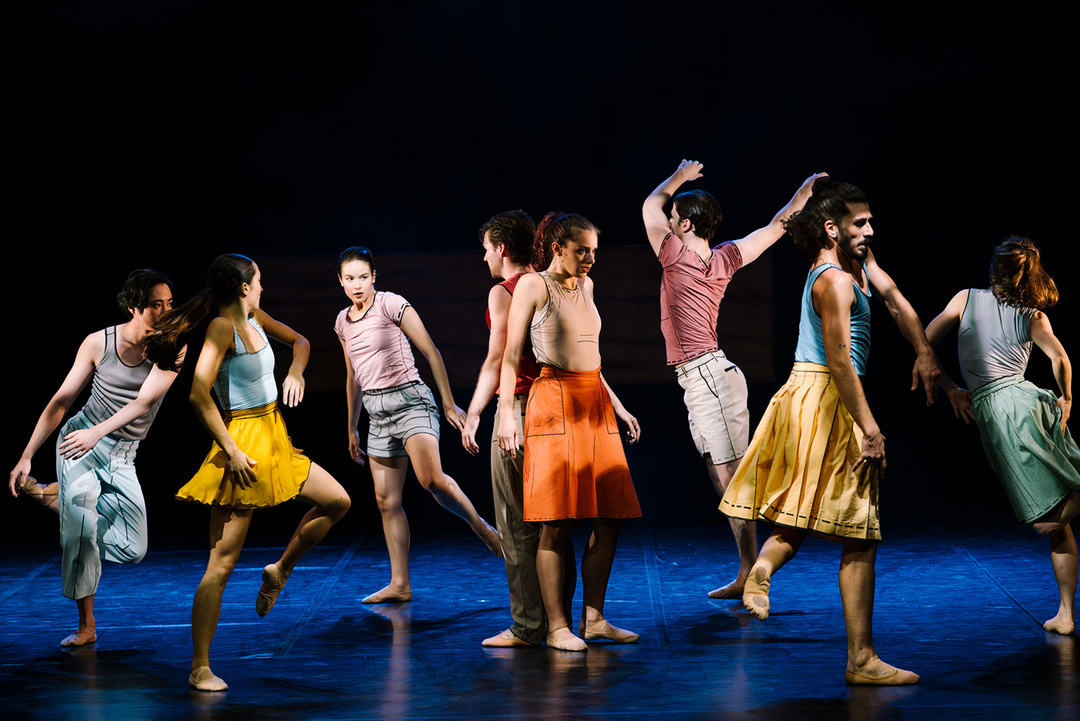
For Ich.Du.Wir, Tim Behren, artistic director of Overhead Project, lets his acrobatic dancers and the Neustrelitz ensemble play together. Duo work is the DNA of his company's work, says Behren. The classically trained (and classically training) dancers have embarked on the rougher, but no less precise interaction of the bodies with one another — with obvious joy in taking risks, in the floating tilt of the body, in headstands and hanging upside down. Together they form body bridges, celebrate being thrown back and forth and becoming one with another. They rehearsed together for the production on site for just one week, learning to fly and catch, says Behren. The result is remarkable, the energy infectious.
A Trust Committee for Forward-Looking Models
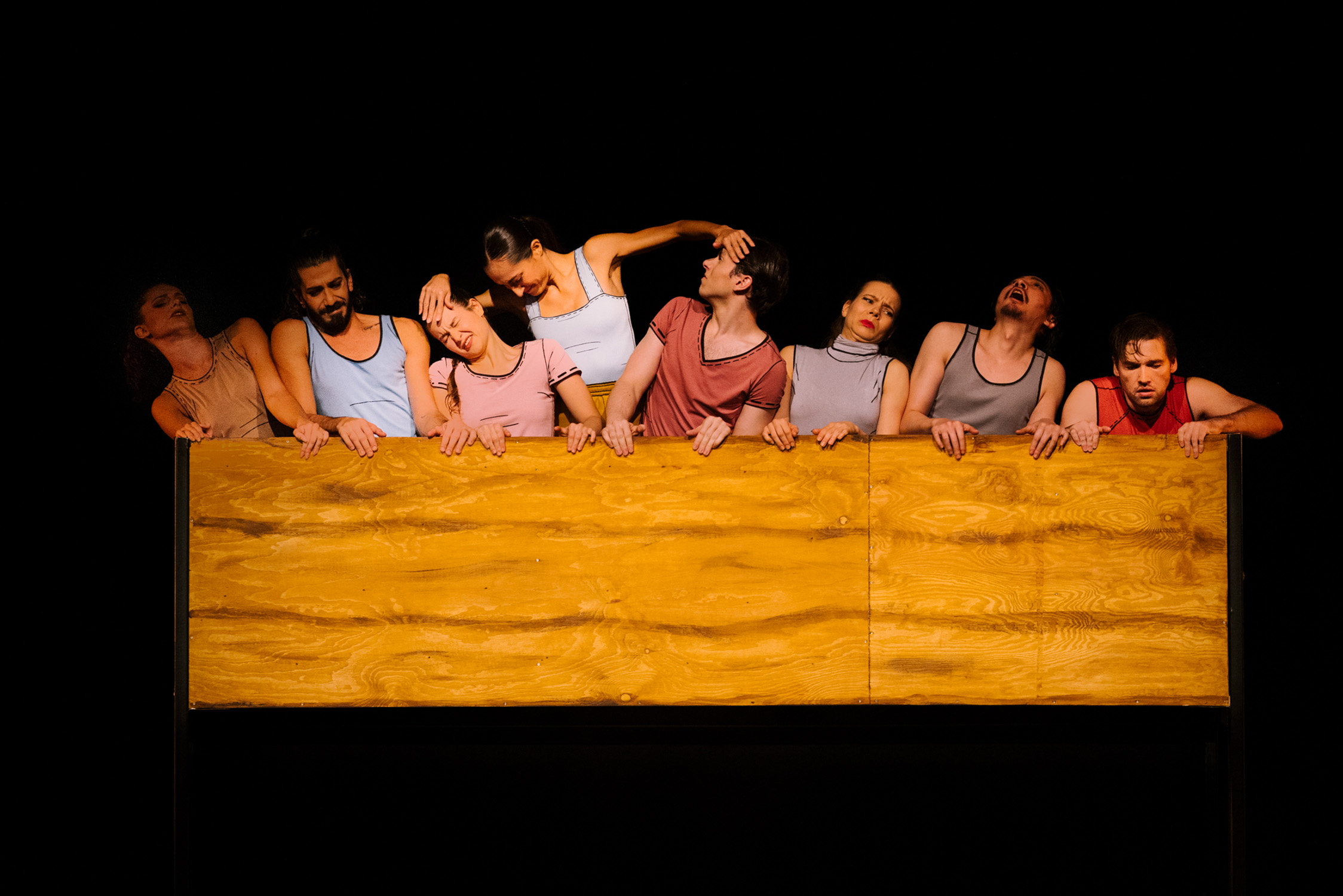
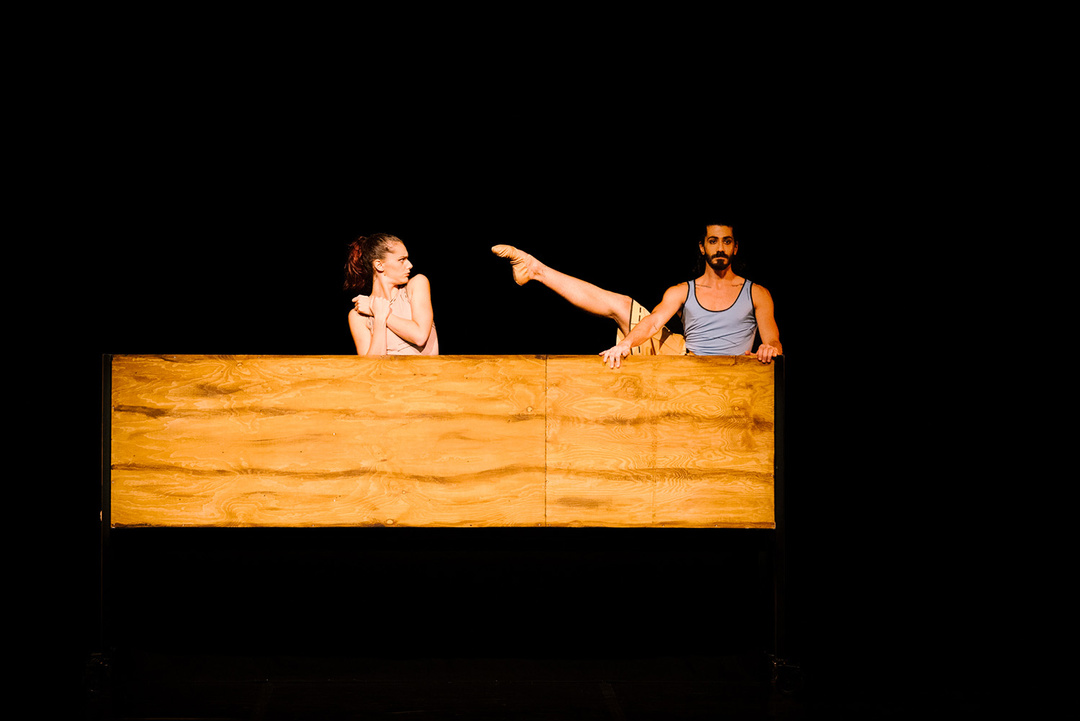
Torsten Händler, choreographer and former artistic director of DTK, is staging Schweben with the Neustrelitz ensemble as the third production of the evening, combining tender, pantomimic and comic scenes with the lightness of beings in love. DTK focuses on narrative dance theater. Even in its more abstract Zyklus der Elemente, staged by Lars Scheibner, there are slapstick moments when the dancers stand in the rain or unpack deck chairs and flippers by the pool (Wasser). Then again, they rush gracefully across the stage in body waves or whirlingly swing their arms up high in the air. This is impressive in its versatility.
The dancers come to Neustrelitz primarily to be able to work on their own, contemporary productions, says Marco Zabel. Others appreciate being able to perform in the musical and operetta productions of the local multi-disciplinary theater, the Theater und Orchester GmbH Neubrandenburg/Neustrelitz — for instance in Walzertraum at the open-air festival in the summer. Or in Chicago, starting in February. "We are needed here locally and we are wanted," says Zabel. DTK rents space for its own productions. But in his eyes, attaching the dance company to the theater as a division would not be an option. The theater — unlike the company — does not have the mandate to tour. And it also does not have the space or technical equipment a dance ensemble needs. Costs would not be saved either, because the collective wage agreement would take effect immediately.
In Mecklenburg-Vorpommern, there is now a trust committee that is supposed to consider models for the future. Marco Zabel is participating as a reporter. "We can no longer economize," he says. Due to inflation and in view of the adjustments that are actually necessary, "we are already lagging behind." Artistic self-exploitation and commitment make the work possible to this day. The dancers' willingness is immeasurably great, and their desire to take artistic risks is evident. But will they continue to do so for much longer?
Der Zyklus der Elemente: Luft by Gaetano Posterino, premiere at the Schauspielhaus Neubrandenburg on 14 March; www.deutsche-tanzkompanie.de