
Deep Dive
Global Spotlights
Upheavals on the political stage and social developments are reflected in dance. We take a look at five selected regions
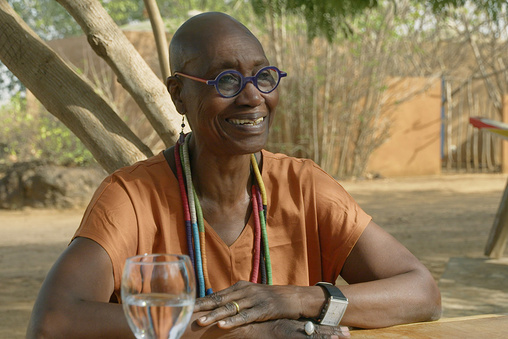
Germaine Acogny in the documentary Germaine Acogny – The Essence of Dance, coming to cinemas across Germany early next year; photo: CALA FILM
Senegal
In the far west of Africa, Germaine Acogny runs one of the world's most important dance schools, the "École des Sables".
An Interview
––
Germaine Acogny, in 2004, you and Helmut Vogt founded the dance school "École des Sables" near the fishing village of Toubab Dialao, south of Dakar. The workshops you organize there bring together young dancers from various regions and countries across the African continent. To what extent can your school take on the role of an incubator?
The "École des Sables" is a place for encounters and the confrontation of ideas, where people exchange ideas about their respective traditions and demonstrate and pass on dance techniques. We support young talent in their development and creativity. And when the young people talk about their living conditions, we encourage them to express them with their bodies. But we do so with the idea that it's important to reflect on one's origins, because one doesn't understand where one's journey is headed, and one won't grow up if one isn't aware of one's origins and roots. But that applies to dance in general. Béjart once said to me when I was practicing at the barre with him at the Mudra school: "If you're not grounded, you won't be able to lift your leg!" That's why we have an open-air studio where we dance barefoot in the sand. And the dancers bring this sand with them from their countries. We scratch our bare feet in the sand from all over the world! And we see the "École des Sables" as a place where tradition and modernity are in dialogue with each other. They are allowed to clash occasionally if it serves to inspire each other. Because only in this way can development progress innovatively.
What does this mean specifically for the development of dance in Africa?
Contemporary dance forms—it makes no sense to speak of just one so-called "contemporary dance"—spread, when the first approaches to new works are made at the "École des Sables," which are then completed by our students in their own countries. Many of our alumni—we call them "Sablistes," "the Sand People"—teach in their countries, create pieces, and establish their own schools and continuing education programs. For example, I was in Nigeria, where Adedayo Liadi drove the development of dance. He was one of the first, but also studied in Europe, just like many others. It's important to note that today's African dance stands on its own artistic feet. Historically, each newly independent country initially wanted to have its own national ballet to emphasize their independence and reinforce their identity. Then, choreographic competitions, controlled from Europe, emerged, and our choreographers imitated Western models to gain acceptance. Now, they are proud to distinguish themselves from European models.
Is an African momentum really emerging? What's the situation in Senegal, for example, on your doorstep?
Government support on the continent remains very thin, even for the most famous dance artists. When they apply, they have to explain who they are every time—it's very tiring. On the other hand, we've had a new government in Senegal since April 2024, under President Bassirou Diomaye Faye and Prime Minister Ousmane Sonko. And as a gesture of goodwill, around fifty companies practicing traditional or urban dances have actually received small donations of three to five million CFA francs each, equivalent to approximately 4,500 to 7,500 euros. It is also important that companies, whether European or African, take social responsibility above all else, to help young dancers. In Senegal alone, a number of festivals have now been established, and workshops are organized during the festivals where the skills learned at the "École des Sables" are passed on.
What's the situation in other African countries?
The young people who meet at the "École des Sables" are taking their first steps in their own countries and sharing what they have absorbed and developed here. Some organize festivals and invite each other. A few examples: In Burundi, Florette Gateka leads the "Parcours Danse" course, and Ange Aoussou founded the Un pas vers l'avant (One Step Ahead) festival in Abidjan. Bonaventure Sossou, director of the Hovidé dance company, is presenting the first edition of the EGI ESO festival in Cotonou this year. In Lomé, there is the FA'ARTS festival, founded by Nadège Ametogbe. And many initiatives are located outside of the metropolises—in Bukavu, Congo, Josh Chrispin Elia Masheka leads the "Danse sans frontière" training program. Maman Sani Moussa founded the Matassa company and the Festival de l'Oh in Zinder, Niger. Wesley Ruzibiza directs the Amizero dance company in Kigali, Rwanda, created the East African Night of Tolerance festival, and is co-founder of the "Afrika Mashariki Dance Network," which connects dance professionals from East Africa. At the École des Sables, he coordinates a workshop dedicated to exchange between the African continent and its diaspora. In total, we have a list of more than 30 alumni who have organized new initiatives on African soil. This doesn't even include well-known figures like Gregory Maqoma from South Africa or Faustin Linyekula from the Congo. They also tend to give our workshops. This year, we are also pleased to welcome an illustrious participant to our exchange: Danseur Étoile Guillaume Diop from the Paris Opéra.
So, is dance doing well in Africa?
There are plenty of people who would like to devote themselves more to dance. Everything is actually even more difficult than before, but they believe in their dream. We always advise them not to give up the professions they have learned, whether they are bakers, carpenters, cooks, or farmers. Dance is an excellent training ground for other professions as well. We offer training for precisely this at the École des Sables: For example, someone came who, although he had no particular talent for dance, was able to intensify his connection to his roots through dance and became one of the largest farmers in our area. He said that dance helped him develop the discipline he needed to do this.
In September, you'll be showing a new solo in Paris dedicated to Josephine Baker.
Josephine was much whiter than I am and yet was still a victim of racism. Now she'll be reborn in the body of a real Black person! Not bad, is it? Along with the solo, we'll be showing Pina Bausch's Frühlingsopfer in the African version which we were able to develop thanks to Salomon Bausch. I just hope that the current diplomatic tensions in Mali and Burkina Faso with the French government don't lead to visa difficulties. Artists shouldn't be punished for political problems. No one from these countries wants to escape to Europe. Everyone wants to return to their homeland and develop dance there.
Thomas Hahn
Continue reading with the DIGITAL MONTHLY SUBSCRIPTION to tanz – international edition

- Access all articles of tanz – international edition instantly online
- Optimized reading experience on all devices
- Full access to the complete online archive