Wonderfully Curious
In 2020, Kaltuk won first prize for choreography at the International Solo-Dance-Theater Festival Stuttgart. His piece was performed by Tanaka Roki, who has been a member of the ensemble in Lucerne for several years now. That was the breakthrough moment. Richard Wherlock—director and chief choreographer of Ballett Basel from 2001 to 2023—approached him, asking if he would like to choreograph for the company. Wanda Puvogel also discovered him through this; the co-artistic director of the Lucerne Theater had been Director of TanzLuzern. She describes Kaltuk as "wonderfully curious." She had him choreograph a 20-minute piece: "We gave him an afternoon to play around with the stage. It was like a kid in a toy store. He experiments, he takes chances, he goes after things and makes something of them." She quickly recognized his drive: "It didn't just fall into his lap; rather, he is curious to find out what is possible and where. He actively seeks things out instead of waiting for someone to come to him." Isabella Spirig, who has been heading Danse Suisse since 2024, confirms this: "He knew I was friends with Sidi Larbi Cherkaoui. So he simply asked me if he might be able to meet him. That’s his kind of reaction to my recommendation: Think big!"
St. Gallen, Lucerne, Basel—in the end, they all approached him. Kaltuk quickly began choreographing in all these places. Yet for him, this is anything but child’s play: "I find it difficult to choreograph and perform on stage at the same time. I can’t do that yet. By now, I could dance in Same Love because everything is just right; it works. But for me, it is very difficult to create a piece that holds up within a theatrical context. That’s why it’s better for me to be on the outside, exchanging ideas with the dramaturge and others."
Community at Its Best
He premiered the piece in Gütersloh in 2024, a collaboration between his own company, MEK, and the Urban Arts Ensemble Ruhr. It was his third full-length production to date. As part of the Tanztriennale in Hamburg, Kaltuk presented it outdoors as a "site-specific drama." The soundtrack alone weaves together a vast array of cultural references with remarkable organic ease. It tells the story of a fraught emotional connection threatening to shatter under the weight of societal pressures—a theme that resonates across cultures. He also toured this summer with his work Father Politics (2021), which is set to be performed in Gelsenkirchen as well. Guest performances have taken him to Ghana, Uganda, Tanzania, and Egypt; India is currently under discussion. Thanks to marketing? Not particularly. These days, the magic word is Insta.
It is fair to describe it as a project that has taken on a life of its own. Kaltuk reaches not just many people, but—it feels like—everyone. In several countries, he has shared the rights to Same Love with local dancers, allowing them to tour with the piece themselves. It is community at its best—and not just for the sake of it, as Wanda Puvogel emphasizes: "He has a very clear message in his pieces. And for him, it’s about getting that message across to people, not just standing on stage and making a statement for his own sake. He doesn't want to pat himself on the back and say, 'Right, I’ve finally voiced my opinion.' His goal is to get people on board and build a connection with the people he creates for. I find that very unusual.”
Catja Loepfe—who served as Artistic and Managing Director of Tanzhaus Zürich until the end of last season—also speaks of his high level of professionalism and clear vision. In 2019, she gave Kaltuk a platform in Show-off, the venue's showcase for emerging talent. She views Kaltuk as a generous and approachable individual—though she offers a slight caveat: "He has big ambitions—sometimes, perhaps, too big." In Zurich, Kaltuk received two years of conceptual funding, becoming what the venue calls a "Komplize" (accomplice/collaborator). It was there that he developed the "Common Ground" concept, inviting the public to monthly "sharing" sessions. "He regularly packed the house with those events because he simply knows how to engage the community through a genuine spirit of solidarity." He is continuing this work in Gelsenkirchen with the new monthly format "Tanz.Hautnah” which offers glimpses into training sessions and rehearsals. Tickets for the inaugural event in late October sold out as early as mid-August.
Yet Muhammed Kaltuk is by no means a factory-style producer of work. "Many choreographers create several pieces in a single season. I can’t do that. I certainly need a year or a year and a half for a piece. I feel that the process of working through things is important. Dealing with it is important." That’s why, following the premiere of Kleine Hände in Gelsenkirchen in November—featuring songs by Bettina Wegner—there are no further premieres of his own scheduled for this season. He has been working on a second piece since the summer of 2025: his first full-length solo performance for Kaserne Basel. "I need time, breathing room, exchange, and also education. I want to further my training and expand my art; for that, I need time and the freedom to experiment. Sometimes I feel a desire to be bolder and more extreme—to dive into a production without the fear of falling. I have to keep reminding myself to shut out the pressure of a production and focus instead on my intuition and the movement." It almost sounds as if he is apologizing—even though there is hardly anything wiser than staying off the hamster wheel.
A Foothold in the Independent Scene
In concrete terms, this means that over the initial three-year term of his contract, he will personally create only two productions. Catja Loepfe puts this into perspective: "He is producing a limited number of pieces in Gelsenkirchen because maintaining a foothold in the independent scene is so important to him. To me, he is a classic bridge-builder in that regard." But before Gelsenkirchen even appeared on the horizon, Kaltuk had a vision of a "ten-year project" in mind—a cultural center, a space where everyone is welcome. Or perhaps training as a dog sitter. His unsettled lifestyle leaves no room for a dog of his own. So: a foster care model. Or delving further into care work—training with the Swiss Red Cross in emergency and crisis management. He felt that what he was giving back to the world—the good he was doing—wasn't enough. And then came the email from Frank Hilbrich, the MiR’s new General Intendant as of this season. Was he open to a conversation? Joining an institution? Kaltuk, the free spirit?
So, to begin with, he sounded people out and listened to others' opinions—including Wanda Puvogel’s. Two days before his appointment at the theater, he was already in Gelsenkirchen, checking out the city and its communities, and talking to people: "My expectation is that the theater reflects the city and collaborates with it—that the city and the theater are one." He was impressed by the immense size and diversity of the community of people perceived as Arab or Turkish. That wasn't something he was used to from Switzerland. Next, the sheer size of the theater blew him away. And Frank Hilbrich approached him with complete openness, asking: "What is your vision? What do you want to do?"
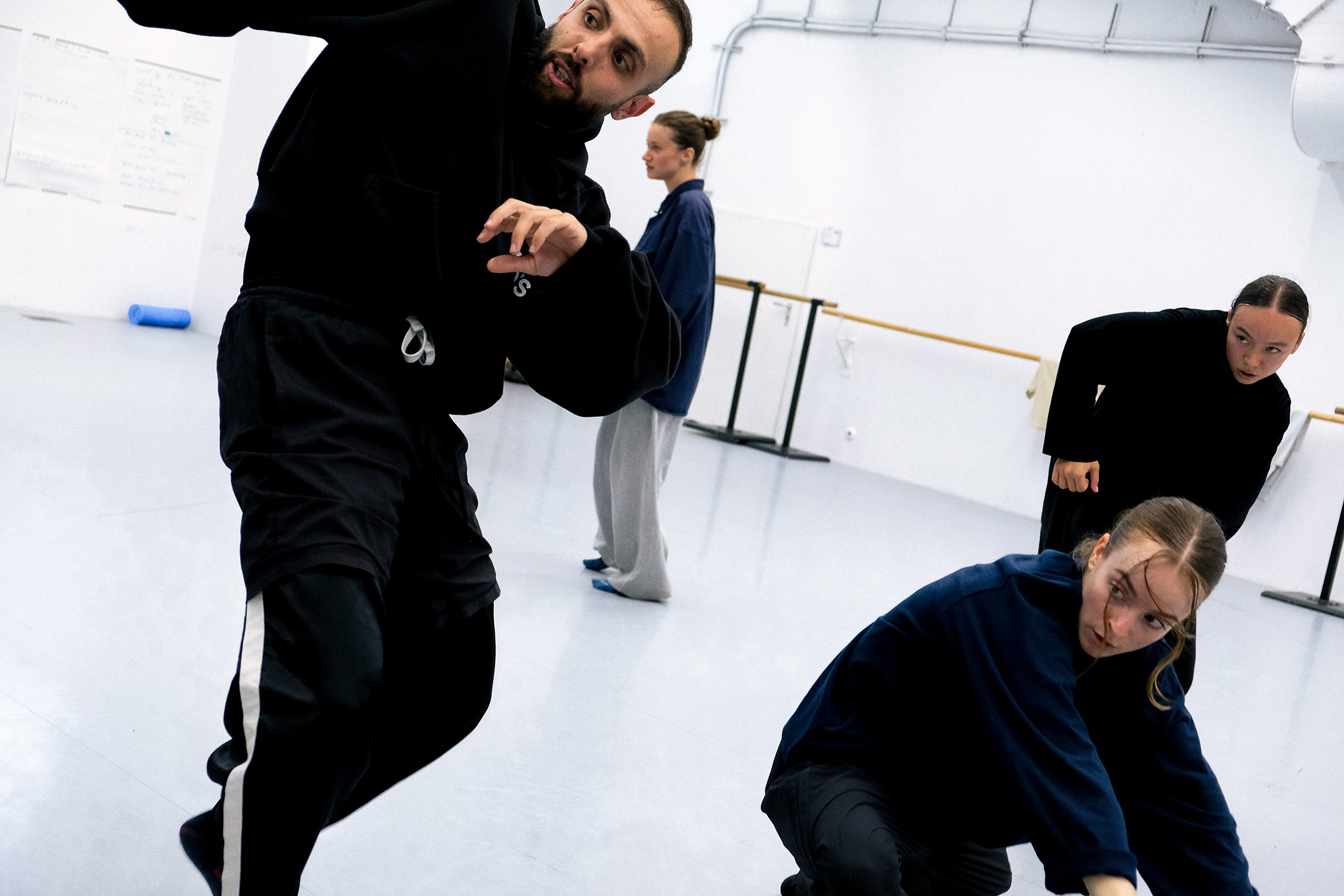
One thing was clear to Kaltuk: hip-hop dancers within the institutional structure of a permanent company—that doesn’t work. What he wants and needs is freedom and exchange—for the dancers, but also for himself. He finds that in Gelsenkirchen. He also made clear: He is political—advocating for the marginalized and for visibility, and standing against violence. That is something he will not abandon. Hip-hop is political, and that is what he intends to—and will—bring to the stage. Censorship in cultural spaces? Not with Kaltuk. He has the institution’s blessing. He and Hilbrich have reached an understanding regarding fundamental values, guidelines, and a strategy. Kaltuk takes his responsibilities seriously. For his part, Hilbrich is “amazed by Kaltuk’s openness,” describing him as a “deeply committed curator.”