Content

People

Drag and Drama

Berlin State Ballet dancer Jan Casier masters the enormous balancing act between comedy and tragedy, farce and Weltschmerz

by Dorion Weickmann

In essence, the ballet studio is nothing more than a kaleidoscope of worlds and personalities. Whoever walks in brings their own mood along with them. The cheerful type radiates good spirits into every corner; the empathetic one gently strokes a downcast colleague’s cheek; the striver launches into yet another tour à la seconde; five young women discuss the logistics of their shared sequence; while a strikingly handsome man saunters in and settles his supple body behind one of the barres wedged beneath the sloping ceiling.

Today’s rehearsal at the Berlin State Ballet began just before 1:00 p.m., under the watchful eye of a television crew; the cameraman weaves through the rows and clusters of dancers whom Christian Spuck—alongside three ballet masters—is guiding through his Fearful Symmetries. There is just one week left until the world premiere, which will bring John Adams’s composition of the same name to the stage of the State Opera. Consequently, the choreography feels like a work in transition—in the home stretch toward opening night—even though the contours of the piece are already clearly taking shape.

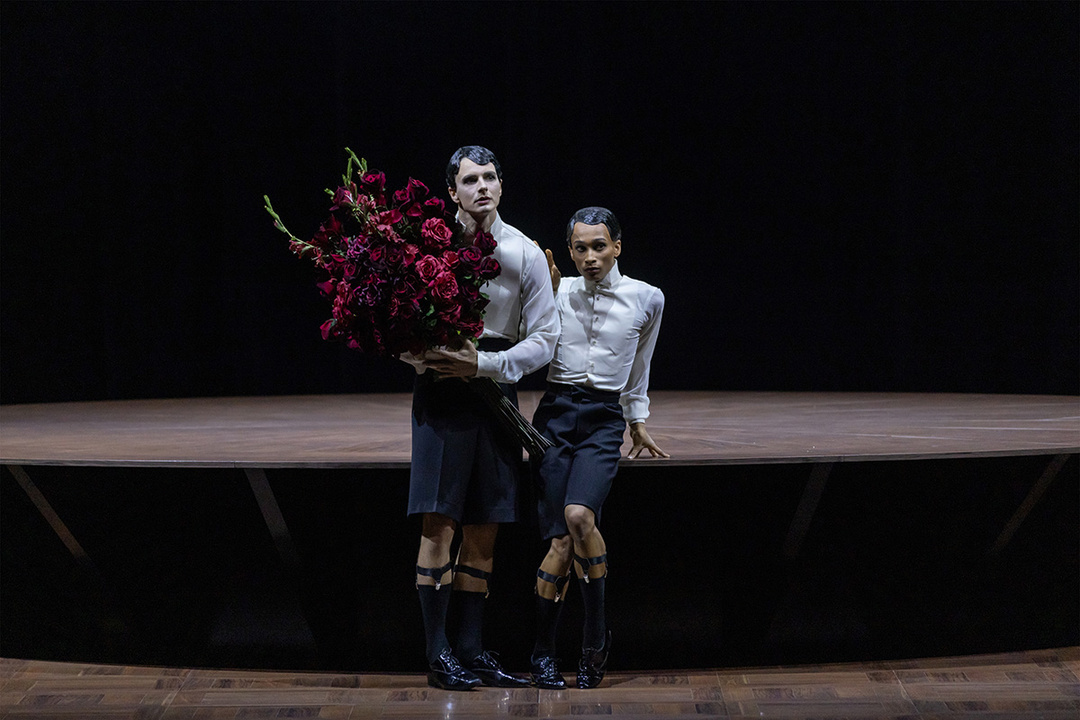
Amidst a host of mini-collectives coordinating nuances and sequences among themselves and exchanging helpful timing tips, a quartet moves through the hall with an almost sleepwalking grace. The fabulous Weronika Frodyma dances, dallies, and torments three men—Ross Martinson, Dominik White Slavkovský, and Jan Casier—who appear as court jesters in Her Majesty’s orbit or the entourage of a medieval matriarch. At any rate, the themes are power, beauty, and cruelty—that "fearful symmetry" evoked by William Blake in his 1794 poem The Tyger and translated into music by John Adams in 1988: fast-paced, explosive, and full of allusions, with a penchant for subtle and profound humor. Tailor-made for Jan Casier.

The tall lady, handbag on her wrist, sweeps in and bends over one of the prams, whose precious cargo remains in celestial care until fully grown. The satin suit, worn by the flawless mannequin, gleams in a rich purple. A matching hairstyle to boot—et voilà: that ‘s how the Lilac Fairy appears in Tchaikovsky’s The Sleeping Beauty, staged by Christian Spuck for the Zurich Ballet in 2020. Just days after the premiere, a mask mandate is back in force; only weeks later, Switzerland’s second lockdown takes effect. Yet the Lilac Fairy remains unforgettable—because Jan Casier portrayed her with elegance and grandeur, empathy and humor, decisiveness and that touch of self-irony that wards off the danger of garish overacting.

A resounding success for both the soloist and the entire ensemble— which soon found itself facing the extraordinary circumstances brought on by the coronavirus. For Jan Casier, the pandemic remains a heavy burden; he is experiencing what is arguably the most critical situation of his entire career. Speaking openly in the conference room of the Berlin State Ballet, he describes the doubts and self-doubt into which the forced hiatus plunged him. At just under thirty years of age, he had felt fit and truly at one with himself and his art.

The Driving Force of Emotion
It all began in 2002 in his hometown of Antwerp. Jan Casier’s parents decided to send their son to the prestigious Royal Academy, which had encouraged him to attend. He himself was not the driving force; rather, the family agreed that he would be in good hands there—certainly better off than at a regular school, where his mother feared early experiences with bullying foreshadowed a troubled adolescence. A career in the arts was not something the Casier family had typically envisioned; Jan’s older sister now works in the ecological non-profit sector.

Yet the ballet student enjoyed his time at the academy, feeling seen, protected, and nurtured, and—as he puts it—he entered the profession with an “open mind toward everything”: “Because we were truly taught that openness, that curiosity about every style—without any blinkers.”

The recent graduate joined what is now Opera Ballet Vlaanderen—at the time still bearing a royal seal and led by Kathryn Bennetts. In terms of openness, Bennetts continued the approach taken during his training: Casier danced Forsythe for the first time—"Bill’s works run like a common thread through my career"—and was immediately captivated by the choreography. "You learn dynamics, timing, energy," he says, his eyes shining; indeed, he is filled with joy and gratitude for the experiences and artistic treasures he has gathered over the years. Jan Casier possesses a remarkably discerning judgment and a fundamental trust in the ecosystem known as ballet—"my bubble." What is evident in the studio and on stage holds true in personal interaction: Jan Casier is an attentive, thoughtful, and alert individual who takes a deep interest in what he does, as well as the "why" and the "with whom." He examines motives and underlying contexts in order to take flight with the full thrust of his emotions—much like the hot-air balloon he had tattooed on the inside of his left upper arm.

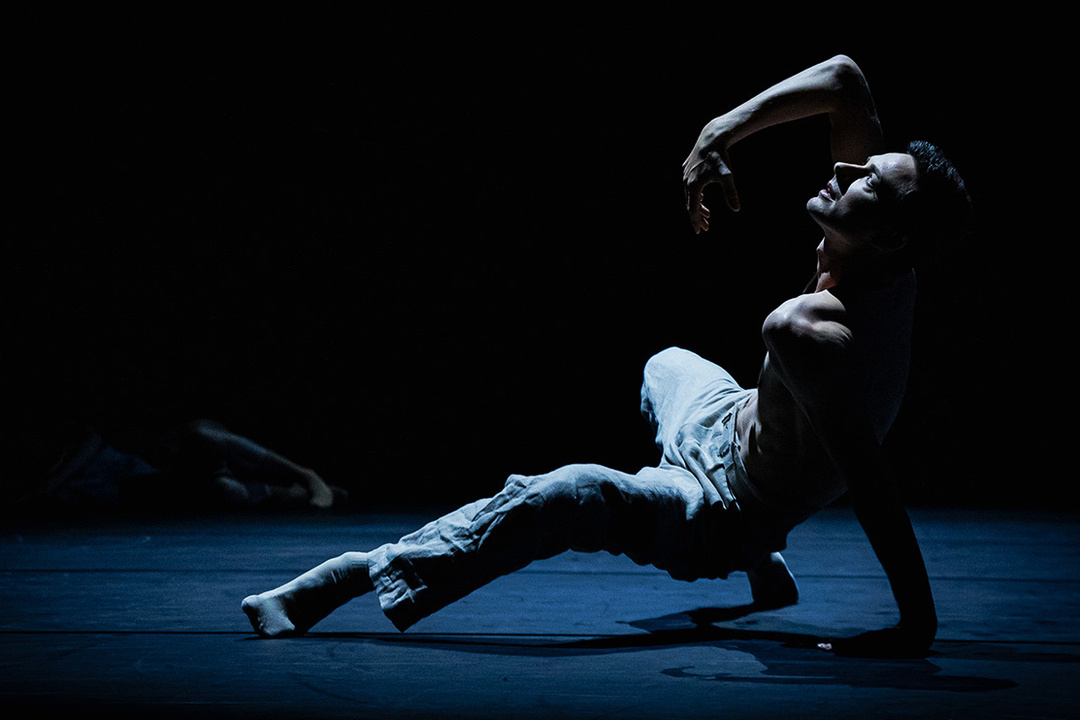
A man on the brink of despair—head hunched between drooping shoulders, socially so shattered that he can ultimately only explode in a murderous rage. This is Jan Casier as Christian Spuck’s Woyzeck; later, he would portray the exquisitely sensitive Nijinsky for Marco Goecke, and later still—again for Spuck—the solitary, yet coupled, figure in Winterreise: a man for whom the chill of a bleak existence seems to creep right under the skin. Yet there are also, time and again, roguish, impish characters with a mischievous glint in their eye, or roles that tap into abstract registers, puristically eschewing the mundane—such as in Crystal Pite’s Angels’ Atlas and, with a political edge, Marcos Morau’s Nachtträume in Zurich. It is this immense range that—thanks to Jan Casier’s exceptional talent—stretches, expands, and reaches out in every direction with each new choreography. He imprints himself on the memory as a figure who is unobtrusively striking: a dancer capable of making the trivial fascinating, of turning dust into gold—whether in Antwerp, Zurich, Dresden, or Berlin.

The Fun Factor
In 2012, Jan Casier left the city of his childhood and youth to head to Switzerland and join the Zurich Ballet— to work with Christian Spuck—though he stayed there for only two years: "I moved on to Dresden, in fact, the then-director Aaron Watkin and his team pushed me out of my comfort zone, leading me to the realization: white tights and classical roles are not my strong suit." And yet—despite that—he says: "I am infinitely grateful for my time at the Semperoper, and indeed for everything I’ve gained throughout my career." Jan Casier doesn't say this lightly. He loves ballet; he loves the daily interaction with his colleagues; he can’t imagine anything better: "I’m more cooperative than competitive; in the studio and at work, I want—above all—fun. Yes, really fun. Mutual exchange is so much more important and counts for far more than competition. And since this profession isn't all sunshine, camaraderie can be a source of comfort and support." Conversely, shared joy is, of course, an unbeatable source of fun.

In 2016, Jan Casier left the Dresden dance scene—steeped in the tradition of Marius Petipa—and headed back to Zurich. Christian Spuck welcomed him back without hesitation; by the time the coronavirus pandemic hit, the Belgian dancer had matured into a genuine star and a firm audience favorite. By his own account, it took years to emerge from the crisis into which the lockdowns had forced every dance company. He is fortunate enough to have been married since 2014 to a man whom fate had already brought into his life back in Antwerp.

The relationship with dancer Craig Davidson—now a successful choreographer—is clearly a perfect match in every sense: "I love cooking—anything and everything from global cuisine. Craig doesn't enjoy the actual cooking, but he’s fantastic at tidying up the kitchen!" It’s a great fit, just like Berlin, where the couple has lived since 2023: "The culinary scene is incomparably better—and, of course, significantly more affordable—than in Zurich!"

The Early Bird’s Privilege
Even the tough-minded Berliners immediately took this versatile soloist—who arrived at the State Ballet with Spuck—to their hearts. He, in turn, eagerly awaits the coming season, which will feature a performance of Artifact Suite—the very work in which he made his Forsythe debut nearly twenty years ago. Time has not left him untouched. While he used to roll out of bed just half an hour before training began, he now embraces the privilege of the early bird: preparing for the day with an omelet, stretching, and reading the news (from Belgian sources), he arrives early at the Deutsche Oper’s dance wing. There, he looks with a touch of emotion at the youngsters in whom he recognizes his younger self—the young Jan who still has so much ahead of him. Visually, moreover, he is barely distinguishable from the younger generation. At thirty-five, Jan Casier radiates inner maturity, yet outwardly he remains a young man. And he still has a great deal ahead of him.

At some point, Jan Casier decided not to let go of dance. After all, why should he, as long as he still has his original knees and hips—and manages the ongoing issues with his back? Some days are better than others, but overall things are going well enough that, alongside his engagement in Berlin, he has begun teacher training at the Palucca Hochschule für Tanz in Dresden: "I’m finally realizing just what—and how much—is actually in my toolbox!" Namely, an enormous wealth of knowledge, experience, and material. Who stands to benefit from this in the future? "I’m open to anything"—as long as there’s a ballet studio! As long as there are colleagues! As long as there is communication!

Jan Casier is actually quite comfortable being alone. When melancholy strikes—albeit rarely—he puts on some music. Max Richter’s soundtrack for Chloé Zhao’s Hamnet, for instance—a score that imprints itself upon every sense, upon both mind and heart. Yet Jan Casier wouldn’t be Jan Casier without a counterpoint. In this instance, that counterpoint is The Devil Wears Prada 2—cinematically, the finest offering Hollywood has to show for the first half of 2026. It too features an actress capable of anything: the loud and the quiet, the suffering and the passionate, comedy and tragedy alike. Forty years separate Meryl Streep and Jan Casier. Yet, on closer inspection, their art forms a bond of elective affinity—a connection transcending the boundaries of gender and generation. This, too, is a match that bodes well. The future will most certainly embrace Jan Casier, and every one of his gifts will bear fruit.

www.instagram.com/jan_casier