
In Practice
Miscellaneous

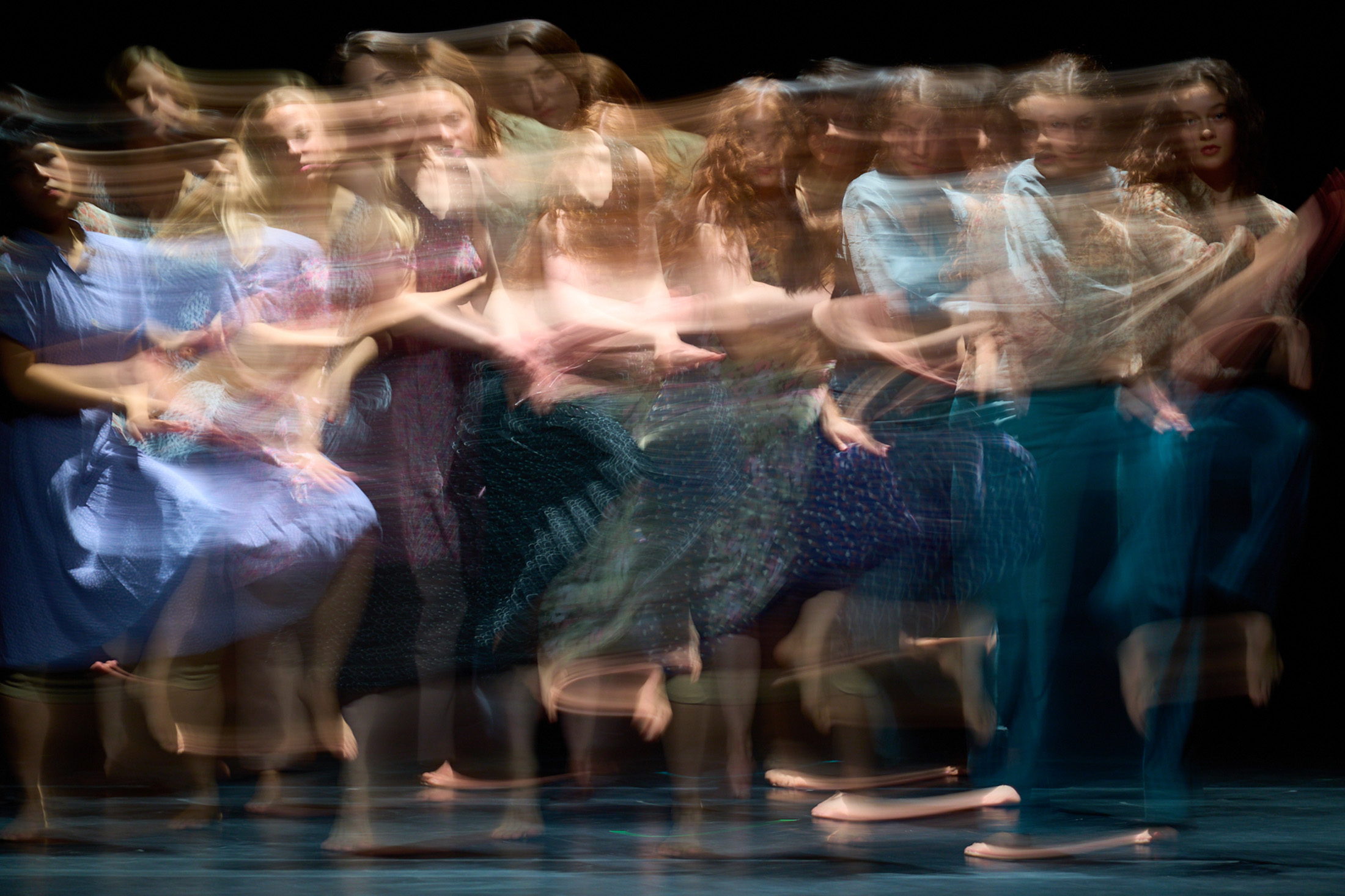
Gala of the Dance Education Biennale: Wait a Second! by Ioannis Mandafounis, University of Music and Performing Arts Frankfurt am Main; photo and background: Carlos Quezada
Dance Training
Cuts
Cultural budgets are shrinking. What are the implications for the next generation? Constanze Schellow, spokesperson for the Dance Training Conference Germany (Ausbildungskonferenz Tanz Deutschland) and professor at the Cologne University of Music and Dance, is concerned.
We regularly report on cuts in the cultural sector. But you are concerned about cuts to training budgets in the artistic field.
Both cuts are intertwined. However, there is no single, definitive training program. The spectrum is broad, ranging from classical training to performance-oriented programs. Especially in the field of contemporary dance, the cooperation partners, festivals, and venues with which our students gain their first experiences often come from the independent scene. In North Rhine-Westphalia for instance there was the Cheers for Fears network, through which young professionals could showcase their work. And these are often the first programs that are affected by cuts in the cultural sector.
By the time you start working in the independent arts scene, your formal training is essentially over.
University can only truly prepare you for the profession to a certain extent, and that's why it was important for us to emphasize that teaching is always conceived as an integrated process, especially as it gets closer to the professional field. This involves working with partners who can afford to launch such projects alongside their regular curriculum.
However, more graduates are coming from universities than there are jobs.
Under the umbrella of the Dance Training Conference, we bring together five to six different job markets for which universities train students. In any case, employment conditions are becoming more precarious; we cannot say: For all our graduates, there are long-term, secure jobs at opera houses, municipal theaters, ballet companies, or independent companies. We also observe, however, that the students are very versatile: many later work in hybrid roles, including dramaturgy, production, and dance education. On the one hand, there are indeed fewer positions available at municipal theaters. But on the other hand, dance practice is interwoven with various social fields of practice in different ways.
Interview: Falk Schreiber
Continue reading with the DIGITAL MONTHLY SUBSCRIPTION to tanz – international edition

- Access all articles of tanz – international edition instantly online
- Optimized reading experience on all devices
- Full access to the complete online archive