

In Practice
Miscellaneous
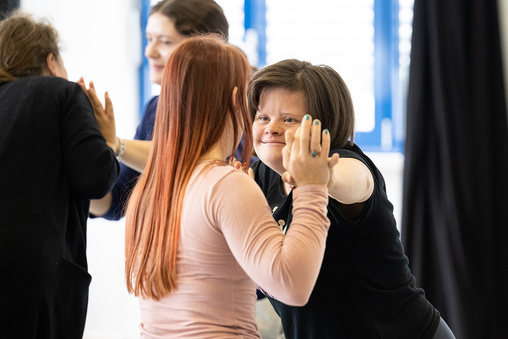
Rehearsal for touch_taff; photo: Susanne Reichardt
Merger
Junges Tanztheater Corinna Clack
Resilience — the ability to remain capable of action despite adverse circumstances and thereby find new strength — has gained attention in recent years. It was therefore quickly clear to Corinna Clack that this resilience should be the focus of the youth dance piece for the Tanzbiennale Heidelberg 2025 festival. touch_taff is being developed with 15 young people with and without disabilities. The choreography is created by a team of three choreographers: Clack herself and Jona Oldenburg from Junges Tanztheater Corinna Clack, both with many years of experience in inclusive dance education, and Gaëlle Morello from the Heidelberg Theater.
For many young people, touch_taff is their first inclusion project. In a mindful rehearsal process, they explore how different needs can exist side by side; the slower way of working is a new experience for some. Music has played a central role since the rehearsals: a quartet of vocals, keyboard, percussion and bass accompanies the dancers live and interacts with them in a sensitive dialogue. Instead of dominating with strict rhythms, the musicians react to movements and emotions, which creates a dynamic connection between sound and body.
Barriers are shown through dance — (in)visible, abstract, concrete. Walls, talent shows and children's games become metaphors for obstacles and power structures, the dancers question positions of power and reflect on group dynamics, their own texts are embedded in the dance narrative through self-recorded audio recordings. From the confrontation with injustice and feelings such as anger, a union emerges that gives new strength. In just four months, the ensemble has developed a piece that touches, moves and shows how much hope there is in solidarity and togetherness.
Alina Saggerer
«touch_taff» opens the Tanzbiennale Heidelberg festival on 1, 2 February at Zwinger 1; www.theaterheidelberg.de
Guide
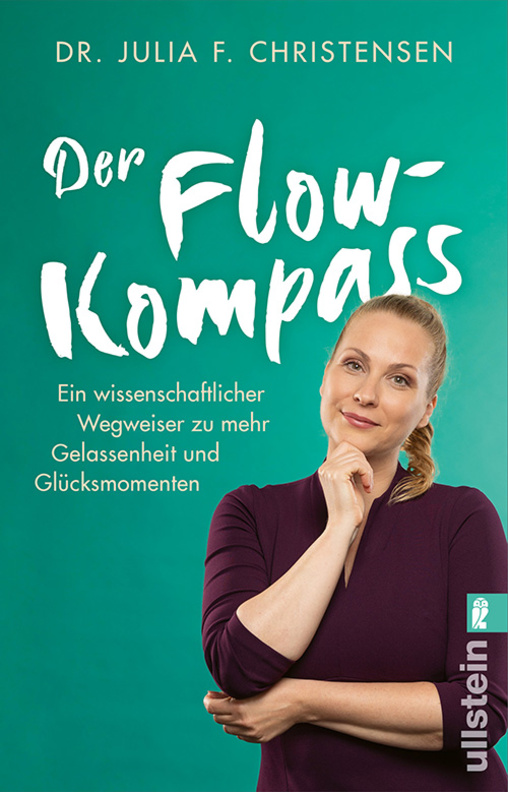
Der Flow-Kompass
Julia F. Christensen, psychologist and neuroscientist, conducts research at the Max Planck Institute for Empirical Aesthetics in Frankfurt am Main. Her focus: dance and movement. Her latest book deals with everything to do with the topic of the flow compass. In other words: How can endless brooding and stagnation be replaced with more vigor and energy? The researcher is adept at writing briskly and gets to the heart of even complex issues in an entertaining way. This time, dance only plays one part in the large orchestra of activities that stimulate the mind, soul and body in the long term — even Tango Argentino is part of the mix.
Julia F. Christensen: Der Flow-Kompass; www.ullstein.de
App
Shriya Srinivasan
Last summer, Stefan Kaegi, in collaboration with Sasha Waltz & Guests, showed his piece Spiegelneuronen at the Salzburg Festival and in Berlin's Radialsystem — impressive proof of how emotions can be transmitted to the audience via dance and movement. An insight that’s also used by Shriya Srinivasan, assistant professor of bioengineering at the Harvard John A. Paulson School of Engineering and Applied Sciences as well as artistic director of the Anubhava Dance Company which specializes in classical Indian dance. By performing aesthetic archetypes, she creates an emotional connection with the audience.
But as a scientist, this artistic approach is not enough for her, which is why Srinivasan and her team have developed an app that allows viewers to follow the movements of the performers: sensors are attached to the dancers' extremities, triggering vibrations in the audience's smartphones. For average viewers, this opens up another sensory level in the reception of dance, but for a visually or hearing-impaired audience, Srinivasan's development is a quantum leap in the effort to make dance and performance accessible.
Falk Schreiber
Background photo: picture alliance / Amazing Aerial Agency | Matthew Borowick